Mental Health in Nursing Homes Often Missed—How to Spot the Signs and Protect a Loved One
About This Article
Mental health decline in nursing homes is common and often underrecognized. Learn the warning signs, causes, and how to advocate for better care and protect quality of life.

Anna Marino
Anna Marino is a seasoned writer specializing in topics related to family, aging, and lifestyle in retirement. She shares advice on intergenerational relationships and strategies for enjoying retirement.
Table of Contents
- A Widespread but Underrecognized Problem
- Why Mental Health Decline Is Often Missed
- An Overlooked Factor: ADHD in Older Adults
- Link Between Depression and Cognitive Strain
- Why Connection and Environment Matter
- What You Can Do: Practical Steps to Advocate
- Facility Quality Directly Impacts Mental Health
- Emotional Support and Connection as Part of Mental Health Care
- How Digital Health Tools Are Supporting Mental Wellness
- Medicare Limitations: Many Families Don’t Expect
- Financial Reality: Mental Health and Long-Term Care Costs
- Planning Ahead: Why Long-Term Care Insurance Matters
You leave the long-term care facility your father has been living in, get into your car, and sit in the silence for a moment. On paper, it was a good visit. The nurse said your dad ate all his lunch; his vitals are stable; his physical therapy is on track. He is getting help with his bathroom needs and with getting around safely. But as you pull out of the parking lot, a heavy knot stays in your stomach.
It wasn't something he said, it was the things he didn’t say. The way his eyes didn't quite light up when you mentioned the grandkids, or the way the conversation felt like walking through sand. In an assisted living, memory care, or nursing home, decline doesn't always look like a medical crisis. Sometimes, it’s just a slow, quiet fading of the person you love. That 'gut feeling' isn't just your imagination; it’s the most important diagnostic tool you have."
You don’t always see a dramatic change. It’s subtle. Conversations lose depth. Visits feel more routine than meaningful. Nothing on the chart explains it. The care team may report no medical concerns. Still, that change is often the first warning sign.
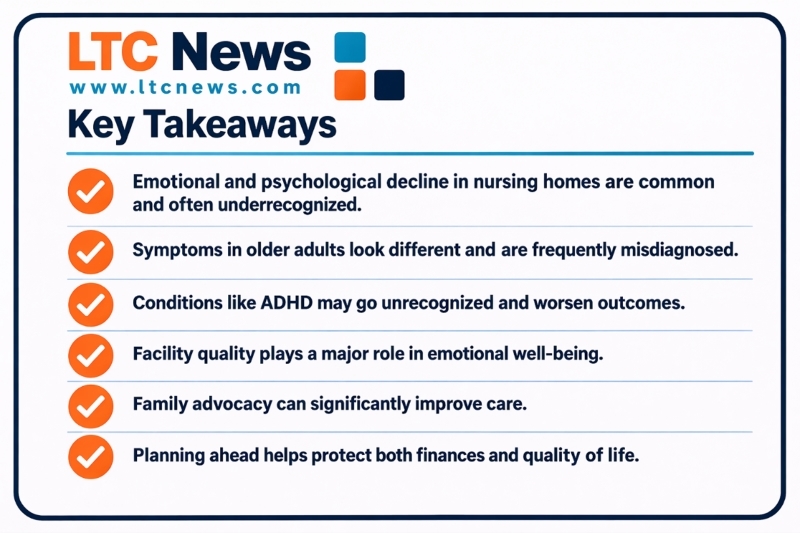
Emotional and psychological decline in long-term care facilities is common, often underrecognized, and closely connected to physical health, independence, and long-term care outcomes. Recognizing the signs early—and knowing how to respond—can help protect your loved one’s quality of life.
A Widespread but Underrecognized Problem
Mental health conditions are one of the most significant—and least addressed—issues in long-term care. According to the Centers for Disease Control and Prevention’s National Study of Long-Term Care Providers (most recent available data), nearly 49 percent of nursing home residents have a diagnosis of depression.
By comparison, CDC data from 2021 to 2023 show that about 13% of U.S. adults report symptoms of depression, highlighting how dramatically risk increases in institutional settings.
Older adults in institutional care face a higher risk due to isolation, loss of independence, and chronic medical conditions. Other peer-reviewed research suggests a majority of nursing home residents live with at least one mental health or cognitive condition, including depression, anxiety, or dementia.
Despite this, mental health care remains underdiagnosed and undertreated.
Depression is not a normal part of aging, yet it is frequently overlooked in older adults. — the National Institute on Aging.
Untreated depression is also linked to higher fall risk, slower recovery, and increased hospitalization in older adults, making early recognition essential.
Why Mental Health Decline Is Often Missed
Depression in older adults rarely looks the way you expect. Instead of sadness, you may see:
- Withdrawal from social interaction
- Changes in appetite or sleep
- Irritability or agitation
- Loss of interest in activities
- Increased confusion
These symptoms are often mistaken for:
- Normal aging
- Dementia progression
- Adjustment to a new environment
At the same time, nursing homes face real challenges:
- Limited behavioral health training among staff
- High patient-to-caregiver ratios
- Complex medical conditions masking symptoms
- Polypharmacy affecting mood and cognition
The result is a quiet decline that can go untreated for months.
Mental health conditions in long-term care settings are frequently underrecognized, especially when symptoms overlap with chronic illness or cognitive decline.
One of the biggest challenges is recognizing cognitive impairment in older adults, especially those with long-standing mental illnesses like depression or bipolar disorder. Many of the symptoms—like social withdrawal, lack of motivation, and memory issues—can be easily mistaken for the natural aging process or the physical toll of chronic disease. — Dr. Brent Forester, Psychiatrist-in-Chief and Chairman, Department of Psychiatry at Tufts Medical Center.
An Overlooked Factor: ADHD in Older Adults
You may not expect to hear about ADHD in a nursing home—but it matters. Research suggests that millions of adults over age 50 live with attention-deficit/hyperactivity disorder (ADHD), many of whom were never diagnosed earlier in life.
In long-term care settings, ADHD can appear as:
- Difficulty following routines
- Emotional ups and downs
- Restlessness or disengagement
- Trouble participating in group activities
These behaviors are often misinterpreted as:
- Cognitive decline
- Personality changes
- Depression alone
If you suspect that a loved one in long-term care may be living with undiagnosed ADHD, a preliminary ADHD test can be a useful first step in deciding whether to pursue a formal clinical evaluation. Formal diagnosis in older adults requires a thorough assessment by a qualified clinician familiar with how ADHD presents across the lifespan.
Without proper recognition, treatment may miss the underlying cause.
Link Between Depression and Cognitive Strain
Mental health and brain function are closely connected. Residents struggling with attention, emotional regulation, or adjusting to structured environments may become:
- Frustrated
- Isolated
- Less engaged in care
Over time, this can lead to:
- Worsening depression
- Reduced participation in rehabilitation
- Faster functional decline
Mental health is not separate from physical care—it directly shapes outcomes.
Why Connection and Environment Matter
Clinical treatment is only part of the solution. Residents do better when they feel:
- Connected
- Engaged
- Heard and valued
Facilities that prioritize emotional well-being often provide:
- Structured social programs
- Access to therapy or counseling
- Companion programs
- Pet therapy or animal interaction
Even small changes, like consistent family visits, can improve mood and engagement.
What You Can Do: Practical Steps to Advocate
You play a critical role in protecting your loved one’s mental health. Here are steps that make a real difference:
Ask About Mental Health Screening
Request formal screening using validated tools such as the Geriatric Depression Scale.
Document Changes
Track patterns in:
- Mood
- Appetite
- Sleep
- Social interaction
Request a Medication Review
Some medications can contribute to depression or confusion.
Raise the Possibility of ADHD
If lifelong patterns suggest it, bring it up directly with the care team.
Ask About Mental Health Services
Find out if the facility offers access to:
- Psychologists
- Licensed clinical social workers
- Psychiatric providers
Stay Engaged
Visit regularly and ask specific questions like: “What activity did you enjoy today?”
Facility Quality Directly Impacts Mental Health
Not all facilities approach mental health the same way. Research shows residents in lower-rated nursing homes often experience:
- Higher levels of depression
- Less access to behavioral health services
When evaluating care, ask about:
- Mental health programming
- Staff training in behavioral health
- Access to psychiatric consultation
These factors are just as important as physical safety.
Emotional Support and Connection as Part of Mental Health Care
Clinical treatment is only one part of the picture. Emotional connection, companionship, and a sense of purpose all play measurable roles in the mental health of nursing home residents. Facilities that prioritize social engagement and emotional well-being alongside medical care tend to produce meaningfully better outcomes for residents with depression and anxiety.
One area gaining attention in long-term care is the role of animal-assisted interaction and emotional support animals (ESAs). For older adults who have had companion animals throughout their lives, the loss of a pet during the transition to residential care can be a source of grief in itself. Some facilities now accommodate ESA arrangements as part of resident-centered care planning.
Families considering this option should understand that it involves navigating both facility policy and legal frameworks. Emotional support animal laws by state vary considerably, and the protections that apply to housing under the federal Fair Housing Act do not automatically extend to long-term care facilities in the same way.
Before pursuing an ESA arrangement for a loved one in a long-term care facility, it’s worth speaking directly with the facility’s administration about their specific policies and consulting with a licensed mental health professional who can determine whether an ESA recommendation is clinically appropriate for your loved one’s situation.
How Digital Health Tools Are Supporting Mental Wellness
One quiet shift in the long-term care space is the growing use of digital health tools to help residents, families, and care teams stay better connected and better organized around health concerns. For families managing a loved one’s care from a distance, tools like Lotus Health offer a way to track symptoms, organize medical information, and prepare more effectively for care team conversations.
These platforms serve as supportive resources, helping families and patients engage more meaningfully with their providers rather than replacing clinical care.
For older adults with cognitive or executive function challenges, having a structured way to organize health information can reduce the kind of confusion and overwhelm that worsens mental health. Families who find it difficult to coordinate across multiple providers and appointments may find this kind of organizational support genuinely useful as a complement to formal care.
Medicare Limitations: Many Families Don’t Expect
Many families assume programs like Medicare will cover long-term care.
They don’t.
Medicare only covers:
- Short-term skilled care
- Up to 100 days under strict conditions
It does not pay for ongoing custodial care. Long-Term Care Insurance will pay for extended care in all settings, but the policy must be in force prior to the need for extended care. Without LTC Insurance, the financial impact on a family is tremendous, and often, once the money runs out, a care recipient must utilize Medicaid.
Financial Reality: Mental Health and Long-Term Care Costs
Mental health decline doesn’t just affect quality of life—it can increase long-term care needs and costs. When memory care or additional skilled services are required, the cost of extended care is higher.
When depression or cognitive issues worsen:
- Assistance with daily activities increases
- Risk of hospitalization rises
- Length of care often extends
Using the LTC News Cost of Long-Term Care Services Calculator, you can estimate current and future long-term care costs based on location and level of care, especially as mental health decline leads to greater dependence.
Planning Ahead: Why Long-Term Care Insurance Matters
Mental health support is directly tied to the quality of care available.
A Long-Term Care Insurance policy can help:
- Expand your choice of extended care settings
- Provide access to higher-quality facilities and evin in-home care
- Support in-home care, which often leads to better emotional outcomes
- Reduce physical, emotional, and financial strain on family caregivers
Learn more by reviewing the LTC News Long-Term Care Insurance Learning Center
Planning early, ideally before retirement, gives you more control and more dignity in how care is delivered. You may be dealing with a family crisis with your parents, but planning allows you to avoid the crisis for you and your family decades from now.
Frequently Asked Questions
How common is depression in nursing homes?
Depression is one of the most common health conditions in long-term care settings. According to the Centers for Disease Control and Prevention’s National Study of Long-Term Care Providers, nearly 49% of nursing home residents have a diagnosis of depression. This rate is significantly higher than in the general population, where about 13% of U.S. adults report symptoms of depression.
Why is depression often missed in assisted living and nursing homes?
Depression is frequently underdiagnosed because symptoms can resemble normal aging or dementia. In addition:
- Staff may have limited behavioral health training
- Medical conditions can mask symptoms
- Medications may affect mood or cognition
These factors make it harder to recognize mental health issues without proper screening.
What are the early warning signs of mental health decline in a nursing home resident?
Mental health decline in older adults often appears differently than in younger people. Early warning signs include:
- Withdrawal from conversations or activities
- Reduced emotional response or engagement
- Changes in sleep or appetite
- Increased confusion or irritability
- Loss of interest in family visits or hobbies
Subtle changes—like shorter conversations or less eye contact—are often the first indicators.
Do higher-quality nursing homes provide better mental health care?
Generally, yes. Facilities with higher ratings tend to offer:
- Better staff training
- More structured activities
- Greater access to mental health professionals
Asking about mental health programs and services is an important part of evaluating care quality.
How can emotional support improve mental health in long-term care?
Emotional connection plays a major role in well-being. Residents who feel connected and engaged often experience:
- Lower rates of depression
- Better participation in care
- Improved overall quality of life
Regular visits, meaningful conversations, and supportive environments can make a significant difference.
How can Long-Term Care Insurance help with mental health care?
Long-Term Care Insurance provides financial support for extended care services, including:
- In-home care
- Assisted living and memory care
- Nursing home care
Having coverage can give you access to higher-quality care options that prioritize both physical and emotional well-being.
Can ADHD affect older adults in long-term care?
Yes. Many older adults may have undiagnosed attention-deficit/hyperactivity disorder (ADHD), especially since it was rarely diagnosed decades ago. In a nursing home setting, ADHD may appear as:
- Difficulty following routines
- Emotional ups and downs
- Restlessness or disengagement
These symptoms are often mistaken for cognitive decline or depression.
Does Medicare cover long-term mental health or custodial care?
No. Medicare only covers short-term skilled care, typically up to 100 days under strict conditions. It does not cover ongoing custodial care or long-term mental health support in nursing homes.
How does mental health impact physical health in older adults?
Mental health and physical health are closely connected. Untreated depression can lead to:
- Increased fall risk
- Slower recovery from illness or injury
- Higher hospitalization rates
- Faster functional decline
Addressing mental health can improve overall health outcomes and quality of life.
What can families do if they suspect mental health decline?
You can take several proactive steps:
- Request a formal mental health screening
- Document behavioral or emotional changes
- Ask for a medication review
- Speak with staff about mental health services
- Stay actively involved through regular visits
Your observations and advocacy can play a critical role in early detection and treatment.