Medicaid Long-Term Care Rules Change in 2027. What Families Need to Know

About This Article
New federal rules will limit retroactive Medicaid coverage in 2027 and tighten home equity eligibility in 2028. Families facing rising care costs need to understand the changes and how planning now can protect savings and care choices.

James Kelly
LTC News staff writer specializing in long-term care and aging.
Table of Contents
- Medicaid's Retroactive Coverage Is Changing
- Why Applying Promptly Could Save Thousands
- Which Homeowners Face New Medicaid Limits in 2028?
- Families Are Already Spending More on Caregiving
- Will Medicaid Pay for the Care You Want?
- Medicaid Is a Safety Net, Not a Retirement Planning Goal
- How Partnership LTC Insurance Protects Savings
- Which States Offer Partnership Protection?
- Massachusetts Offers Different LTC Insurance Home Protections
- What Makes an LTC Policy Qualify for MassHealth Protection?
- Will the 2028 Federal Cap Override Massachusetts Protections?
- What Families Should Do Before a Care Crisis
- Planning Ahead Protects More Than Savings
It’s hard not to notice the quiet shifts as a parent gets older: the slower pace, the extra appointments, the way you start wondering what happens if their needs grow beyond what your family help or everyday savings can cover. And in the back of your mind, it’s natural to catch yourself thinking ahead to your own aging, too, and hoping you’ll have a clearer plan when your turn comes.
Many families assume Medicaid will step in to pay for long-term care, and eventually nursing home care, once a parent’s savings run out. The catch is that timing and rules don't always line up with real life. What happens if the application takes months to process, nursing home bills keep arriving in the meantime, and Medicaid won't cover care provided before the application or eligibility window kicks in?
Beginning Jan. 1, 2027, new federal Medicaid rules will reduce retroactive coverage for many applicants. Another change in 2028 will affect some older homeowners, particularly in states with higher home equity limits and in California, where no such limit currently applies.
These shifts come as families are already stretched thin by rising long-term care costs, from professional in-home caregivers to assisted living and nursing homes. Many have never thought about, let alone planned for, aging and long-term care, while others never had the financial resources to begin with and have to rely on government programs.
Medicaid remains an essential safety net for people with limited financial resources. However, qualifying often requires spending down assets, and coverage may not provide the flexibility families want when choosing where and how a loved one receives care.
Understanding the rules before a care crisis hits can save your family thousands of dollars in unexpected expenses, and a great deal of worry.
Medicaid's Retroactive Coverage Is Changing
Medicaid is the nation's largest public payer of long-term services and supports, including nursing home care. Unlike Medicare, which limits covered skilled nursing facility care to a maximum of 100 days per benefit period when eligibility requirements are met, Medicaid can pay for ongoing custodial care for people who satisfy financial and medical eligibility rules.
Under longstanding federal rules, Medicaid has generally allowed up to three months of retroactive coverage before the application month, provided the applicant met eligibility requirements during those months.
That protection can be especially important when an older adult enters a nursing home following a sudden health crisis and begins accumulating bills before the Medicaid application is completed.
Under the 2025 budget reconciliation law (Public Law 119-21), the federal retroactive eligibility period will be reduced for applications made on or after Jan. 1, 2027:
- One month before the application month for adults in the Affordable Care Act Medicaid expansion eligibility group.
- Two months before the application month for most other Medicaid applicants, including older adults seeking nursing home coverage.
The application date matters. Someone already receiving care who files before Jan. 1 may preserve the previous three-month retroactive eligibility period, assuming they met the requirements during those months.
Some states already have shorter retroactive coverage periods under approved federal waivers. The Centers for Medicare & Medicaid Services confirmed the application-date requirement in its November 2026 Medicaid eligibility guidance. The change does not automatically shorten ongoing Medicaid benefits after approval.
Why Applying Promptly Could Save Thousands
Consider an older woman who enters a nursing home in January 2027. Her family spends several months gathering financial records and preparing a Medicaid application. If the application is filed in April, the new federal rule generally permits retroactive eligibility for February and March, assuming she met the applicable requirements. January would fall outside that window.
According to the LTC News Cost of Care Calculator, the national median cost of nursing home care is approximately $11,085per month as of November 2026. Actual expenses vary by location, room type, and care needs.
One uncovered month could leave the older adult responsible for more than $11,000 in nursing home bills. The practical lesson: If your parent enters a nursing home in January and may qualify for Medicaid, investigate applying in January.
Filing during the admission month can help establish eligibility for that month, even if processing takes longer. An application does not guarantee coverage, and the applicant must meet the applicable requirements.
Family members may feel pressured to use their own savings to prevent a disruption in care. However, relatives generally are not personally responsible for a resident's nursing home bills merely because of their family relationship.
Which Homeowners Face New Medicaid Limits in 2028?
A second Medicaid change could affect homeowners in communities where property values have risen sharply. For 2026, federal Medicaid rules establish a home equity eligibility range of $752,000 to $1,130,000. Most states use the lower threshold, while 10 states and Washington, D.C., use the higher federal maximum.
California is the exception. It currently has no home equity limit for Medicaid long-term care eligibility.
The changes unfold in stages:
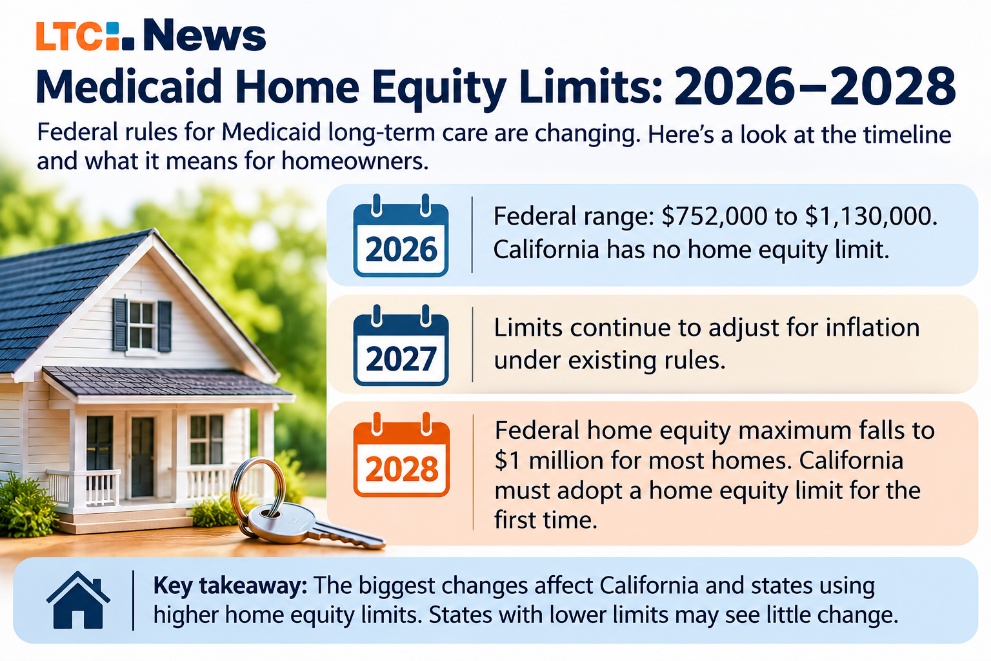
States already using the lower federal threshold will not automatically see their limits reduced because those limits are below $1 million. The impact will be greater in states using the higher maximum, including Massachusetts, New York, and Connecticut.
California faces a particularly significant change. An older Californian who purchased a home decades ago for $200,000 might now own property worth $1.5 million or more. Even with modest retirement income or limited savings, that homeowner's equity could affect Medicaid eligibility beginning in 2028. However, owning a home worth more than $1 million does not automatically disqualify someone from Medicaid. The rules consider the applicant's equity rather than the home's full market value. Outstanding mortgage debt can reduce the equity calculation.
Exceptions apply when a spouse or qualifying child lives in the home. Federal law also provides for demonstrated hardship waivers and permits homeowners to use reverse mortgages or home equity loans to reduce equity.
Those arrangements can have significant financial consequences. Families should consult a qualified elder law attorney before making property transfers or using home equity financing for Medicaid planning.
The 2028 cap generally does not apply to homes on qualifying agricultural land, although other eligibility rules remain. The CMS November 2025 bulletin explains the new home equity provisions. KFF's 2026 Medicaid eligibility survey identifies the states most affected.
Families Are Already Spending More on Caregiving
The Medicaid changes arrive as families face growing financial pressure from caregiving. An October 2026 NPR report highlighted how quickly caregiving expenses are increasing, often forcing adult children to make difficult decisions about work, savings, and household budgets.
According to AARP's 2026 caregiving research, family caregivers spend an average of $11,508 annually out of pocket helping loved ones, approximately 59 percent more than reported in 2021. That works out to about $959 a month.
Caregivers reported spending an average of 31 percent of their household income on caregiving expenses. Among employed caregivers, 65 percent experienced at least one work-related disruption. The burden can be particularly severe for families dealing with dementia. AARP found average annual out-of-pocket expenses of $15,846 for dementia caregivers, compared with $10,221 for those helping someone without dementia.
These figures reflect reported caregiving expenses rather than the full cost of professional care. Changes in survey methods also mean the increase since 2021 cannot be attributed entirely to inflation. For many families, the financial consequences begin long before a loved one enters a nursing home or qualifies for Medicaid.
Will Medicaid Pay for the Care You Want?
Cost is only part of the Medicaid discussion. Access to care, available providers, and quality also matter. Medicaid provides essential care funding for people with limited financial resources. Many nursing homes depend heavily on Medicaid payments, and millions of Americans rely on the program for long-term services and supports. However, Medicaid reimbursement rates are often lower than private-pay rates, creating financial pressures for facilities.
Learn More: Medicaid is the primary payer for over 60% of nursing facility residents, and federal payment studies show Medicaid has historically reimbursed less than the full cost of care, creating operational and bed-availability pressures.
Lower reimbursement does not automatically mean lower-quality care. Many Medicaid residents receive excellent care. Still, funding constraints can affect staffing, operations and whether providers accept additional Medicaid residents. Families may discover that a preferred nursing home has limited Medicaid beds or does not participate in the program.
Care at home can be even more complicated. Medicaid home- and community-based services vary by state and may have enrollment limits, waiting lists, or restrictions on authorized care hours. HCBS programs vary significantly by state and frequently rely on enrollment caps, interest/waiting lists (affecting roughly 650,000 people across 40 states in 2026), or care-hour limits.
Federal minimum staffing standards adopted in 2024 were struck down in two federal district court cases. The 2025 budget law barred implementation and enforcement through Sept. 30, 2034. CMS subsequently repealed the new requirements in December 2025, effective Feb. 2, 2026. Earlier federal nursing staffing requirements remain in effect.
Families should evaluate providers based on staffing, inspection results, services, resident experiences, and the ability to meet a loved one's needs. The LTC News Caregiver Directory helps your family locate home care agencies, assisted living communities, memory care facilities, and nursing homes. You can also use the federal Eldercare Locator (by phone, text, or online chat) or text/dial 211 to connect with local Area Agencies on Aging and community care resources. Before making a decision, families should contact providers directly to confirm Medicaid participation and bed or service availability.
Medicaid Is a Safety Net, Not a Retirement Planning Goal
Medicaid plays a vital role for people with limited financial resources. But for families who have the opportunity and means to prepare, becoming financially eligible for Medicaid should not be the goal. Qualifying may require spending down savings and other countable assets accumulated over decades. Families may also have fewer choices about care providers and settings.
Long-Term Care Insurance offers another approach. Long-Term Care Insurance is generally not appropriate for individuals with very limited financial resources unless family members are willing to pay the premiums to help preserve care options beyond those available through Medicaid.
However, people with modest savings may still benefit from an affordable Long-Term Care Partnership policy, which can help protect assets while providing additional choices for future care. Depending on the policy, LTC Insurance can provide benefits for care at home, adult day care, assisted living, memory care, and nursing homes. Qualified benefits are generally received tax-free under federal rules, subject to applicable requirements and limits.
Coverage can help protect retirement income and savings while providing greater flexibility in choosing care providers. Traditional LTC Insurance, hybrid life insurance policies with qualified long-term care benefits and certain annuity-based options offer different ways to address these expenses. However, generally these options are more appropriate for those with more income and assets.
The objective is not simply to pay nursing home bills. It is to preserve independence, maintain control over care decisions, and reduce the financial and emotional responsibilities placed on family members.
Coverage is generally easier and less expensive to obtain while someone is relatively healthy, often in their late 40s, 50s, or early 60s. Premiums, benefits, and underwriting requirements vary considerably. LTC News research shows most people start considering LTC Insurance and acquiring coverage between the ages of 47 and 67.
How Partnership LTC Insurance Protects Savings
Qualified Long-Term Care Partnership policies offer an additional advantage, especially for those with modest means. These policies combine private insurance benefits with special Medicaid asset protection.
The protection generally works on a dollar-for-dollar basis. Suppose you purchase a Partnership-qualified LTC policy that eventually pays $300,000 in benefits for covered care. If you later need Medicaid, you could generally protect an additional $300,000 in countable assets beyond what Medicaid would ordinarily allow. Whatever benefits the policy pays will be disregarded if the policyholder later needs to qualify for Medicaid.
What this means is even a small LTC policy can provide asset protection beyond the actual benefits paid by the policy. For example, if the policy pays out $100,000, a like amount would be disregarded. For someone with limited assets, this could mean the difference between leaving an inheritance or losing most everything.
Partnership protection also generally extends to Medicaid estate recovery for the assets protected through the program. However, Partnership protection does not guarantee Medicaid eligibility. Applicants must still satisfy income, medical, and other requirements. It also does not override separate federal home equity restrictions.
Asset protection is based on qualifying insurance benefits paid, not simply the amount of insurance originally purchased. A policyholder does not necessarily have to exhaust every benefit before qualifying for Medicaid.
Which States Offer Partnership Protection?
Partnership programs operate in 45 states. Alaska, Hawaii, Massachusetts, Mississippi, and Vermont do not have programs. California, Connecticut, Indiana, and New York established the original Partnership programs. Most newer programs participate in interstate reciprocity, allowing qualifying asset protection to follow policyholders who relocate.
California does not participate in the national reciprocity arrangement. Utah recognizes qualifying out-of-state Partnership policies, although currently, no Partnership policies are being sold in Utah. Not every LTC policy qualifies for Partnership protection. Policies must meet federal and state requirements, including applicable inflation protection standards.
The advantage is that private insurance and Medicaid can work together. Insurance benefits can pay for care first, while Partnership protection may preserve additional savings if Medicaid is eventually needed.
Massachusetts Offers Different LTC Insurance Home Protections
Massachusetts does not participate in the Partnership program. Instead, qualifying LTC Insurance policies can provide special protections for a homeowner's residence under MassHealth, the state's Medicaid program.
These protections involve two separate provisions of Massachusetts law. The first concerns Medicaid eligibility. Under Massachusetts General Laws, Chapter 118E, Section 25, a home generally becomes a countable asset when MassHealth determines that a nursing home resident cannot reasonably be expected to return home. However, the home may remain exempt when the resident owns qualifying LTC Insurance, certain family members continue living there or counting the property would cause undue hardship.
The second concerns estate recovery. Under Section 33, MassHealth generally cannot recover certain nursing facility and other long-term care expenses when the person was permanently institutionalized, notified MassHealth that they did not intend to return home and had qualifying insurance when admitted. The protection does not necessarily prevent recovery of unrelated medical expenses.
What Makes an LTC Policy Qualify for MassHealth Protection?
For policies subject to the modern Massachusetts standards, the insurance generally must provide the following benefits when the insured enters a nursing home:
- At least 730 days of available nursing facility benefits.
- At least $125 per day in nursing facility benefits.
- An elimination period no longer than 365 days, or a qualifying deductible within the state's limit.
Different standards may apply to older policies. The timing matters. A policy that qualified when purchased may no longer meet the requirements if benefits used for home care or assisted living reduce the remaining nursing facility coverage below the required amount.
The Massachusetts Division of Insurance explains these requirements and their limitations.
Will the 2028 Federal Cap Override Massachusetts Protections?
Massachusetts uses the higher federal home equity limit of $1,130,000 in 2026. Beginning in 2028, the maximum will fall to $1 million for most non-agricultural properties. The Massachusetts LTC Insurance home exemption and the federal home equity limit are separate eligibility tests.
A qualifying policy may keep the home from being counted as an asset under Massachusetts law. However, federal law separately restricts Medicaid long-term care eligibility when home equity exceeds the applicable threshold. Federal law does not provide an exception simply because someone owns LTC Insurance.
A Massachusetts homeowner with more than $1 million in home equity could therefore be ineligible for Medicaid-funded long-term care beginning in 2028, even with a qualifying policy, unless a federal exception applies.
MassHealth has not yet published specific guidance explaining how its existing insurance-related home exemptions will be administered alongside the new federal cap. Residents with substantial home equity should consult a qualified Massachusetts elder law attorney before relying on either protection.
What Families Should Do Before a Care Crisis
If your parent is already experiencing declining health, waiting until a nursing home admission to investigate Medicaid can create avoidable financial problems.
Several steps can help:
1. Understand Medicaid eligibility. Review your state's income, asset, home equity, and medical eligibility requirements.
2. Apply promptly when appropriate. If a parent is already receiving care and may qualify, investigate filing before Jan. 1, 2027. After the change, applying during the admission month can help avoid losing coverage for that month.
3. Organize financial records. Keep bank statements, property records, insurance information, and documentation of financial transfers accessible.
4. Compare care providers. Ask whether facilities accept Medicaid, have available Medicaid beds, and permit residents to transition from private payment to Medicaid.
5. Review existing LTC policies. Determine available benefits, claims requirements, and whether Partnership or state-specific protections apply.
6. Get legal guidance before transferring assets. Medicaid has strict transfer rules. Moving money or changing property ownership without professional advice can create periods of ineligibility.
Families with substantial assets, complex financial arrangements, or questions about home equity should consult a qualified elder law attorney.
Planning Ahead Protects More Than Savings
The new federal rules do not eliminate Medicaid long-term care benefits. For millions of Americans with limited financial resources, Medicaid will remain an essential source of care funding. But beginning in 2027, new applicants will have less retroactive coverage available. In 2028, some homeowners will face tighter home equity eligibility limits.
For families with the financial means to prepare, the objective should be to avoid having Medicaid eligibility dictate their care choices. LTC Insurance can provide a dedicated source of funds for care, help protect retirement savings, and reduce the responsibilities placed on adult children. Partnership policies and certain state-specific protections, including those available in Massachusetts, can offer additional safeguards if Medicaid is eventually needed.
Medicaid should remain a safety net for those who need it, not the primary goal of a retirement or long-term care plan. The time to decide how you want future care funded is before a health crisis forces those decisions on your family.
Frequently Asked Questions
Will Medicaid still pay for nursing home care in 2027?
Yes. Medicaid will continue paying for qualifying nursing home care for eligible individuals. The new federal law reduces the retroactive eligibility period for applications made on or after Jan. 1, 2027. It does not eliminate ongoing nursing home benefits.
Does Massachusetts LTC Insurance protect your home from Medicaid?
Qualifying policies can provide special MassHealth asset eligibility and estate recovery protections. However, those protections are separate from the federal home equity limit, which will be capped at $1 million for most homes beginning in 2028.
Can LTC Insurance protect assets if I eventually need Medicaid?
Yes. Qualified Partnership policies generally provide dollar-for-dollar protection for additional countable assets based on insurance benefits paid. Medicaid's other eligibility rules still apply.
Does Medicaid guarantee care at home?
No. Medicaid home- and community-based services vary by state and program. Availability, authorized hours, and waiting lists can limit access.
Should I apply for Medicaid before Jan. 1, 2027?
If you or a loved one is already receiving care and may qualify, filing before Jan. 1 could preserve the previous three-month retroactive eligibility period, subject to state rules and eligibility requirements.
Will the $1 million home equity cap affect every state?
No. The 2028 maximum primarily affects states using higher home equity thresholds and California, which currently has no limit. States already using lower thresholds may see little immediate change.

Sponsored