IRS Raises 2027 Long-Term Care Insurance Tax Deduction Limits — What You Can Deduct

About This Article
The IRS increased the 2027 tax-deductible Long-Term Care Insurance premium limits to up to $6,290 per person, depending on age. Self-employed individuals, business owners, and eligible taxpayers using Health Savings Accounts may receive additional tax advantages. The new limits apply to the 2027 tax year.

James Kelly
LTC News staff writer specializing in long-term care and aging.
Table of Contents
- What Are the 2027 LTC Insurance Tax Deduction Limits?
- Can You Deduct Long-Term Care Insurance Premiums on Your Personal Tax Return?
- Higher Standard Deductions Make Itemizing Less Common
- Self-Employed? Long-Term Care Insurance Offers Additional Tax Advantages
- Business Owners May Deduct More Than the Individual IRS Limits
- Can LTC Insurance Be Offered Through a Cafeteria Plan or Health FSA?
- Are Hybrid Long-Term Care Insurance Premiums Tax-Deductible?
- What If LTC Charges Come from the Policy's Cash Value?
- Tax-Free 1035 Exchanges Can Help Fund Long-Term Care Coverage
- Health Savings Accounts Can Pay LTC Insurance Premiums Tax-Free
- 2027 HSA Contribution Limits Increase
- Can You Withdraw Retirement-Plan Money to Pay LTC Insurance Premiums?
- Penalty-Free Does Not Mean Tax-Free
- Your Insurance Company Must Certify the Coverage
- IRS Raises the Long-Term Care Per Diem Benefit Limit to $445 in 2027
- Why Long-Term Care Insurance Matters Beyond Tax Deductions
- What Does Long-Term Care Cost?
- When Should You Purchase Long-Term Care Insurance?
- Do States Offer Additional Long-Term Care Insurance Tax Incentives?
- Primary sources
If you own Long-Term Care Insurance, the Internal Revenue Service (IRS) is giving you a little more room to deduct your premiums in 2027. The increase from 2026 isn't large, but depending on your age and how you file your taxes, it could help reduce the cost of protecting your retirement income and assets.
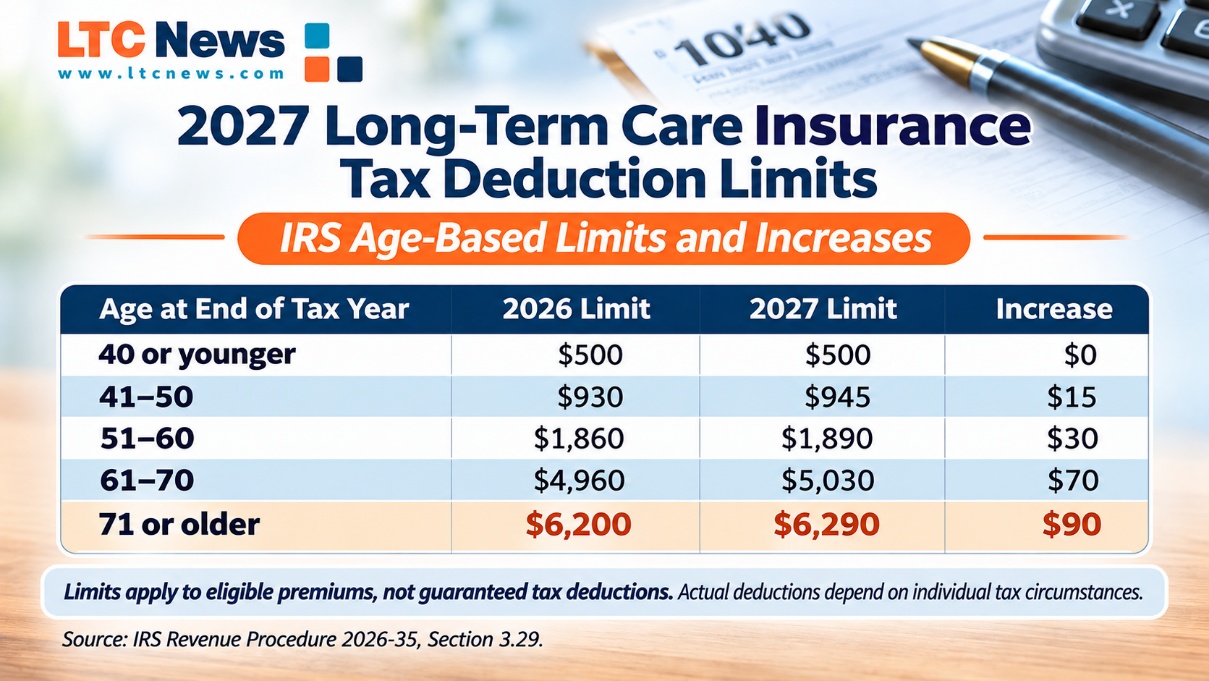
The IRS announced the new limits on Nov. 5, 2026. The deductions increase with age, so as a policyholder ages, the premium amount allowed for deduction increases. For example, if you are age 71 or older, you can count up to $6,290 in qualified premiums toward certain federal tax deductions, up from $6,200 in 2026. Younger policyholders also receive modest increases.
The tax advantages go beyond individual deductions. Self-employed individuals and business owners have additional opportunities, while Health Savings Accounts (HSAs) can be used to pay eligible premiums tax-free. A newer federal provision also allows certain retirement-plan withdrawals for LTC Insurance without the usual early withdrawal penalty.
Not everyone qualifies for a deduction. Understanding the rules can help you decide how to pay for coverage and whether you qualify for additional tax benefits.
Learn More: How Does Long-Term Care Insurance Work?
What Are the 2027 LTC Insurance Tax Deduction Limits?
The IRS establishes annual age-based limits for premiums paid toward tax-qualified Long-Term Care Insurance policies.
Source: IRS Revenue Procedure 2026-35, Section 3.29.
The limits apply to each insured individual based on age at the end of the tax year. If you turn 61 during 2027, your maximum eligible premium amount increases to $5,030.
For a married couple in which both spouses are between ages 61 and 70, the combined maximum eligible premium amount could reach $10,060, provided each pays sufficient qualifying premiums. These figures represent maximum eligible premium amounts, not automatic tax deductions. Your actual deduction depends on how much you pay, your income, filing status, and whether you qualify under individual or business-related tax rules.
Keep in mind, the younger you were when you purchased an LTC policy, the lower the premium. Premiums for tax-qualified Long-Term Care Insurance are intended to remain level, based on several factors including age and health at the time you apply. The 2027 limits apply to the 2027 tax year, with federal income tax returns generally filed in 2028.
Can You Deduct Long-Term Care Insurance Premiums on Your Personal Tax Return?
Yes, if you itemize deductions and meet the IRS medical expense requirements. Qualified LTC Insurance premiums can be included with other eligible medical expenses on Schedule A, subject to the age-based limits. However, only the portion of total qualifying medical expenses exceeding 7.5 percent of your adjusted gross income (AGI) is deductible.
For example, if your AGI is $100,000, your qualifying medical expenses must exceed $7,500 before you can claim a medical expense deduction. If your total eligible expenses reach $12,000, you could deduct $4,500, assuming you itemize.
Higher Standard Deductions Make Itemizing Less Common
With the standard deduction increasing to $33,200 for married couples filing jointly and $16,600 for single filers in 2027, many taxpayers will not benefit from itemizing deductions, including those for Long-Term Care Insurance premiums.
Additional deductions are available for eligible taxpayers age 65 and older, making individual tax circumstances even more important. Always consult a qualified tax professional to determine whether your LTC Insurance premiums are deductible and how to take advantage of available federal and state tax benefits.
👉 The senior deduction is separate from the LTC Insurance deduction and is available to qualifying taxpayers whether they itemize or take the standard deduction.
Self-Employed? Long-Term Care Insurance Offers Additional Tax Advantages
If you're self-employed, qualified Long-Term Care Insurance premiums can provide a more substantial tax benefit. Eligible self-employed individuals can deduct qualifying premiums through the self-employed health insurance deduction, subject to the IRS age-based limits and other requirements. Unlike an itemized medical expense deduction, this deduction is not subject to the 7.5 percent AGI threshold.
Consider a self-employed consultant who is 62 years old in 2027 and pays $4,800 annually for a tax-qualified LTC Insurance policy. If the consultant meets the eligibility requirements and has sufficient qualifying business income, the entire $4,800 premium could qualify for the deduction. At a hypothetical 24 percent marginal federal income tax rate, that could reduce federal income taxes by approximately $1,152. The deduction can also cover eligible premiums for a spouse and qualifying family members.
The deduction is limited by qualifying business income. Self-employed taxpayers with more complex circumstances may need to use IRS Form 7206 to calculate the allowable amount.
Business Owners May Deduct More Than the Individual IRS Limits
Business owners have additional opportunities to use Long-Term Care Insurance as part of their financial and employee benefits planning. The tax treatment depends on how the business is organized.
- C Corporations
A C corporation can generally deduct 100 percent of the premiums it pays for tax-qualified Long-Term Care Insurance covering eligible employees, including shareholder-employees, as a business expense. Unlike individual deductions, the corporation is not restricted by the IRS age-based premium limits.
The ability to deduct the full premium allows a C corporation to purchase more substantial coverage for an owner who is also an employee or offer generous benefits to key executives. Long-Term Care Insurance can also serve as a valuable employee retention tool, sometimes called a "golden handcuff," helping companies attract and retain important employees.
Another advantage is flexibility in selecting who receives coverage. Unlike many other employee benefit arrangements, qualified LTC Insurance can generally be offered to a select group of employees, such as executives or key personnel, without extending the benefit to the entire workforce. However, applicable nondiscrimination and employment laws still apply.
Business owners should work with a qualified tax adviser to structure the arrangement properly and preserve the available tax advantages.
For example, a C corporation that pays $7,000 annually for an eligible employee's qualified LTC Insurance coverage could deduct the full $7,000 if the payment qualifies as a business expense. Qualifying employer-paid coverage is generally excluded from the employee's taxable income.
- S Corporations
Shareholders owning more than 2 percent of an S corporation are subject to special tax rules. Employer-paid LTC Insurance premiums are included in the shareholder-employee's Form W-2 compensation. The shareholder may then qualify for the self-employed health insurance deduction, subject to the applicable age-based limits and other requirements.
- Partnerships and Sole Proprietorships
Partners and sole proprietors may qualify for the self-employed health insurance deduction for eligible LTC Insurance premiums. The amount depends on the insured person's age, qualifying earned income, and other tax requirements. Proper reporting is particularly important when premiums are paid through a partnership.
Can LTC Insurance Be Offered Through a Cafeteria Plan or Health FSA?
No. Qualified Long-Term Care Insurance premiums cannot be offered as a tax-free benefit through a Section 125 cafeteria plan or reimbursed tax-free through a health flexible spending account (FSA). These restrictions differ from the rules governing employer-paid LTC Insurance and HSAs.
Are Hybrid Long-Term Care Insurance Premiums Tax-Deductible?
Usually, no; not all of a hybrid policy's premium is deductible. Hybrid policies combine life insurance with qualified long-term care coverage. The portion of the premium attributable to life insurance does not qualify as a medical expense deduction.
Some hybrid policies separately identify charges for qualified long-term care coverage. A qualifying charge paid as an eligible LTC Insurance premium can be deductible, subject to the applicable age-based limits and other tax requirements.
However, a carrier's allocation of part of the premium to long-term care does not, by itself, establish deductibility. The policy's structure, the nature of the charge, and how it is paid all matter. Again, always check with a tax advisor before taking a deduction.
What If LTC Charges Come from the Policy's Cash Value?
Some hybrid policies deduct qualified long-term care charges directly from the policy's cash value rather than requiring separate premium payments. Under Section 72(e)(11), qualifying charges deducted from the cash value of a life insurance or annuity contract are not included in taxable income. They are also not deductible as medical expenses.
The charges reduce the policyholder's investment in the contract, commonly called the cost basis, but not below zero.
That matters if the policyholder later surrenders the contract. A lower cost basis can increase the portion of the surrender proceeds subject to income tax.
Tax-Free 1035 Exchanges Can Help Fund Long-Term Care Coverage
The Pension Protection Act of 2006 expanded opportunities to use existing life insurance and annuity values to fund qualified long-term care coverage through tax-free exchanges under Section 1035.
The law permits certain exchanges without immediately recognizing otherwise taxable gains:
- Life insurance can be exchanged for another life insurance policy, an annuity, or qualified LTC Insurance.
- An annuity can be exchanged for another annuity or qualified LTC Insurance.
- Qualified LTC Insurance can be exchanged for another qualified LTC Insurance contract.
The exchange rules work in one direction for certain products. An annuity cannot be exchanged into life insurance tax-free under Section 1035. For example, someone who owns an older life insurance policy with accumulated cash value may be able to reposition that value into a policy offering qualified long-term care benefits.
Before exchanging an existing policy, review potential surrender charges, tax basis, death benefit changes, underwriting requirements, and valuable guarantees that could be lost.
Health Savings Accounts Can Pay LTC Insurance Premiums Tax-Free
An HSA offers another way to pay for tax-qualified Long-Term Care Insurance. You can use existing HSA funds to pay eligible premiums without federal income tax on the qualifying distribution, up to the annual IRS age-based limits.
For example, a 55-year-old paying $2,200 annually for qualified LTC Insurance in 2027 can use HSA funds tax-free for up to $1,890 of those premiums.
The remaining $310 would not qualify for tax-free HSA treatment as an eligible LTC Insurance premium. You cannot deduct the same premium expense separately after paying it with a tax-free HSA distribution.
2027 HSA Contribution Limits Increase
Source: IRS Revenue Procedure 2026-24
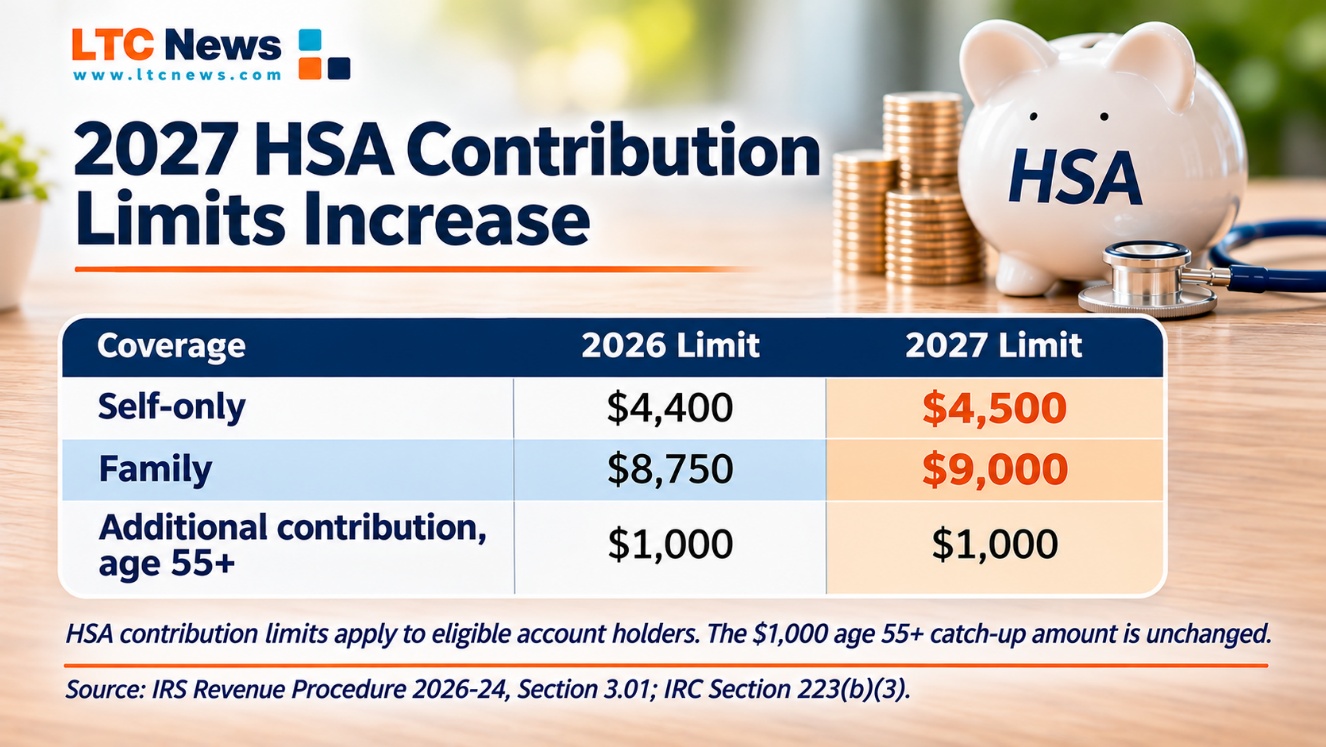
The additional $1,000 contribution is available to eligible account holders aged 55 or older. Each eligible spouse must have a separate HSA to make an individual catch-up contribution. Money already accumulated in an HSA can continue to be used for qualified expenses after retirement, even when you are no longer eligible to make new contributions.
Medicare enrollment ends eligibility to make new HSA contributions, but it does not prevent you from spending existing HSA funds on qualified expenses.
Can You Withdraw Retirement-Plan Money to Pay LTC Insurance Premiums?
A provision of the SECURE 2.0 Act permits qualifying distributions from certain employer-sponsored defined contribution retirement plans to pay premiums for certified Long-Term Care Insurance. The provision became effective for distributions made after Dec. 29, 2025.
Under IRS Notice 2026-33, the maximum qualifying distribution for 2026 is the smallest of the eligible premium amount, 10 percent of the participant's vested plan benefit, or $2,600. The dollar limit is indexed for inflation, so the applicable limit for 2027 must be determined under the IRS inflation adjustment rules.
Penalty-Free Does Not Mean Tax-Free
A qualifying distribution is exempt from the usual 10 percent additional federal tax on early retirement-plan withdrawals. However, the amount remains subject to ordinary income tax to the extent it would otherwise be taxable.
There is also an important restriction for married couples: If the distribution pays for a spouse's coverage and the couple files separate federal income tax returns, the special 10 percent penalty exception does not apply.
The provision is optional for retirement plans and does not directly apply to IRA distributions.
Your Insurance Company Must Certify the Coverage
Not every Long-Term Care Insurance policy qualifies for this special retirement-plan withdrawal provision. Under Notice 2026-33, the insurance company must submit an issuer disclosure to the IRS for the specific coverage product and receive acknowledgment that the disclosure requirements have been satisfied.
At the policyholder's request, the insurer must then provide a long-term care premium statement to the retirement plan. The statement identifies the coverage, confirms its certified status, and documents the premiums owed. The retirement plan uses that statement to determine whether a qualified distribution can be made.
Before requesting a withdrawal, ask your insurance company whether your policy meets the SECURE 2.0 certification requirements and whether it can provide the required premium statement. Also confirm that your retirement plan permits these distributions.
IRS Raises the Long-Term Care Per Diem Benefit Limit to $445 in 2027
The IRS increased the per diem limitation under Section 7702B(d)(4) from $430 per day in 2026 to $445 per day in 2027, equivalent to $162,425 over a 365-day year. The limit applies to certain cash or periodic benefits paid without regard to actual care expenses. It applies across applicable policies covering the same insured person, not separately to each policy.
👉 Reimbursement benefits paid for actual qualified long-term care expenses are generally tax-free without being subject to the statutory per diem cap.
For cash or other periodic benefits, the exclusion calculation can also take qualified care expenses into account, so the statutory daily amount is not necessarily the maximum tax-free benefit. Insurance companies report applicable benefit payments on Form 1099-LTC. Policyholders may need to complete IRS Form 8853 to determine whether any benefits are taxable.
Receiving Form 1099-LTC does not automatically mean you owe income tax.
Why Long-Term Care Insurance Matters Beyond Tax Deductions
Tax savings can make Long-Term Care Insurance more attractive, but the bigger issue is how you will pay for extended care without using your income, exhausting retirement savings, or placing the burden on your family.
The U.S. Department of Health and Human Services estimates that approximately 56 percent of Americans turning 65 will develop significant long-term care needs during their remaining lifetimes.
The estimate refers to people expected to need assistance with at least two of six activities of daily living for 90 days or longer, or substantial supervision because of severe cognitive impairment. It does not mean 56 percent will necessarily use paid long-term care services.
The need for extended care often develops gradually. Someone may initially require help with bathing, dressing, or mobility before needing more extensive assistance. Others develop dementia or other cognitive conditions that require supervision to remain safe.
Medicare does not cover ongoing custodial long-term care. It may pay for limited skilled nursing facility care for up to 100 days per benefit period when specific requirements are met, but it does not provide comprehensive long-term care coverage.
Medicaid can pay for long-term care for eligible individuals, although the individual must have limited financial resources.
What Does Long-Term Care Cost?
The LTC News Cost of Long-Term Care Services Calculator tracks the cost of professional care services across the United States. Costs vary depending on where you live and the type of services you or a loved one needs.
Most long-term care costs rise largely with labor expenses. However, care facilities face additional financial pressures, including rising food and utility costs and the expense of meeting regulatory requirements.
Important note: Long-Term Care Insurance provides tax-free benefits to help pay for professional care at home, in assisted living, memory care, or a nursing home, depending on the policy, even if you deducted the premium for tax purposes.
When Should You Purchase Long-Term Care Insurance?
LTC News research finds most people apply for Long-Term Care Insurance between ages 47 and 67, although some companies offer policies to those as young as 21. New coverage for older adults typically stops at age 78, although some plans extend to older ages, assuming the individual meets the underwriting requirements. Once a policy is approved, it is guaranteed renewable for life, meaning the insurance company cannot cancel it based on attained age or changes in your health.
Applying before retirement can provide more coverage options, particularly while you're healthy enough to qualify for preferred underwriting. Premiums are lower when you buy coverage at a younger age, although a policy's total cost and value depend on its design and how long you pay premiums.
Traditional Long-Term Care Insurance, hybrid long-term care plans with death benefits, and short-term cash indemnity plans offer different approaches to protecting retirement savings.
A Long-Term Care Insurance specialist can compare available plans from multiple insurance companies, review underwriting requirements, and help determine which benefits fit your needs.
Do States Offer Additional Long-Term Care Insurance Tax Incentives?
Some states provide additional tax deductions or credits for qualifying Long-Term Care Insurance premiums. These incentives are separate from federal tax deductions and vary by state. Eligibility, dollar limits and whether a policy qualifies depend on the applicable state rules.
Review your state's rules before claiming a deduction or credit. State tax incentives and Partnership asset protection are separate benefits with different eligibility requirements.
Primary sources
- IRS Revenue Procedure 2026-35 — 2027 Tax Inflation Adjustments
- IRS Publication 502 — Medical and Dental Expenses
- IRS Publication 969 — Health Savings Accounts
- IRS Notice 2026-33 — Qualified Long-Term Care Distributions
- 26 U.S.C. Section 72 — Annuity and Life Insurance Tax Treatment
- 26 U.S.C. Section 1035 — Tax-Free Insurance Exchanges
- IRS Form 8853 — Long-Term Care Insurance Contracts
- HHS ASPE — Long-Term Services and Supports for Older Americans: Risks and Financing, August 2022
This article provides general educational information, not individualized tax, legal, or financial advice. Consult a qualified tax professional regarding deductions, policy exchanges, and retirement-plan distributions.
Frequently Asked Questions
How much of my Long-Term Care Insurance premium can I deduct in 2027?
The IRS allows eligible premiums of up to $6,290 per person in 2027, depending on your age. The limits range from $500 for those age 40 or younger to $6,290 for those age 71 or older. These are maximum eligible premium amounts, not guaranteed deductions. Your actual deduction depends on your tax circumstances.
Can I use my Health Savings Account to pay LTC Insurance premiums?
Yes. You can use Health Savings Account (HSA) funds tax-free to pay eligible Long-Term Care Insurance premiums, subject to the IRS age-based limits. The 2027 HSA contribution limits are $4,500 for self-only coverage and $9,000 for family coverage, plus an additional $1,000 contribution for eligible account holders age 55 and older. You cannot; however, use HSA funds AND take a tax deduction.
Are Long-Term Care Insurance benefits taxable in 2027?
Benefits from tax-qualified LTC Insurance policies are generally received income tax-free. Reimbursement benefits for actual qualified care expenses generally are not subject to a statutory daily dollar cap. Certain cash or periodic benefits are subject to special exclusion rules, including a 2027 per diem limit of $445, although qualifying care expenses may support a higher exclusion.
How Do I Know Whether My Long-Term Care Insurance Policy Is Tax-Qualified?
Review your policy documents or contact the insurance company. A tax-qualified LTC Insurance contract must meet federal requirements under Section 7702B. Policies issued before Jan. 1, 1997, may qualify under special grandfathering rules.
Do states offer additional tax deductions for Long-Term Care Insurance?
Yes. Some states offer deductions or credits for qualifying LTC Insurance premiums in addition to federal tax benefits. Rules vary by state. Certain states also participate in Long-Term Care Partnership programs, which provide additional Medicaid asset protection for eligible policyholders. Consult a qualified tax professional to determine which benefits apply to you.
Can my business deduct 100 percent of Long-Term Care Insurance premiums?
Yes, depending on the business structure. A C corporation can generally deduct the full cost of qualifying LTC Insurance premiums paid for employees, including shareholder-employees, without the individual age-based limits. S corporations, partnerships and sole proprietorships follow different rules
Can I Deduct LTC Insurance Premiums After I Retire?
Yes. Retirement does not eliminate the possibility of deducting eligible premiums. Retirees who itemize can include qualifying premiums with eligible medical expenses, subject to the 7.5 percent AGI threshold and other requirements. Retirees with qualifying self-employment income may also be eligible for the self-employed health insurance deduction.
Can I deduct Long-Term Care Insurance premiums if I don't itemize?
Generally, no. Individuals typically must itemize deductions and meet the IRS medical expense threshold to deduct qualified LTC Insurance premiums. However, eligible self-employed individuals may deduct premiums without itemizing, subject to age-based limits and other requirements. Certain business arrangements offer additional tax advantages.
Are hybrid Long-Term Care Insurance policies tax-deductible?
Yes, in some cases, but not the full premium. The long-term care portion of hybrid life insurance premiums that separate the life insurance and long-term care premium can be deductible. Qualified LTC charges deducted internally from a policy's cash value generally are not taxable or deductible, but they reduce the policyholder's tax basis.
Can I Deduct LTC Insurance Premiums I Pay for a Parent or Adult Child?
Yes, if the person meets the applicable IRS dependency and medical expense requirements and you otherwise qualify for the deduction. The age-based premium limit is determined by the insured person's age, not the age of the person paying the premium.
For example, if you're 55 and pay eligible premiums for a qualifying dependent parent who is 78, the parent's age determines the applicable premium ceiling.


Sponsored