'I'm Fine': What Your Aging Parent May Not Be Telling You

About This Article
When an older parent says "I'm fine," it can mean they are hiding a fall, memory lapses, money trouble, or loneliness to protect their independence and avoid burdening you. Watch for changes in the home, health, mood, and finances, then start a calm, respectful conversation.
Table of Contents
- Why Older Adults Hide Their Struggles
- Warning Signs to Look For
- Around the House
- Health and Appearance
- Mind and Mood
- Money
- What You Hear on the Phone
- How to Start the Conversation
- Words That Help and Words That Hurt
- When They Still Say 'I'm Fine'
- Ask if They Own Long-Term Care Insurance
- Start With Why They Bought It
- Get the Details
- Keep It Positive
- Get Help With Filing the LTC Insurance Claim
- Start With a Small Step
- Plan Before the Crisis
- Listen Past the Words
You call your mom on Sunday. You ask how she is doing. She answers the way she always does: "I'm fine." You want to believe her. You have a job, a family, and a full calendar. "Fine" lets everyone move on. Those two words end many conversations. We move on, but should we?
Then you visit. The mail is stacked on the counter. The refrigerator holds little more than condiments. She grips the back of a chair when she crosses the kitchen. Your muscles tighten, and concern and worry fill your head and heart. My personal family history and decades of experience in the Long-Term Care Insurance industry make this all too familiar.
"I'm fine" is rarely a lie meant to hurt you. More often, it is a shield. Your parent is protecting their independence, their pride, and you. Knowing what sits behind those two words helps you see trouble early, while you both still have choices.
Why Older Adults Hide Their Struggles
Your parent spent decades taking care of you. Reversing those roles can feel like a loss, and many older adults work very hard to avoid it. Research backs up what families see. Dr. Lee Lindquist of Northwestern University's Feinberg School of Medicine led eight focus groups with 68 older adults to learn why they resist help. Participants said they feared losing their independence, becoming a burden on loved ones, being taken advantage of, and giving up control over their lives.
The study appeared in the Journal of the American Geriatrics Society in August 2018 and was reported by The Washington Post. The study was published several years ago, but the concerns participants described — independence, control and fear of becoming a burden — remain familiar to families today.
The silence shows up in the numbers too:
- Falls go unreported. More than one in four adults age 65 and older falls each year, yet less than half tell their doctor, according to the Centers for Disease Control and Prevention (CDC). Falling once doubles the chance of falling again.
- Care plans go undiscussed. Only 30 percent of adults age 50 and older have talked with their children about their long-term care plans or options, according to the University of Michigan National Poll on Healthy Aging.
- Control matters. In the same poll, 61 percent said they will not let their family make long-term care decisions for them.
Common reasons your parent stays quiet:
- Fear of losing independence. They worry that admitting a problem leads to losing the car keys or the house.
- Not wanting to be a burden. They see how busy you are and decide their problems can wait.
- Pride and privacy. Many in their generation were raised to handle things on their own.
- Denial. Change comes slowly, and it is easy to explain away.
- Protecting a spouse. One parent often covers for the other, hiding memory loss or a decline in health.
- They may not notice. Cognitive changes can keep a person from recognizing their own decline.
Warning Signs to Look For
Words can hide a problem. A home, a body, and a bank statement usually cannot. Look for change from what was normal for your parent, not for perfection.
Around the House
- Unopened mail, unpaid bills, or late notices
- Little food in the refrigerator, or food that has spoiled
- Clutter, dirty dishes, or laundry piling up in a home that used to be tidy
- Scorched pots or a stove left on
- New dents or scratches on the car
Health and Appearance
- Weight loss or clothes that hang loose
- Bruises or cuts they cannot or will not explain
- Holding onto walls and furniture to get across a room
- Trouble getting up from a chair or climbing stairs
- Wearing the same clothes for days, or a decline in grooming
- Pill bottles that are too full or empty too soon
Mind and Mood
- Repeating the same story or question in one conversation
- Missed appointments or confusion about dates
- Getting lost on a familiar route
- Dropping friends, faith services, or hobbies they once loved
- New irritability, sadness, or flat mood
Memory changes deserve a doctor's visit, not a shrug. An estimated 7.4 million Americans age 65 and older are living with Alzheimer's in 2026, according to the Alzheimer's Association. Other treatable problems, including medication side effects, can also cause confusion.
Money
- Unusual withdrawals, purchases, or donations
- A new "friend" or caller who asks for money or gift cards
- Bounced checks or utilities shut off
What You Hear on the Phone
If you live far away, listen for vague answers, quick changes of subject, and shorter calls. Ask a specific question. "What did you have for dinner last night?" tells you more than "How are you?"
How to Start the Conversation
Your goal is not to win an argument. Your goal is to keep your parent safe and keep them talking to you.
- Pick the right moment. Choose a private, unhurried time. Skip the holiday dinner table and the hospital hallway.
- Describe what you saw, not what you decided. "I noticed the mail is piling up" opens a door. "You can't manage on your own" closes it.
- Ask, then listen. Try "What is the hardest part of your day?" Then stay quiet long enough to hear the answer.
- Make independence the goal. Frame help as the way to stay in their home longer, not the first step out of it.
- Offer choices, not ultimatums. Adults of any age push back when they feel cornered.
- Start small. A grab bar, a pill organizer, or a weekly housekeeper is easier to accept than a big change.
- Bring in a trusted voice. Ask if you can join their next doctor's appointment. A doctor, nurse, faith leader, or longtime friend can sometimes say what a child cannot.
- Plan on more than one talk. Few families settle these questions in a single afternoon.
In the Northwestern focus groups, older adults responded well to the idea of interdependence. People need one another at every age, and accepting help can be a gift to the person offering it. Tell your parent that helping them matters to you.
Words That Help and Words That Hurt
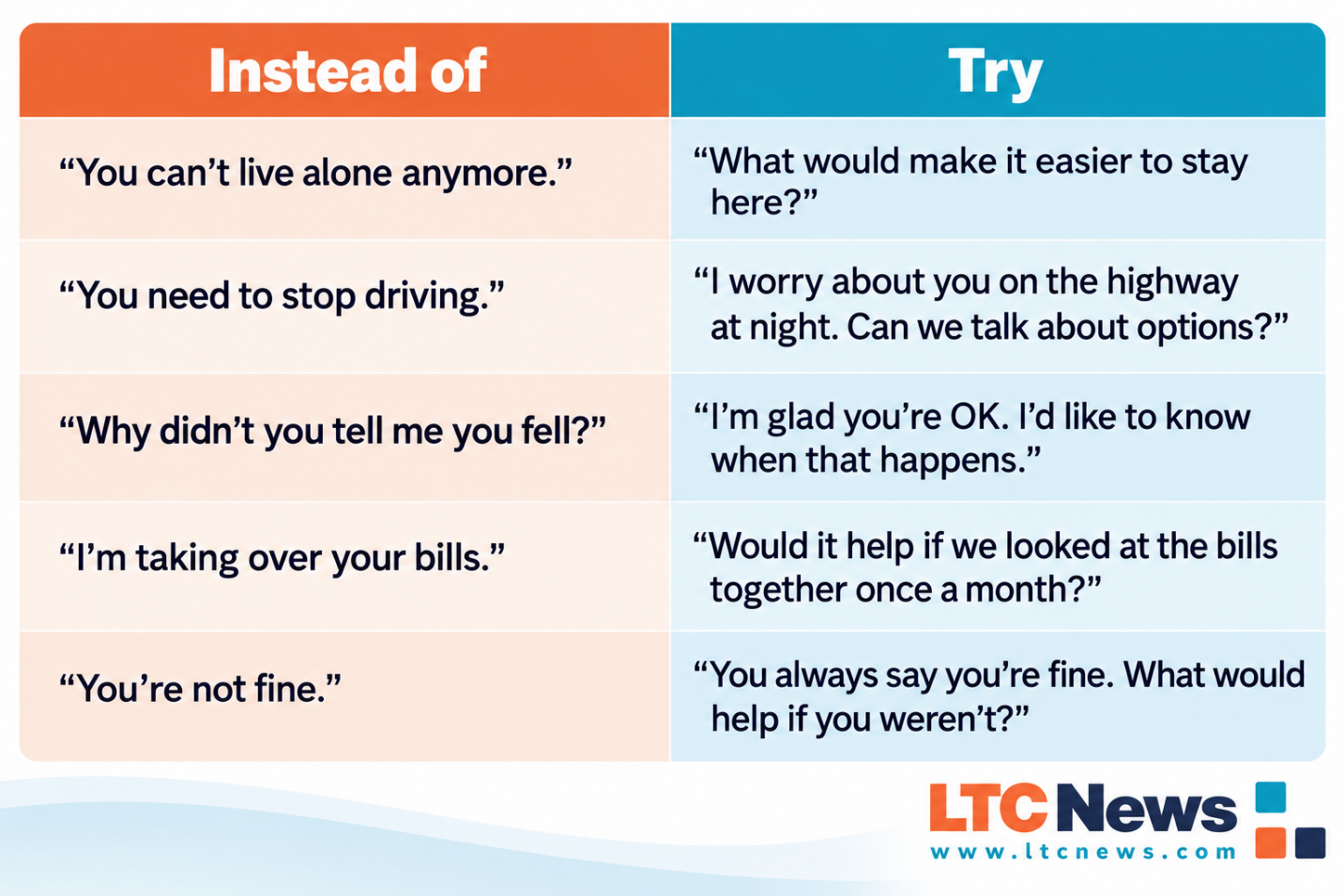
Parents spend a lifetime protecting their children, and that instinct never retires. When Mom says she is fine, she is often trying to spare you worry. Your job is to make it safe for her to tell you the truth.
When They Still Say 'I'm Fine'
Expect resistance. A first "no" is not a final answer, and pushing harder usually backfires.
- Back off and return later. Leave the door open: "I hear you. Can we revisit it next month?"
- Respect their right to choose. A parent who understands the risks can make decisions you disagree with.
- Keep watching. Visit more often, or ask a neighbor or relative nearby to check in.
- Share the load. Talk with your siblings so your parent hears one calm message, not several competing ones.
Some situations require prompt action:
- A fall with an injury, or repeated falls
- Wandering or getting lost
- A stove left on or other fire risks
- Missed doses of critical medication
- Signs someone is taking their money
- Not eating, not bathing, or living in unsafe conditions
If your parent is in immediate danger because of an injury, wandering, a fire risk, or another emergency, call 911. For other serious concerns, contact their doctor and describe what you see.
The Eldercare Locator, a public service of the U.S. Administration for Community Living, connects families with local help at 800-677-1116 or eldercare.acl.gov. If you suspect abuse, neglect, or financial exploitation, contact Adult Protective Services in your parent's state.
Ask if They Own Long-Term Care Insurance
Your parents may have planned better than you know. No industry statistic tracks it, but I have seen it again and again as a Long-Term Care Insurance specialist, and other specialists tell me the same. People buy a policy in their mid-to-late 40s, 50s, or 60s and some never mention it to their children. Years later, the policy just sits in a file drawer while they struggle on their own.
Even parents who remember the policy often hesitate to use it. In my experience, the reason is rarely the paperwork. Filing a claim means admitting they need help. They want to save it for a rainy day. It is hard for anyone, at any age, to think of themselves less than what they were. So, ask the question directly and without judgment: "Did you and Dad ever buy Long-Term Care Insurance?"
Start With Why They Bought It
If the answer is yes, ask what led them to buy it. The answer usually tells you what they value. Most people buy an LTC policy to stay in their own home, protect their savings, and keep their children from becoming full-time caregivers. Remind them of that. They bought the policy for a moment like the one they may be facing now.
Get the Details
Ask to see the policy together. Write down:
- The insurance company, policy number, and claims phone number
- The daily or monthly benefit and how much total benefit is in the policy now
- The types of care covered, such as home care, adult day care, assisted living, memory care, and nursing homes. Often, LTC policies are comprehensive, but some very old plans were not.
- The elimination period, meaning the waiting period before benefits begin.
- What triggers benefits, typically needing help with at least two of the six activities of daily living or requiring substantial supervision because of severe cognitive impairment.
- Whether premiums are current and who gets a notice if a payment is missed. If they failed to list someone for what is called the third-party notification, have them call the insurance company and add you right away, just in case.
Keep a copy where you and your siblings can find it.
Keep It Positive
If your parent seems like they could use help, do not lead with what they can no longer do. Ask how help at home would make their life better.
- "What would you do with your energy if someone else handled the laundry and the cooking?"
- "Would a little help in the morning give you more peace of mind getting ready, so you can get out and see your friends?"
- "How would it feel to stay in this house and not worry about the stairs?"
Frame care as the tool that keeps them independent, not the sign they have lost independence. Help at home is how many people avoid a move. Then tell them what it means to you. "You planned ahead so we would not have to worry. Using the policy would give me and the rest of the family peace of mind."
Keep this in mind: Many parents will accept help for their children's sake before they accept it for their own.
They paid the premiums for years. Using the benefits is not giving up. It is the plan working the way they intended. Reinforce the positive impact of the decision they made years ago.
Get Help With Filing the LTC Insurance Claim
You do not have to sort out the claim alone, and neither does your parent. LTC News partners with Amada Senior Care to provide free claim support with no cost or obligation. Their trained experts can help you understand the policy and navigate the claims process — File a Long-Term Care Insurance Claim.
Professional help can make the process easier in practical ways:
- They know the paperwork. Claim forms, doctor's statements, and care plans have to match what the policy requires. Often, they'll start with a nurse assessment.
- They understand the insurance company's language. An expert can explain the elimination period, benefit triggers, and what the policy may pay.
- They can advocate for you. The insurance agent or financial professional who originally helped with the policy may no longer be available. Experienced claims support can help the family understand the policy, communicate with the insurer, and navigate the process. Through LTC News, that assistance is available at no cost and with no obligation.
- They help you avoid mistakes. Missing or incomplete documents are a common cause of delay.
- They take the pressure off the family. You get to be the son or daughter, not the claims department.
Start With a Small Step
A claim can feel like a big, final decision to a parent who is not ready to say they need help. You do not have to present it that way. Try a lower-stakes ask: "Let's just see if you qualify for benefits first."
Starting the claims process does not commit your parent to hiring a caregiver that day. It gives the family a chance to understand the policy, determine whether they may qualify for benefits, and consider the available options. In my experience, the first step is the hard one. Once parents see what they are entitled to, using the policy starts to feel like a choice they are making, not something being done to them.
Plan Before the Crisis
The need for help with daily living activities or supervision because of dementia is common, not a personal failure. About 56 percent of Americans turning 65 will need long-term care, according to the U.S. Department of Health and Human Services (HHS).
For tax-qualified Long-Term Care Insurance, benefits generally become available when a person is certified as chronically ill, meaning they need substantial assistance with at least two of the six activities of daily living for an expected period of at least 90 days or require substantial supervision because of severe cognitive impairment.
The cost of that care surprises many families. In the University of Michigan poll, 62 percent of adults age 50 and older mistakenly thought Medicare would pay if they had to move permanently into a nursing home. Health insurance and Medicare pay for short-term skilled care only. They do not pay for most long-term care.
- Know the numbers. Use the LTC News Cost of Long-Term Care Services Calculator to see current and projected care costs where your parent lives. The calculator shows median care costs anywhere in the United States, the District of Columbia, Puerto Rico, and the U.S. Virgin Islands.
- Find quality care. Search the LTC News Caregiver Directory for home care agencies, adult day care, assisted living, and memory care near your loved one.
- Are you prepared? As you manage your older parents' needs, have you taken steps to plan for the future costs and burdens of aging?
Your parent's "I'm fine" is also a preview of your own future. Long-Term Care Insurance requires you to qualify medically to get a policy, so most people cannot buy it once their health has declined. LTC News research finds most people apply for an LTC policy between ages 47 and 67.
Seek a specialist for accurate LTC Insurance quotes. The LTC News Learning Center explains how LTC Insurance works and what it costs.
LTC Insurance options include traditional policies, partnership-certified LTC policies, hybrid policies that combine life insurance or annuities with a qualified rider for long-term care, and short-term cash indemnity plans with wider underwriting standards.
Listen Past the Words
The next time you hear "I'm fine," slow down. Look around the house. Ask one more question. Then ask it again next week. You do not need to fix everything in one visit. You need to notice, start the conversation, and keep it going. Pick one sign from the list above and check on it during your next call or visit.
Ask yourself: If your parent needed help today, would they tell you? And when your own children ask how you're doing years from now, will you have a plan to show them?
Frequently Asked Questions
What warning signs could mean an older parent needs help?
Watch for changes such as unopened mail, unpaid bills, spoiled or missing food, unexplained bruises, difficulty walking, medication problems, poor grooming, repeated questions, missed appointments, getting lost, social withdrawal, or unusual financial activity. A change from your parent's normal behavior is often more important than any single sign. Pasted markdown
How should I talk to a parent who refuses help?
Start with what you have observed rather than telling your parent what they can no longer do. Ask questions, listen, and make maintaining independence the goal. Offer choices and consider starting with a small amount of help. Expect the conversation to take place over time rather than trying to settle everything at once. Pasted markdown
When does Long-Term Care Insurance typically begin paying benefits?
Tax-qualified Long-Term Care Insurance generally requires a person to be certified as chronically ill. Typically, that means needing substantial assistance with at least two of the six activities of daily living for an expected period of at least 90 days or requiring substantial supervision because of severe cognitive impairment.
Can someone help my family file a Long-Term Care Insurance claim?
Yes. LTC News offers access to free Long-Term Care Insurance claims assistance through Amada Senior Care. Claims specialists can help families understand the policy, benefit triggers, elimination period, and paperwork, and navigate the claims process. There is no cost or obligation. Pasted markdown
Why might an aging parent say they are fine when they are struggling?
Older adults may hide problems because they fear losing their independence, do not want to burden their children, value their privacy, or do not recognize changes in their own abilities. Rather than relying only on what a parent says, look for changes in their home, health, appearance, mood, memory, and finances.
Does Medicare pay for long-term care?
Medicare and health insurance can pay for qualifying short-term skilled care, but they do not pay for most ongoing long-term care. Families should understand how care would be funded before a crisis develops. Pasted markdown
When should I act immediately instead of waiting to talk again?
Prompt action may be necessary if your parent is injured in a fall, repeatedly falls, wanders or gets lost, creates a fire hazard, misses critical medications, is not eating or bathing, lives in unsafe conditions, or shows signs of financial exploitation. Call 911 when there is an immediate emergency. Pasted markdown
Where can I find care and compare long-term care costs for my parent?
Use the LTC News Cost of Long-Term Care Services Calculator to see current and projected care costs. You can also use the LTC News Caregiver Directory to search for home care, adult day care, assisted living, memory care, and other care options.
What should I do if my parent has Long-Term Care Insurance?
Ask to review the policy together. Find the insurance company, policy number, claims contact information, current benefits, elimination period, covered services, and benefit triggers. Also make sure premiums are current and determine who receives notification if a premium is missed. Pasted markdown


Sponsored