How Workplace Wellness Programs Can Support Employees Caring for Aging Parents
About This Article
Working caregivers of aging parents face real burnout, changing their quality of life and ability to both work and care for a parent.

Anna Marino
Anna Marino is a seasoned writer specializing in topics related to family, aging, and lifestyle in retirement. She shares advice on intergenerational relationships and strategies for enjoying retirement.
Table of Contents
- What Is the Caregiving Squeeze?
- How Caring for an Aging Parent Affects Employee Health
- How Caregiving Pressure Affects the Workplace
- Why Traditional Employee Wellness Initiatives Often Miss Caregivers
- What Should a Caregiver-Inclusive Workplace Wellness Program Include?
- Filling Existing Benefit Gaps
- Supporting Caregivers Without Invading Their Privacy
- Building a Caregiver-Friendly Wellness Strategy
- What Small and Medium-Sized Employers Can Realistically Offer
- Supporting Caregivers Is Part of Supporting an Aging Workforce
- Why Planning Before a Crisis Changes Everything
- Cost of Waiting
- Helping Prepare
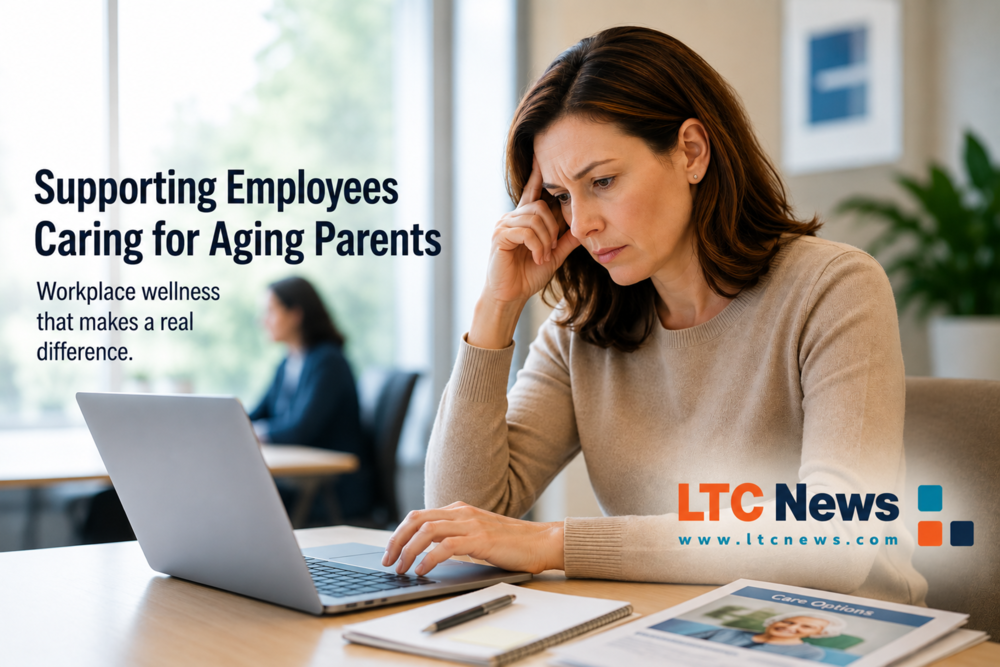
One night spent helping a parent who has fallen, sitting through a medical appointment, or juggling hours of calls to arrange home care can leave you showing up to work looking composed while running on empty inside. And even if it isn’t affecting you yet, you’ve likely seen the strain in a coworker’s face. An aging America is reshaping daily life for families everywhere, and the impact is becoming impossible to ignore.
For many working caregivers, that’s just Tuesday. You’re doing your job while also arranging medical appointments for an older family member, managing their medications, coordinating home care, or dropping everything when a parent has an emergency. No doubt, this is stressful.
Some of you are raising children at the same time — which is why this group is known as the sandwich generation. And let’s be honest: a gym discount or a meditation app doesn’t move the needle when you’re juggling hospital visits, latenight worry, and the constant logistics of caregiving. What actually makes a difference is a workplace wellness program built around the realities employee caregivers face, not around whatever is easiest for an employer to offer.
What actually helps is a workplace wellness program built around what caregivers are dealing with, not around what's easy to offer. LTC News receives many emails asking about how wellness programs can help and how they make a long-term care situation easier on employees." — Nick DeFrank, Vice President of LTC News.
An estimated 61 percent of the 37 million Americans caring for an older adult are balancing that caregiving with a job, and these working caregivers provide an average of 64.8 hours of hands-on assistance per month, or roughly 15 hours a week, on top of their regular work schedule. (Source: Grochowski, Lamont & Dey, "Identifying Employer Supports for Family Caregivers of Older Adults," U.S. Department of Health and Human Services, Office of the Assistant Secretary for Planning and Evaluation, December 2024.) That's not a side project. That's a second, unpaid job layered on top of a first one that is physically and emotionally difficult.
What Is the Caregiving Squeeze?
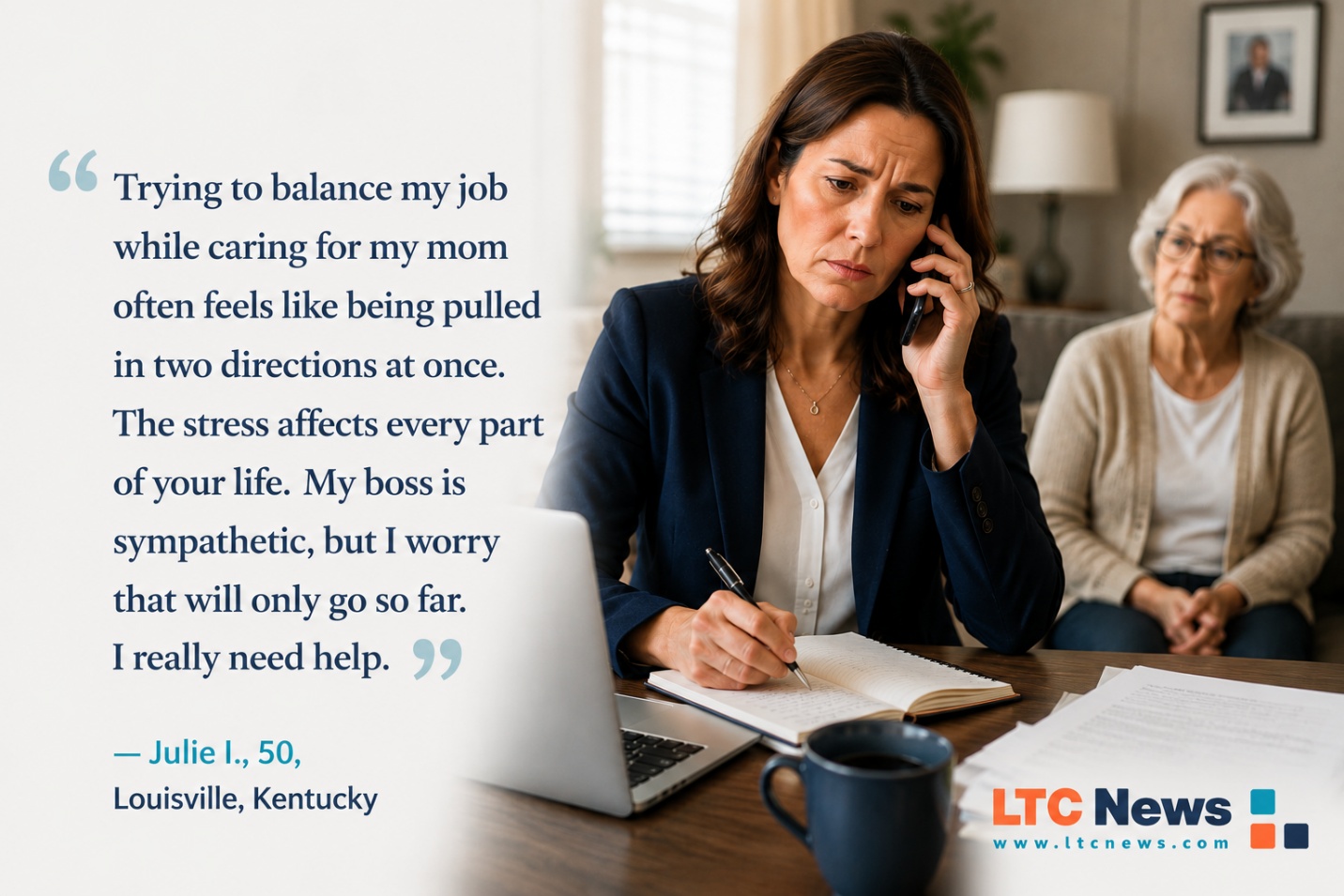
The caregiving squeeze happens when your job and your responsibility for an aging parent pull in different directions at the same time. It involves time, money, emotions, health, and often some genuinely hard family decisions, all at once.
Presenteeism is a fancy word for something pretty simple. Someone's sitting at their desk, technically working, but they're exhausted, in pain, worried sick, or fielding calls from a home care agency, and none of that leaves much room for actual focus. Often a parent does not have Long-Term Care Insurance in place putting the full responsibility on an adult child, someone who is often still working.
When an employer truly shows up for employees in this situation, it creates something real — loyalty, engagement, and a sense that it’s safe to be honest about what’s happening at home. That kind of trust encourages employees to speak up early, long before a crisis pushes them to a breaking point.
Share your thoughts and experiences about aging, caregiving, health, retirement, and long-term care with LTC News —Contact LTC News.
How Caring for an Aging Parent Affects Employee Health
Caring for an aging parent takes a toll on the mind, the body, and often finances too. Constant stress, broken sleep, physically demanding tasks and uncertainty about tomorrow all chip away at resilience, and eventually that leads to burnout.
- Chronic stress and emotional exhaustion. A low-grade alertness never really switches off when you're worried about a parent. Add hard care decisions, sometimes with siblings who disagree, plus anxiety about a parent's decline and grief that can start long before anyone passes away, and you end up running two full-time emotional jobs at once.
Caregivers without formal training or those juggling multiple responsibilities, such as work and family, are especially vulnerable" to burnout." — Chelsea Mendonca, MD, a geriatric psychiatrist affiliated with Yale Medicine and unit chief of Adult Inpatient Psychiatry at Lawrence + Memorial Hospital.
- Sleep disruption and reduced concentration. Late-night calls, early hospital visits, medication timing, and worry that won't let you rest add up to poor sleep. Poor sleep shows up the next day as brain fog, forgetfulness, slower thinking, and a shorter fuse.
- Physical pain and caregiver injury. Caregiving is more physical than people realize: helping a parent stand or walk, lifting mobility equipment, supporting transfers, hauling supplies, and hours spent driving or waiting. Repeated often enough, with poor posture and no breaks, this leads to back pain, shoulder strain, reduced mobility, and old injuries flaring back up.
- Neglected preventive health. Working caregivers tend to put themselves last. Doctor's appointments get pushed back, exercise stops, meals get rushed, screenings get missed, and rest becomes a luxury you don't think you can afford.
How Caregiving Pressure Affects the Workplace
Caregiving pressure shows up as missed days, distracted work, last-minute schedule changes, and eventually, people leaving. The real issue isn't that employees are caregivers. It's that most workplaces give them no real way to manage it.
- Absenteeism and unplanned schedule changes. Emergency appointments, discharge planning after a hospital stay, a home care aide who quits without notice, a parent's condition changing overnight, legal or financial paperwork that can't wait: all of it can pull an employee away with almost no warning.
- Presenteeism and reduced focus. Presenteeism describes someone sitting at their desk, technically working, while exhausted, in pain, worried sick, or fielding calls from a home care agency. A nationally representative study of 8.8 million employed family caregivers found that nearly one in four, 23.3 percent, missed work or had reduced productivity while at work over a one-month period because of caregiving. Among those affected, productivity dropped by roughly a third, working out to about $5,600 per employed caregiver a year when spread across the full caregiving workforce, mostly driven by reduced performance while present at work rather than missed days. (Source: Keita Fakeye et al., "Caregiving-Related Work Productivity Loss Among Employed Family and Other Unpaid Caregivers of Older Adults,"
- Burnout, reduced hours, and resignation. Without support, people scale back. They turn down promotions, ask for part-time hours, quietly start job hunting somewhere with more flexibility, take extended leave, or leave the workforce altogether.
Employers who show up for employees in this situation build real loyalty, engagement, and trust. That trust makes employees more likely to ask for help early, before things reach a breaking point.
Why Traditional Employee Wellness Initiatives Often Miss Caregivers
A lot of employee wellness initiatives are built for general wellbeing: step challenges, mindfulness apps, an occasional lunch-and-learn. Fine for some people, but not much use to someone dealing with a caregiving crisis, chronic stress, physical pain, or limited time to see a doctor.
Step challenges, after-work fitness classes, long seminars and clunky apps that want constant check-ins all assume employees have spare time and spare energy. Working caregivers usually have neither. There's also a real gap between signing up for something and actually using it, between running an activity and providing real health support, and between a one-off wellness week and something that's there when it's actually needed. Caregivers need accessibility, not another obligation. A good caregiver benefits program makes life easier: flexible appointment times, remote options, easy booking, confidentiality, and resources that don't take an hour to read.
What Should a Caregiver-Inclusive Workplace Wellness Program Include?
A workplace wellness program built for employee caregivers needs to cover physical health, mental wellbeing, preventive care, real flexibility and dependable caregiving resources: support that can bend around a life that doesn't run on a fixed schedule.
- Flexible work and leave policies. Flexible start and end times, remote or hybrid work where possible, dedicated caregiver leave, paid time off for appointments, the ability to swap shifts, reduced-hours options and clear procedures for emergency absences. None of it works if it's applied inconsistently or only honored by certain managers.
- Mental health and emotional support. An Employee Assistance Program (EAP) that's actually used, not just mentioned in the handbook. Stress-management support, peer groups where caregivers can talk to other caregivers, managers trained to respond well, and referrals to qualified mental health professionals when someone needs more than a listening ear.
- Physical health, pain, and recovery services. Musculoskeletal assessments, ergonomic advice, mobility support, physical recovery care, exercise guidance, referrals when something needs a closer look, and consultations delivered onsite or by video.
- Caregiving navigation and practical resources. Eldercare consultations, long-term care planning resources, directories of home care providers, legal and financial education, dementia support, help coordinating care across providers, and backup care options for when the usual plan falls through.
- Onsite, remote, and hybrid delivery. A modern employee health program needs to reach office staff, remote employees, shift workers, field teams, and anyone who can't leave work for an outside appointment.
Filling Existing Benefit Gaps
Employers don't need to tear up a current benefits package to make a real difference. A personalized workplace health program can sit alongside existing insurance, leave policies, and EAP services, filling in the gaps around pain, preventive health, and everyday stress. These programs can be shaped around a company's actual workforce: its health risks, job demands, schedules, locations, existing benefits, and size, rather than a one-size-fits-all approach.
Programs like BioFunctional Health Solutions are becoming popular, working alongside existing benefits by giving employees easier access to care for pain, injuries, stress, preventive health, and personalized wellness coaching. Services can be provided onsite, remotely, or through local clinics, helping employees stay healthier while reducing lost work time and improving productivity. This is a growing category often called advanced corporate health, occupational health, or musculoskeletal (MSK) health management. However, very few companies offer the same combination of services, which is why it is mentioned here.
Supporting Caregivers Without Invading Their Privacy
Support only works if employees feel safe using it, which means making it easy to access without forcing anyone to share more than they want to.
Participation should always be voluntary, with no effect on how someone is viewed or evaluated at work and no public tracking of who's using what. Employers should limit who can see personal health data, work with qualified third-party providers rather than handling it in-house, keep health information separate from management decisions, share only aggregate results, and be upfront about how data is used.
It's also worth avoiding assumptions about who's caregiving. Not every employee over 45 is caring for a parent; caregiving isn't only a women's issue; someone without kids may still have a lot on their plate at home; and no two employee caregivers need the same kind of help.
Building a Caregiver-Friendly Wellness Strategy
- Assess employee needs confidentially. Use anonymous surveys, benefit usage data, absence patterns, employee resource groups, and honest feedback from managers and HR.
- Review current benefits. Look for gaps in leave policies, scheduling, mental health support, physical health services, care navigation, preventive health, manager training, and remote access.
- Start with the greatest source of strain. Flexible scheduling, caregiver leave, remote consultations, help with pain and mobility, care navigation and mental health counseling are all reasonable starting points.
- Communicate clearly. Employees need to know what's on offer, who's eligible, how to use it, whether it's confidential, whether it's optional, and who to ask with questions.
- Review meaningful outcomes. Track participation, repeat usage, satisfaction, absence trends, retention, reported barriers, health improvements, and manager confidence, not just short-term savings.
What Small and Medium-Sized Employers Can Realistically Offer
A decent workplace wellness program doesn't require a massive budget. Smaller employers can offer flexible scheduling guidelines, paid or unpaid caregiver leave, remote mental health services, telehealth access, a simple caregiver resource guide, manager training, partnerships with local eldercare organizations, preventive health days, health coaching, musculoskeletal screening, EAP services, and anonymous check-ins on what employees actually need. A small caregiver support program that people actually use beats a long list of eldercare benefits nobody understands.
Supporting Caregivers Is Part of Supporting an Aging Workforce
Caregiver support matters more every year, partly because so many employees are aging themselves while caring for even older parents. Their own health, their family responsibilities, and their work decisions are tangled together. Some employees are managing their own chronic conditions while caring for a parent. Some are putting off retirement because they need the income. Others leave work early because caregiving becomes too much to juggle.
Employers who understand how these pressures overlap end up building better, more inclusive health programs, ones that support healthy aging, long-term independence, family caregiving, care planning, and keeping experienced people in the workforce longer. Supporting caregivers also helps companies hold onto the knowledge and experience that walks out the door when someone quits.
Why Planning Before a Crisis Changes Everything
Wellness support treats the symptoms of caregiving strain. Planning ahead prevents a lot of that strain from happening in the first place, and it's the piece employers are uniquely positioned to encourage, even though they can't do it for their employees.
- Long-Term Care Insurance purchased before retirement. A parent who bought a Long-Term Care Insurance policy years earlier, while still healthy enough to qualify, changes the entire experience for the adult child who ends up coordinating care. Instead of scrambling to privately fund $6,000-plus a month in home care or over $11,000 a month for skilled nursing, the family works from a funded plan with benefits already in place. Employees planning their own retirement benefit from the same logic: buying an LTC Insurance policy earlier, typically in their 50s, generally means better health qualification and more affordable premiums than waiting until a crisis forces the issue.
- Adult children starting the conversation early. Most families put off talking about a parent's care preferences, finances, and wishes until a fall, a diagnosis, or a hospital stay forces the conversation. Starting it years earlier, while a parent can still weigh in, avoids decisions made under pressure and reduces conflict between siblings later.
- Legal planning. A power of attorney, healthcare proxy, and updated will, done before a parent loses the capacity to sign them, prevent a family from ending up in court to make basic medical or financial decisions on a parent's behalf.
- Financial planning. Understanding what Medicare actually covers, what a parent's assets and income can sustain, and what Medicaid eligibility requires, well before a care need arises, turns a financial emergency into a manageable budget conversation.
- Setting realistic family expectations. Many families assume one adult child will "handle it," often without ever discussing who has the time, the proximity, or the capacity to take that on. Naming those expectations early avoids resentment and burnout for whoever ends up as the default caregiver.
- Avoiding caregiver burnout before it starts. Every one of the health and workplace impacts described earlier is harder to prevent once a crisis is already underway. Families who plan ahead, financially and logistically, tend to enter caregiving with support already lined up rather than assembling it in a panic.
Employers can't make these decisions for employees, but pointing people toward free, unbiased planning and cost-of-care tools costs nothing and gives employees a place to start before a crisis forces their hand.
Cost of Waiting
The financial stakes make planning ahead worth the effort. According to LTC News Caregiver Directory cost data, home care can easily run $6,000 per month or more depending on location, and that's just for help at home, where most people prefer to receive care. Assisted living averages $5,000 to $6,000 per month in base costs, with care-level surcharges that can add another $2,000 per month, and around-the-clock skilled nursing care exceeds $11,000 per month in many markets. Over a multi-year care need, and most people need care longer than expected, out-of-pocket exposure can reach $350,000 or more.
Much of that exposure catches families off guard because of a widespread misunderstanding about what Medicare covers. According to the University of Michigan National Poll on Healthy Aging, 62 percent of adults age 50 and older incorrectly believe Medicare covers the cost of long-term care and a permanent nursing home stay. It does not. Medicare covers short-term skilled care after a hospital stay, not the ongoing custodial help with bathing, dressing, eating and mobility that most aging parents eventually need.
"Families make financial decisions based on this assumption for decades, and then face a crisis when the bills arrive, and Medicare pays almost nothing," said James Kelly, an editor and correspondent at LTC News.
Roughly 56 percent of Americans turning 65 will need some level of long-term care, meaning help with two or more activities of daily living (ADLs) or supervision due to cognitive impairment. The impact on the American family, your family, is clear. Cognitive decline is a significant part of that need: an estimated 7.4 million Americans age 65 and older were living with Alzheimer's disease in 2026, a number projected to reach 13.8 million by 2060, according to the Alzheimer's Association. Dementia caregiving in particular tends to be longer, more physically demanding, and harder on an employee's own mental health than caregiving for other conditions.
Helping Prepare
Working caregivers aren't a small, niche group tucked into the corner of the workforce. What they're dealing with touches their health, their emotions, their focus, their attendance, and the career choices they make.
Employers cannot solve the financial realities of aging, but they can help employees prepare before a crisis occurs. Combined with education about long-term care costs, available community resources, and early planning, including Long-Term Care Insurance when appropriate, a caregiver-friendly workplace can reduce stress, improve retention, and help families make better decisions long before an emergency forces them to act.
Employees who want to see real numbers for their own family can start with the free LTC News Cost of Long-Term Care Services Calculator, the LTC News Learning Center, and the LTC News Caregiver Directory, all free and unbiased.
For loved ones who are lucky enough to have purchased a Long-Term Care Insurance policy before their health changed, LTC News provides a free resource to help you process the claim with the insurance company, making it easier on you and the rest of the family. Partnering with Amada Senior Care, trained experts will walk you through the entire process and help you access benefits quickly and correctly — File a Long-Term Care Insurance Claim.
If you're an employer, where does your current wellness program fall short for the caregivers already on your team, and what's the one change you could make this quarter that would actually reach them?
Educating employees that long-term care is not covered by health insurance or later by Medicare is the minimum an employer should do for their employees." — Nick DeFrank, Vice President of LTC News.
There are only a few employer-based Long-Term Care Insurance options, and many of them are not comprehensive and affordable. Be sure to speak with an actual Long-Term Care Insurance specialist, not a workplace benefits advisor, to help you sort through options.
Frequently Asked Questions
How common are working family caregivers?
Family caregiving has become a major workplace issue. An estimated 61 percent of the 37 million Americans caring for an older adult also hold a job, providing an average of nearly 65 hours of unpaid care each month in addition to their regular work responsibilities.
What is the "caregiving squeeze?"
The caregiving squeeze happens when employees are trying to balance the demands of a full-time job while also helping an aging parent with medical appointments, medications, transportation, home care, finances, or daily activities. The competing responsibilities can create emotional, physical, financial, and workplace stress that affects every aspect of life.
What should a caregiver-friendly workplace wellness program include?
Effective programs often include:
- Flexible work schedules and caregiver leave
- Employee Assistance Programs (EAPs)
- Mental health counseling
- Physical therapy and musculoskeletal support
- Eldercare planning resources
- Remote and onsite healthcare services
- Care coordination and navigation assistance
These services help employees manage caregiving responsibilities while remaining productive at work.
How does caring for an aging parent affect an employee's health?
Caregiving can lead to chronic stress, sleep disruption, physical injuries, anxiety, burnout, and neglected preventive healthcare. Many caregivers postpone their own medical appointments, skip exercise, and experience ongoing fatigue while trying to meet both family and work responsibilities.
Can small employers afford caregiver support programs?
Yes. Even employers with limited budgets can make a meaningful difference by offering flexible scheduling, telehealth, caregiver resource guides, manager training, EAP services, and partnerships with local aging or caregiving organizations. Small improvements that employees actually use are often more valuable than expensive benefits that go unused.
How can employers help employees prepare for future caregiving responsibilities?
Employers can educate employees about long-term care planning, provide access to reliable caregiving resources, encourage conversations about future care needs, and help employees understand that Medicare is not designed to pay for most long-term care expenses. Better-informed employees are more likely to prepare before a crisis occurs.
What is presenteeism, and why does it matter?
Presenteeism occurs when employees are physically at work but are distracted, exhausted, or overwhelmed by caregiving responsibilities, reducing productivity. Research shows nearly one in four employed caregivers experiences reduced productivity or missed work because of caregiving demands.
Why is planning before a caregiving crisis so important?
Early planning allows families to discuss care preferences, establish legal documents, understand future care costs, explore Long-Term Care Insurance, and decide who will provide care before an emergency occurs. Planning ahead reduces stress, family conflict, and caregiver burnout.
Why don't traditional workplace wellness programs meet caregivers' needs?
Many wellness programs focus on gym memberships, fitness challenges, or meditation apps. While these benefits may help some employees, caregivers often need flexible schedules, emotional support, physical recovery services, and practical resources that fit into unpredictable daily lives.

Sponsored