How Long-Term Care Providers Market Their Services in a Digital-First World
About This Article
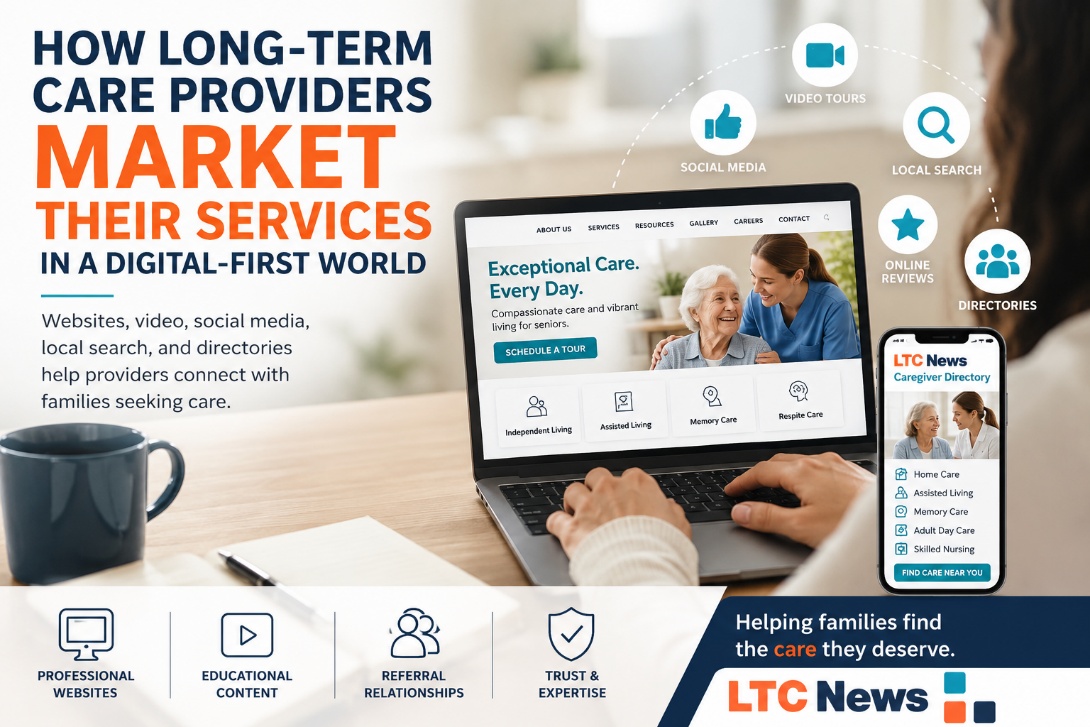
Families increasingly search online for extended care information, costs, and providers before making decisions. Today's home care agencies, assisted living communities, memory care providers, and nursing facilities use websites, video, local search, social media, and online directories to reach consumers and referral sources alike.

James Kelly
LTC News staff writer specializing in long-term care and aging.
Table of Contents
- Websites Have Become the Digital Front Door
- Google Business Profiles Drive Local Visibility
- Video Has Become a Powerful Communication Tool
- Community Tours
- Resident and Family Testimonials
- Educational Content
- Video Is Used Beyond Marketing
- Recruiting Caregivers Requires Marketing Too
- Social Media Helps Build Trust
- Digital Marketing Does Not Replace Professional Relationships
- Artificial Intelligence Is Changing How Families Search for Care
- Families Often Research Costs Before Choosing Care
- Why Directories Continue to Matter
- LTC News Caregiver Directory Helps Families and Providers Connect
- Trust Remains the Most Important Marketing Tool
Running a home health agency or longterm care facility means navigating daily challenges. Demand for extended care continues to rise, but so does the competition, leaving providers under pressure to stand out while meeting the growing needs of aging adults.
You understand that if a family member is helping an aging parent, spouse, or loved one find extended care, their search will likely begin online. They may compare home care agencies, research assisted living communities, watch videos of memory care programs, check reviews, or search for information about costs before ever contacting a provider.
That shift in consumer behavior has transformed how long-term care providers market their services.
"Families rarely pick up the phone as their first step anymore," said Nick DeFrank, Vice President of LTC News.
By the time someone calls a provider, they've usually already compared a few agencies, watched a tour video, and looked at reviews. Providers who aren't visible during that research phase are often left out of the conversation entirely." — Nick DeFrank, Vice President, LTC News.
Home care agencies, assisted living communities, memory care residences, rehabilitation centers, and nursing facilities still rely on professional referrals from physicians, hospitals, discharge planners, elder law attorneys, Long-Term Care Insurance specialists, and financial professionals. However, digital visibility has become increasingly important because families often conduct extensive research before making a decision.
According to the U.S. Department of Health and Human Services, 56% of Americans turning age 65 today will require long-term services and supports at some point in their lives. As America's population continues to age, demand for care services is expected to grow, increasing competition among providers and making consumer education more important than ever.
"Families often spend weeks or months researching care options before making contact with a provider," DeFrank said.
The organizations that provide useful information and help consumers understand their options are often the ones that earn trust early in the decision-making process." — Nick DeFrank, Vice President, LTC News.
Websites Have Become the Digital Front Door
For many providers, a website serves as the first point of contact with prospective clients and residents.
Modern websites often include:
- Service descriptions
- Staff information
- Educational articles
- Photo galleries
- Virtual tours
- Testimonials
- Frequently asked questions
- Contact forms
Many organizations have shifted from purely promotional websites to educational platforms designed to answer common consumer questions about aging, caregiving, dementia, rehabilitation, and long-term care services.
"A provider's website used to be a digital brochure," said Nick DeFrank, Vice President of LTC News.
Now it has to function more like a resource center. Families are researching dementia, rehabilitation, and care costs long before they're ready to talk to anyone, and the providers who answer those questions clearly and honestly are the ones who earn trust early, which is exactly what Google's E-E-A-T standards are designed to reward." — Nick DeFrank.
This approach aligns with Google's E-E-A-T framework, which emphasizes Experience, Expertise, Authoritativeness, and Trustworthiness when evaluating online content.
"Google has been direct about what it's looking for," said Danny Sullivan, who served as Google's Search Liaison when the statement was made. "For anyone who uses any method to generate a lot of content primarily for search rankings, our core systems look at many signals to reward content clearly demonstrating E-E-A-T."
Google Business Profiles Drive Local Visibility
Many families searching for care never visit a provider's website first. Instead, they begin with Google Search or Google Maps.
A provider's Google Business Profile can include:
- Reviews
- Photographs
- Directions
- Contact information
- Service areas
- Frequently asked questions
For local providers, maintaining accurate information and actively managing online reviews can influence how easily consumers discover their services.
Video Has Become a Powerful Communication Tool
Video allows providers to show families what brochures and advertisements cannot. Common marketing videos include:
Community Tours
Video tours allow families to view apartments, common spaces, dining areas, therapy rooms, and activity programs before scheduling a visit.
Resident and Family Testimonials
Testimonials help prospective clients understand the experiences of current residents and their families.
Educational Content
Providers increasingly create videos explaining:
- Dementia and Alzheimer's disease
- Fall prevention
- Caregiver stress
- Aging in place
- Long-term care planning
- Senior safety
Educational videos help answer consumer questions while demonstrating expertise.
Video Is Used Beyond Marketing
Many providers also use video internally. Applications include:
- Staff Training
Training videos may address:
- Dementia care
- Resident safety
- Infection prevention
- Emergency procedures
- New employee onboarding
- Family Communication
Some organizations use video updates to keep families informed about events, programs, and community initiatives.
- Resident Engagement
Video content is frequently incorporated into exercise programs, wellness activities, educational presentations, and entertainment programming.
Recruiting Caregivers Requires Marketing Too
Marketing today is not limited to attracting residents and clients. Providers must also attract employees. Workforce challenges remain a concern throughout long-term care, leading many organizations to invest in recruitment-focused marketing.
Recruitment content often highlights:
- Workplace culture
- Career opportunities
- Training programs
- Employee testimonials
- Benefits
- Flexible scheduling
A provider's online presence can influence both consumer and employment decisions. Long-term care providers don't need Hollywood producers to create and edit their videos. An online video editor platform like VEED makes it dramatically easier for longterm care providers to produce polished videos for marketing, staff training, and internal communication. The core benefit: you don’t need a production team or advanced editing skills to create professional, onbrand content.
Social Media Helps Build Trust
Social media platforms offer long-term care providers opportunities to communicate directly with families and communities.
Common platforms include:
- YouTube
Organizations frequently share:
- Community activities
- Educational information
- Staff recognition
- Volunteer programs
- Resident achievements
- Special events
Families often use social media to gain additional insight into an organization's culture and level of engagement.
Digital Marketing Does Not Replace Professional Relationships
Despite the growth of digital marketing, referral relationships remain critical. Many providers continue to receive referrals from:
- Hospitals
- Physicians
- Rehabilitation facilities
- Elder law attorneys
- Long-Term Care Insurance specialists
- Financial advisors
- Care managers
Successful organizations typically combine digital visibility with strong professional referral networks.
Artificial Intelligence Is Changing How Families Search for Care
Consumers increasingly use artificial intelligence tools to research aging, caregiving, and long-term care issues. Questions frequently asked through AI-powered platforms include:
- What type of care does my parent need?
- How much does assisted living cost?
- What is memory care?
- How do I find quality home care?
As AI-powered search evolves, providers are focusing more attention on creating trustworthy, educational content that can be referenced by search engines and AI systems. Organizations that demonstrate expertise and provide accurate information are likely to benefit most from these changes.
Families Often Research Costs Before Choosing Care
One of the first questions families ask is simple: How much will care cost?The answer varies significantly based on location and level of care. Many consumers begin their research with tools such as the LTC News Cost of Long-Term Care Services Calculator, which provides average local costs for home care, assisted living, memory care, nursing homes, and other long-term care services in every zip code in the United States.
For long-term care providers, advertising on LTC News, particularly on high-traffic pages like the cost-of-care calculator, can be a significant advantage.
"Families don't land on our Cost of Care Calculator by accident," said DeFrank.
They're actively trying to figure out what care is going to cost them or a loved one, which means they're already deep into the decision-making process. For a provider, getting in front of that kind of intent is a different opportunity than a typical display ad." — Nick DeFrank, Vice President, LTC News.
Understanding costs often helps families narrow their options and begin planning for future care needs.
Why Directories Continue to Matter
Many families prefer directories that allow them to compare providers in one place. Directories can help consumers:
- Search by location
- Compare services
- Identify care settings
- Review provider information
- Contact organizations directly
For providers, directories can improve visibility among consumers actively researching care options.
LTC News Caregiver Directory Helps Families and Providers Connect
The LTC News Caregiver Directory helps families locate care providers nationwide, including:
- Home care agencies
- Adult day care centers
- Assisted living communities
- Memory care providers
- Rehabilitation facilities
- Skilled nursing facilities
Providers can claim their directory listing free of charge. Claiming a listing allows organizations to:
- Verify information
- Update services
- Add contact information
- Improve accuracy
- Increase visibility
Enhanced listings are available for a modest fee and may include:
- Expanded descriptions
- Additional photographs
- Video integration
- Website links
- Social media links
- Enhanced branding opportunities
The ability to add video can help providers showcase their services and facilities while giving families additional information during the evaluation process.
Because LTC News attracts readers researching caregiving, retirement, dementia, long-term care planning, and aging issues, providers gain exposure to consumers already engaged in the care decision process.
Claim your free listing on the LTC News Caregiver Directory and/or upgrade the listing to enhance visibility and highlight your staff and services through the LTC News Directory Business Portal.
Trust Remains the Most Important Marketing Tool
Technology will continue to evolve. Websites will change. Search engines will change. Artificial intelligence will continue to reshape how consumers find information. Yet the most effective marketing tool remains trust.
Families are making deeply personal decisions when choosing care for someone they love. Providers that educate consumers, communicate transparently, demonstrate expertise, and deliver quality care will continue to stand out regardless of how technology changes.
Today's technology, including video editing, can make the job easier. Using partners like LTC News can also be a critical advantage as you help to provide quality long-term care for older adults.
Frequently Asked Questions
Why are online reviews important for long-term care providers?
Many families review online ratings and comments before contacting a provider. Reviews can provide insight into communication, responsiveness, staff interactions, and overall satisfaction. While reviews should not be the sole factor in choosing care, they often influence first impressions.
Can providers claim an LTC News Caregiver Directory listing for free?
Yes. Providers can claim their listing at no cost to verify information, update services, and improve accuracy. Enhanced listing options are also available and may include expanded descriptions, photos, videos, website links, social media links, and additional branding opportunities.
Why is trust the most important marketing tool in long-term care?
Families are making important decisions about the health, safety, and well-being of someone they love. Providers that educate consumers, communicate transparently, demonstrate expertise, and consistently deliver quality care are more likely to earn trust and stand out in a competitive marketplace.
What types of videos do long-term care providers create?
Providers use video for several purposes, including:
- Community and facility tours
- Resident and family testimonials
- Educational content about aging and caregiving
- Caregiver recruitment
- Employee training
- Family communication
- Resident engagement programs
Video helps families better understand a provider's services and culture before making a decision.
What is a Google Business Profile, and why does it matter?
A Google Business Profile is a free business listing that appears in Google Search and Google Maps. It can display reviews, photos, directions, phone numbers, websites, service areas, and frequently asked questions. For many providers, it is one of the most important tools for local visibility.
How do long-term care providers market their services today?
Most long-term care providers use a combination of websites, online reviews, social media, video content, local search optimization, professional referral relationships, and online directories. The goal is to help families find information, compare care options, and connect with providers when they need assistance.
What is the LTC News Cost of Long-Term Care Services Calculator?
The LTC News Cost of Long-Term Care Services Calculator provides local cost estimates for home care, assisted living, memory care, nursing homes, and other long-term care services throughout the United States. It helps consumers understand current care costs in their area and plan accordingly.
How is artificial intelligence changing long-term care marketing?
Consumers increasingly use AI-powered tools to ask questions about caregiving, dementia, assisted living, home care, and long-term care costs. Providers that create accurate, trustworthy, and educational content may be better positioned to appear in AI-driven search results and recommendations.
How are social media platforms used by long-term care providers?
Providers often use Facebook, Instagram, YouTube, and LinkedIn to share educational content, community events, staff recognition, resident activities, and caregiving information. Social media can help families learn more about an organization's culture and services.
What is the LTC News Caregiver Directory?
The LTC News Caregiver Directory is a nationwide resource that helps families locate care providers, including home care agencies, adult day care centers, assisted living communities, memory care providers, rehabilitation facilities, and skilled nursing facilities. Providers can create or enhance their presence to help consumers find accurate information about their services.
Why is a website important for a home care agency or senior living community?
A website is often the first impression families have of a provider. Modern websites provide information about services, staff, care options, pricing, testimonials, educational resources, and contact information. Many families research providers online before making a phone call or scheduling a visit.
Does digital marketing replace referrals from healthcare professionals?
No. While digital marketing has become increasingly important, referrals from physicians, hospitals, rehabilitation centers, elder law attorneys, care managers, financial professionals, and long-term care insurance specialists remain an important source of new clients and residents. Successful providers often combine digital marketing with strong professional relationships.
Why do families research long-term care costs before selecting a provider?
Cost is often one of the first concerns families have when evaluating care options. Understanding local costs helps families determine what services they can afford, whether long-term care insurance may help, and which care settings best fit their needs and budget.

Sponsored