How Diabetes Can Become a Healthcare, Financial, and Long-Term Care Crisis for Families

About This Article
Diabetes can become far more than a blood sugar issue as you age. Complications such as neuropathy, blindness, kidney failure, dialysis, and mobility decline can gradually create long-term care needs that Medicare and traditional health insurance generally do not cover.

Kevin Wells
Kevin Wells has devoted years to researching diabetes and its impact on health, lifestyle, and aging, while compiling valuable resources to support healthier living and informed wellness decisions.
Table of Contents
- What Exactly Is Diabetes?
- Three Complications That Drive Diabetic Long-Term Care Need
- Peripheral Neuropathy — From Tingling to Daily Care Needs
- Diabetic Retinopathy — When Vision Loss Becomes a Care Trigger
- Diabetic Kidney Disease — When Dialysis Becomes Life
- What Health Insurance and Medicare Actually Cover — and What They Don't
- Social Security Disability Insurance and Diabetes
- Why Long-Term Care Insurance Is the Most Important Tool in This Plan
- What To Do After a Diabetes Diagnosis
- Build Your Healthcare Team
- Learn Your Numbers
- Schedule a Comprehensive Eye Exam
- Protect Your Feet Every Day
- Improve Nutrition Without Extreme Dieting
- Move More Safely and Consistently
- Pay Attention to Mental Health
- Take It Seriously — But Don’t Panic
You probably know someone living well with diabetes. Good blood sugar control, steady A1c numbers, no major complications — and a full, independent life. That outcome is absolutely possible. But it is not the only trajectory.
For millions of Americans, diabetes follows a different path. The disease damages small blood vessels that feed nerves, the eyes, and the kidneys. Those microvascular injuries accumulate over time. And when they do, the result is not just a medical problem. It is a long-term care problem — one that health insurance and Medicare are not designed to solve.
Experts say that diabetes is one of the few chronic conditions that gives you an early warning sign of what's coming. The complications follow a predictable pattern. That predictability is a planning opportunity, but only if families act on it before those complications appear.
Understanding the three complications most likely to trigger an ongoing chronic healthcare need, and even result in long-term care, will help you and your family prepare and improve your overall quality of life.

What Exactly Is Diabetes?
Diabetes is a chronic disease that affects how your body turns food into energy. Normally, your body breaks food down into glucose — your blood sugar — and uses a hormone called insulin to move that sugar into your cells for fuel.
With diabetes, the body either doesn't produce enough insulin or can't use it properly. The result: too much sugar stays in the bloodstream instead of powering your cells.
Over time, high blood sugar damages blood vessels and nerves throughout the body — affecting the eyes, kidneys, heart and circulatory system. That's why uncontrolled diabetes is linked to serious complications including neuropathy, vision loss, kidney failure, stroke, heart disease and mobility decline.
The two most common forms are:
- Type 1 diabetes: An autoimmune condition in which the body stops producing insulin altogether.
- Type 2 diabetes: The far more common form, often developing after age 45, when the body becomes resistant to insulin or can no longer produce enough.
According to the CDC's 2026 National Diabetes Statistics Report, more than 40 million Americans have diabetes — roughly 1 in 8 — and nearly 28 percent of those living with the disease don't know they have it. Among adults 65 and older, that figure climbs to nearly 1 in 3.
Type 2 diabetes is a condition when your body does not appropriately respond to your insulin and we do not process our glucose normally. That can result in elevated blood glucose levels and other complications down the road." — Kate Kirley, MD Family Physician and Director of Chronic Disease Prevention, American Medical, "What Doctors Wish Patients Knew About Type 2 Diabetes Prevention"
Three Complications That Drive Diabetic Long-Term Care Need
Diabetes is the leading cause of end-stage renal disease (ESRD) and kidney failure, lower-limb amputations, and adult blindness in the United States. Those three outcomes share a common origin: microvascular damage driven by years of elevated blood sugar. They also share a common consequence: the need for extended, ongoing personal care that sometimes falls well beyond what traditional health coverage covers.
Peripheral Neuropathy — From Tingling to Daily Care Needs
Neuropathy is the most common complication of diabetes. Diabetic peripheral neuropathy eventually affects nearly 50 percent of adults with diabetes during their lifetime and is associated with substantial morbidity, including pain, foot ulcers, and lower limb amputation.
It starts subtly. Tingling or numbness in the feet. A reduced ability to feel temperature or pain. Over time, it can progress to balance problems, sleep-disrupting neuropathic pain, and foot ulcers that resist healing. Diabetes is also the leading cause of lower-limb amputations in the U.S.
The care consequences are concrete and costly. A person with advanced neuropathy may need daily foot inspections to catch ulcers before they require hospitalization. Bathing safely can become impossible without assistance. Falls become a serious risk. After an amputation, the home requires modifications — ramps, a wheelchair, and a caregiver trained in wound and prosthetic care.
By the time someone with diabetic neuropathy needs in-home care, they often need it every day. That is not a short-term recovery. That is ongoing custodial care, and health insurance does not pay for it.
The Cleveland Clinic says that “diabetic neuropathy can gradually rob you of your independence. By the time symptoms progress to severe balance problems, muscle weakness, foot ulcers, or loss of sensation, many older adults need help every single day with walking, bathing, dressing, meal preparation, and preventing falls. That level of support is not short-term recovery care. It often becomes an ongoing long-term care need.
None of that fits inside a standard health insurance benefit. It is extended custodial care — paid for outside the medical system entirely.
Diabetic Retinopathy — When Vision Loss Becomes a Care Trigger
Diabetic retinopathy damages the blood vessels in the retina. It progresses silently for years, which is why annual dilated eye exams matter for anyone with diabetes. Modern treatments have improved outcomes for many patients. But diabetic retinopathy remains a leading cause of blindness in the adult working population and carries major social and economic burdens.
When functional vision is lost, care needs follow almost immediately. Driving stops. Reading medication labels and managing insulin doses safely requires help. Cooking, bathing, and navigating the home all change. Families typically move through stages — adaptive technology first, then increasing human support as deficits compound.

Vision loss from retinopathy doesn't just affect what someone can see. It changes nearly every activity of daily living. That's when the family becomes the caregiver — often without training and without a plan.
Vision loss from diabetic retinopathy doesn’t just affect eyesight. It changes nearly every activity of daily living, from reading medication labels and preparing meals to walking safely, driving, and recognizing faces. As vision declines, family members often become caregivers, frequently without training, preparation, or a long-term care plan." — CDC.
Assisted living facilities and many home health agencies are increasingly training staff to support care recipients with low vision, but the cost of that care still falls on the family — and on whatever long-term care funding is already in place.
Diabetic Kidney Disease — When Dialysis Becomes Life
Diabetes and high blood pressure are the leading causes of end-stage kidney disease (ESKD), accounting for 47 percent and 29 percent, respectively, of patients who began treatment in 2019. For people with diabetes, the road to kidney failure follows years of progressive damage — and the day dialysis begins, the entire household changes with it.
In-center hemodialysis typically runs three sessions per week, four hours each, plus travel and recovery time. Diet becomes highly restrictive. Fatigue is constant. Infection risk rises with every treatment. Many older dialysis patients transition from independent living to assisted living or skilled nursing within two years of starting treatment — not because dialysis itself requires it, but because the rest of daily life can no longer be managed alone.
Dialysis extends life, but the National Kidney Foundation says it restructures everything around it. Families often underestimate how much logistical and personal support a dialysis patient needs outside of the treatment chair.
Informal caregivers, often family members or close friends, play a vital yet undervalued role in the lives of individuals undergoing dialysis treatments. — Champion Healthcare Solutions.
What Health Insurance and Medicare Actually Cover — and What They Don't
Thinking that extended care is covered is where planning gaps become dangerous. Your health insurance — whether employer-sponsored or purchased privately — pays for medical care. Doctor visits, hospitalizations, dialysis treatments, surgeries, and medications. It does not pay for custodial care: the ongoing daily assistance with bathing, dressing, mobility, and personal care that diabetes complications often require.
Medicare operates on the same boundary. Medicare and most health insurance, including Medicare Supplement Insurance (Medigap), do not pay for long-term care services, including care in a nursing home or in the community.
Medicare Falls Short on Long-Term Care
Medicare may cover up to 100 days in a skilled nursing facility following a qualifying hospital stay, but that coverage is intended for patients who need skilled care, such as physical therapy or nursing, after a hospital stay, not for long-term custodial care, like help with bathing, dressing, or eating.
You and your loved ones should not rely on Medicare to meet your long-term care needs. Medicare does not pay for custodial care when that is the type of extended care needed, and most long-term care is custodial care.
That gap is where diabetes complications land most families. The wound care clinic treats the neuropathic ulcer. The nephrologist manages dialysis. The ophthalmologist addresses vision loss. But no one in the medical system writes a check for the daily home care aide, the assisted living cost, or the memory care fees. That is entirely on the family — unless a funding plan is already in place, like Long-Term Care Insurance.
Social Security Disability Insurance and Diabetes
Here is something many families don't realize until it's too late: diabetes complications can qualify a person for Social Security Disability Insurance (SSDI) well before age 65 — and SSDI eligibility opens a path to Medicare after a waiting period.
Diabetes itself is not always considered a disabling condition by the Social Security Administration (SSA). However, the complications from diabetes can be severe enough to qualify for SSDI. Those qualifying complications include diabetic neuropathy, diabetic retinopathy, and diabetic kidney disease — the same three conditions most likely to generate long-term care need.
Social Security Disability Insurance provides bridge income and, after a twenty-four-month wait, Medicare. The Social Security Administration evaluates these claims under a five-step framework that focuses on functional limits and complications rather than the diagnosis itself, which is why SSDI eligibility for diabetes complications usually turns on neuropathy, retinopathy, kidney disease, or cardiovascular damage rather than on blood sugar numbers alone.
SSDI claims tend to focus on complications and the functional impacts of diabetes, rather than blood sugar levels alone. Claims are often approved based on secondary conditions — neuropathy, retinopathy, kidney disease, or cardiovascular damage — rather than the diagnosis itself.
The SSA evaluates each claim using a five-step framework. The SSA defines substantial gainful activity (SGA) as the ability to engage in meaningful work; if you are working and earning more than the SGA threshold, benefits will be denied at the first step. Beyond that, the SSA assesses severity, matches conditions against its Listing of Impairments (Blue Book), and evaluates residual functional capacity.
The SSA lists diabetes and other endocrine disorders under section 9.00 of its Blue Book, and many diabetes-related complications are also listed separately. Diabetic retinopathy may qualify under listing 2.00, diabetic nephropathy under section 6.06, and diabetic peripheral neuropathies under the neurological listings.
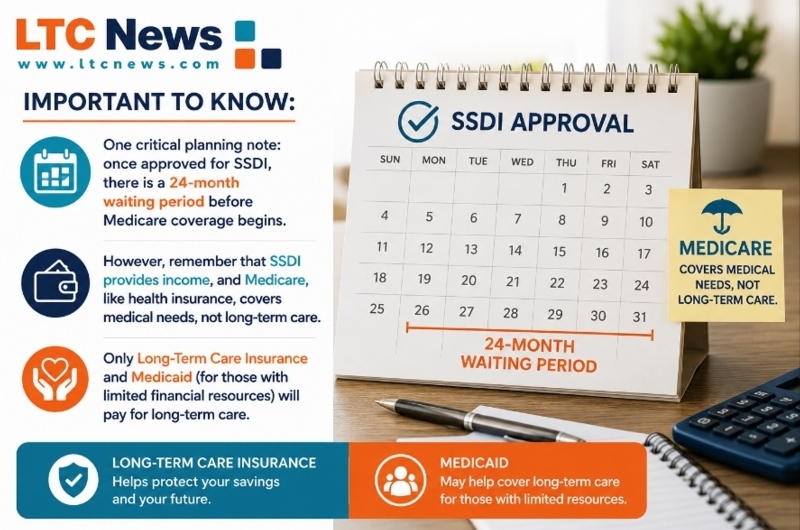
For someone on disability, the ability to obtain Medicare before age 65 is important. However, one critical planning note: once approved for SSDI, there is a 24-month waiting period before Medicare coverage begins. However, remember that SSDI provides income, and Medicare, like health insurance, covers medical needs, not long-term care. Only Long-Term Care Insurance and Medicaid (for those with limited financial resources) will pay for long-term care.
Why Long-Term Care Insurance Is the Most Important Tool in This Plan
Long-Term Care Insurance is designed to pay for care that traditional health insurance and Medicare are not designed to cover. It will help pay for extended in-home care, assisted living, memory care, and nursing facility care. Without coverage, those costs are typically paid out of pocket, which can erode retirement assets quickly and change a spouse's lifestyle, housing choices, and long-term financial security.
LTC News Long-Term Care Insurance Learning Center
For families managing diabetes, the timing of that purchase is everything. Because Long-Term Care Insurance is medically underwritten, applying while diabetes is stable before complications develop (or before you get diagnosed with diabetes) will result in better approval odds and more affordable premiums.
Once neuropathy, retinopathy, or kidney disease is documented, the coverage window closes. Diabetes can be covered by most insurance companies, depending on the A1c level. If complications have already developed, or you need insulin, you have limited, if any, options for Long-Term Care Insurance. It is important to check eligibility with a qualified Long-Term Care Insurance specialist before applying.
How Do You Apply for Long-Term Care Insurance?
"People with diabetes who plan early — before complications appear in their medical records have real options," says Linda Weyer, a LTC Insurance Specialist.
If you wait until after a neuropathy diagnosis or kidney disease diagnosis you will often find those options gone. LTC Insurance is a product you buy when you're healthy enough to qualify, not when you already need it. — Linda Weyer.
For those who do not qualify for traditional LTC Insurance due to existing complications, there may be hybrid LTC policies or short-term cash indemnity policies you might qualify for. Otherwise, Medicaid becomes an option for someone with limited financial resources.
What To Do After a Diabetes Diagnosis
Hearing the words “you have diabetes” can instantly change how you think about your health, future, and independence. You may immediately worry about medications, food restrictions, vision loss, or whether complications could eventually affect your ability to live on your own.
The good news is that many people live long, active, and independent lives with diabetes when they take action early and stay consistent with care.
The first few months after diagnosis are critical. The habits, screenings, and medical support you establish now can help reduce the risk of complications such as neuropathy, kidney disease, heart problems, and diabetic retinopathy later in life.
Diabetes is a disease that affects nearly every organ system in the body if left uncontrolled.
Diabetes is a problem that has many consequences. The disease can lead to serious, even life-threatening problems from your head to your toes. Too much blood sugar can damage the blood vessels and nerves that run throughout your body." — Rita Rastogi Kalyani, MD, MHS, Chief Scientific and Medical Officer, American Diabetes Association; Professor of Medicine, Division of Endocrinology, Diabetes & Metabolism, Johns Hopkins University School of Medicine, "Diabetes: What You Need to Know as You Age."
Build Your Healthcare Team
Diabetes affects nearly every part of the body. Managing it well often requires more than a primary care doctor. Your care team may include:
- An endocrinologist
- A certified diabetes educator
- A registered dietitian
- An eye doctor (ophthalmologist or optometrist)
- A podiatrist for foot care
- A cardiologist if heart disease risks are present
The American Diabetes Association recommends regular monitoring because early damage often develops silently before symptoms appear.
Learn Your Numbers
Understanding your health data helps you stay in control and identify problems early. Important numbers include:
- A1c level
- Daily blood glucose readings
- Blood pressure
- Cholesterol levels
- Kidney function results
- Weight and waist measurement
Your doctor can help establish healthy target ranges based on your age, overall health, and type of diabetes.
Schedule a Comprehensive Eye Exam
Diabetic retinopathy is one of the leading causes of blindness in adults. Vision changes may not appear until damage is already advanced. The Centers for Disease Control and Prevention says diabetes can damage the small blood vessels in the retina, leading to vision loss if untreated.
Protect Your Feet Every Day
Diabetes-related nerve damage can reduce sensation in the feet, making injuries easy to miss.
Inspect your feet daily for:
- Cuts
- Blisters
- Swelling
- Redness
- Skin breakdown
Even small wounds can become serious infections if circulation is poor. Dr. Christina Teimouri, a podiatrist at Beaver Valley Foot Clinic who provides diabetic foot care, tells LTC News that if you notice anything unusual during your daily foot check, seeing a specialist matters more than waiting.
Small changes in skin color, temperature, or sensation are often the earliest signs of a problem. Catching them early is what keeps a minor issue from becoming a serious one." — Dr. Christina Teimouri.
Improve Nutrition Without Extreme Dieting
You do not need a “perfect” diet overnight. Focus on sustainable improvements:
- Reduce sugary drinks
- Limit processed foods
- Increase fiber intake
- Add lean protein
- Watch portion sizes
- Stay hydrated
Many experts recommend gradual changes instead of restrictive crash diets that are difficult to maintain long-term.
Move More Safely and Consistently
Physical activity helps improve insulin sensitivity and blood sugar control.
You do not need intense workouts to benefit. Walking, swimming, resistance training, stretching, and cycling can all help improve:
- Energy
- Balance
- Weight management
- Cardiovascular health
- Mobility as you age
Even short daily walks can make a meaningful difference.
Pay Attention to Mental Health
Diabetes burnout is real. Depression and anxiety are more common in people managing chronic illness.
Talk openly with your doctor if you feel:
- Overwhelmed
- Discouraged
- Exhausted
- Isolated
Support groups, counseling, and diabetes education programs can help you stay motivated and emotionally healthy.
Take It Seriously — But Don’t Panic
A diabetes diagnosis is a wake-up call, not necessarily a crisis. Many complications develop over years, not overnight. The earlier you take diabetes seriously, the more choices you may preserve later in life. Better glucose control, regular screenings, healthier habits, and long-term care planning can help protect your health, finances, and independence for years to come.
If you have a loved one needing in-home care, or long-term care facility care either due to the complications of diabetes or any aging and health need, use the LTC News Caregiver Directory to find qualified care options. If your loved one has an LTC Insurance policy, you will find it easier to find quality care options. Don’t delay in using the benefits from the policy. LTC News partners with Amada Senior Care to provide free claim support with no cost or obligation. Their trained experts can walk you through the entire process and help you access benefits quickly and correctly — File a Long-Term Care Insurance Claim.
If there is no LTC policy, and your loved one has a life insurance policy, you could sell it for cash now to cover the costs of care.
DISCLAIMER: This article is for informational purposes only. Consult your doctor before making health decisions.
Frequently Asked Questions
Can diabetic neuropathy make independent living difficult?
Yes. Advanced diabetic neuropathy can cause numbness, balance problems, muscle weakness, falls, chronic pain, foot ulcers, and amputations. Many people eventually need daily assistance with walking, bathing, dressing, wound care, and household tasks.
Does Medicare cover long-term care for diabetes complications?
No. Medicare primarily covers medical treatment, hospital care, rehabilitation, and short-term skilled nursing care under limited conditions. Medicare generally does not pay for ongoing custodial long-term care such as extended in-home care, assisted living, or help with activities of daily living.
How long after SSDI approval does Medicare begin?
Most people approved for SSDI become eligible for Medicare after a 24-month waiting period. However, Medicare still does not cover most custodial long-term care services.
When should someone with diabetes apply for Long-Term Care Insurance?
Experts recommend applying before serious complications such as neuropathy, kidney disease, retinopathy, or insulin dependence develop. Once complications appear in medical records, eligibility options may become limited or unavailable.
Why does dialysis increase caregiving needs?
Dialysis treatments often require transportation several times per week, strict diet management, medication coordination, fatigue monitoring, and recovery support. Many older adults receiving dialysis eventually require additional help at home or transition into assisted living or skilled nursing care.
Can diabetes qualify someone for Social Security Disability Insurance (SSDI)?
Yes. Diabetes complications such as neuropathy, retinopathy, kidney disease, amputations, or cardiovascular damage may qualify someone for SSDI if those conditions significantly limit the ability to work.
What diabetes complications most often trigger long-term care needs?
The three diabetes complications most commonly associated with long-term care needs are:
- Peripheral neuropathy
- Diabetic retinopathy and vision loss
- Diabetic kidney disease requiring dialysis
These complications can gradually reduce independence and increase caregiving needs over time.
Does Long-Term Care Insurance cover diabetes-related care needs?
Long-Term Care Insurance can help pay for extended in-home care, assisted living, memory care, and nursing home care related to diabetes complications. Coverage eligibility depends on health history and underwriting at the time of application.
Can diabetes lead to long-term care needs?
Yes. Diabetes can lead to serious complications such as peripheral neuropathy, diabetic retinopathy, kidney failure, stroke, amputations, and mobility decline. These conditions may eventually require daily assistance with bathing, dressing, walking, medication management, meal preparation, or supervision.
How does diabetic retinopathy affect daily life?
Diabetic retinopathy can make it difficult to drive, read medication labels, cook safely, manage insulin doses, recognize faces, or navigate stairs and unfamiliar environments. As vision loss progresses, family members often become caregivers.


Sponsored