How Cell Line Development Powers the Life-Saving Biologic Medicines Millions Depend On
About This Article
Many of today's most important medicines begin with a single engineered cell. Cell line development is the process by which scientists create stable, productive cell populations needed to manufacture biologic therapies used to treat cancer, autoimmune diseases, and rare disorders.

Jacob Thomas
Jacob Thomas writes on health, wellness, and retirement topics, including aging, caregiving, insurance, and long-term care.
Table of Contents
- The Biologics Market Continues to Expand
- What Is Cell Line Development?
- From Laboratory Discovery to Patient Treatment
- Why Cell Line Development Matters
- How Cell Line Development Works
- Why CHO Cells Became the Industry Standard
- Industry Experts See Cell Line Development as a Competitive Advantage
- Cell Line Characteristics Directly Shape Drug Quality
- Artificial Intelligence Is Accelerating Development
- Gene Editing Is Creating More Powerful Cell Lines
- Cell Line Development and Personalized Medicine
- The Rise of Biosimilars Is Driving Innovation
- When Manufacturing Challenges Affect Patients
- Why Pharmaceutical Companies Invest Heavily in CLD
- The Growing Role of Specialized Manufacturing Partners
- What Cell Line Development Means for Aging, Chronic Disease, and Long-Term Care
- Regulatory Oversight Remains Extensive
- The Future of Medicine Starts with a Single Cell
If you have ever benefited from a breakthrough cancer treatment, an autoimmune therapy, or a modern biologic medicine, you have likely experienced the results of a process called cell line development.
Most patients never hear about it. Yet long before a biologic drug reaches a hospital, infusion center, or pharmacy, scientists must identify and develop living cells capable of producing the therapy safely, consistently, and at a commercial scale.
Those decisions often determine whether a promising treatment can ultimately reach millions of patients worldwide. As biologic medicines continue to transform health care, cell line development (CLD) has become one of the most important and least visible foundations of modern drug manufacturing.
The Biologics Market Continues to Expand
Biologic medicines have become one of the fastest-growing segments of the pharmaceutical industry. According to the IQVIA Institute for Human Data Science, spending on biologic medicines continues to increase globally as pharmaceutical companies invest heavily in advanced therapies, immunology treatments, and oncology drugs.
Many of the world's top-selling medicines are biologics, including therapies used to treat cancer, inflammatory diseases, and rare genetic conditions. Examples include Keytruda (pembrolizumab), Humira (adalimumab), Herceptin (trastuzumab), and Stelara (ustekinumab).
The growth of these therapies has increased demand for highly efficient manufacturing systems, making cell line development more important than ever.
"Customizable expression systems are the future of bioprocessing, making cell-line development the vital basis of production success." — biotechnology experts wrote in a 2025 special report published by BioProcess International.
The publication noted that advances in artificial intelligence, automation, and cell engineering are helping manufacturers improve both production speed and product quality.
What Is Cell Line Development?
Cell line development is the process of creating, engineering, and selecting cells capable of producing a specific biologic product.
Unlike conventional pharmaceuticals manufactured through chemical synthesis, biologics rely on living cells to produce therapeutic proteins and other complex molecules.
Scientists insert the genetic instructions necessary to create a desired therapy into host cells. Researchers then evaluate thousands of potential candidates to identify those capable of producing large quantities of high-quality product while remaining genetically stable over time.
The selected cells ultimately become the manufacturing engine used throughout the commercial life of the medicine.
From Laboratory Discovery to Patient Treatment
The journey from scientific discovery to patient treatment often spans a decade or longer. Cell line development occurs early in that process, but its impact can last for decades.
A successful cell line may ultimately produce millions of doses administered around the world. Conversely, a poorly performing cell line can create manufacturing bottlenecks, increase costs, and delay patient access to important therapies.
The U.S. Food and Drug Administration (FDA) emphasizes that manufacturing changes should not adversely affect the quality, safety, or effectiveness of biologic products, underscoring the importance of robust manufacturing controls from the earliest stages of development.
Because biologics are produced using living systems, consistency begins with the cells themselves.
Why Cell Line Development Matters
Cell line development influences nearly every aspect of biologic manufacturing. Researchers seek cell lines that deliver high productivity, consistent product quality, genetic stability, reliable scalability, manufacturing efficiency, and regulatory compliance.
The quality of a production cell line can directly affect drug availability, manufacturing costs, commercial scalability, supply chain reliability, and regulatory approval timelines.
Cell line development may occur behind laboratory doors, but it affects every patient who relies on biologic therapies. Better cell lines help manufacturers improve reliability, reduce production risks, and expand access to important medicines. As biologics become increasingly common, the importance of CLD will continue to grow.
How Cell Line Development Works
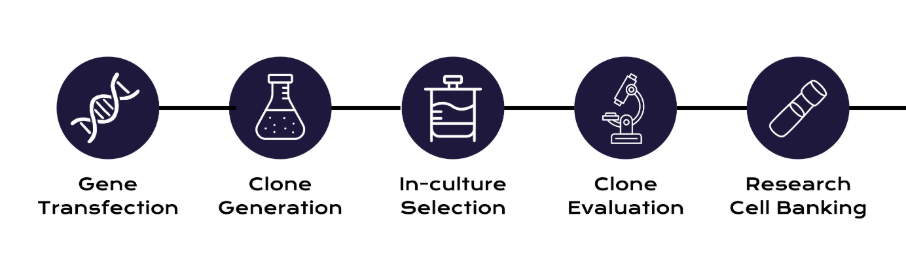
Although specific workflows vary, most CLD programs follow several key steps.
Selecting a Host Cell: Scientists begin by choosing a host cell capable of producing the target protein. Common systems include Chinese hamster ovary (CHO) cells, human embryonic kidney (HEK) cells, hybridoma cells, murine cell lines, and specialized microbial systems.
Modern CHO platforms are often pre-adapted to serum-free suspension culture and chemically defined media, enabling high-density cultivation in industrial bioreactors. These optimized hosts are selected for favorable metabolic characteristics and efficient protein secretion pathways.
Genetic Engineering: Researchers introduce the gene responsible for producing the therapeutic protein. Once integrated, the cell gains the ability to manufacture the desired biologic product. The productivity of a manufacturing process is largely determined by the interaction between the expression vector, genomic integration site, and host cell metabolism. The goal is to ensure sustained transgene expression across extended cell generations while maintaining cellular fitness.
Screening Thousands of Candidates: Following transfection, the central task of cell line development is identifying single-cell clones that combine high productivity with genetic and phenotypic stability. Because random genomic integration produces significant heterogeneity among cells, extensive screening is required to isolate optimal production clones. Modern clone selection workflows rely on high-throughput technologies that enable the evaluation of thousands of individual clones in parallel.
Automated, fluorescence-based screening enables early identification of high-expressing clones while maintaining monoclonality requirements. Productivity measurements are typically combined with growth rate assessment and product quality analysis to ensure selected clones perform well under conditions representative of later bioreactor cultivation.
Researchers analyze protein production, growth characteristics, product quality, metabolic performance, and long-term stability. The objective is to identify clones capable of sustaining stable expression over many population doublings while maintaining consistent product attributes. Platform solutions can shorten cell line development time by up to 30 percent for monoclonal antibodies, enabling a seamless transition from pool-based production to clonal selection in as few as three months.
Stability Testing: Cell lines must maintain their characteristics throughout extended manufacturing campaigns. Instability can lead to reduced yields, product variability, manufacturing failures, and regulatory concerns.
Master Cell Banking: Once an optimal clone is selected, manufacturers establish a master cell bank. These highly controlled frozen repositories provide the source material used throughout a product's commercial life cycle.
Why CHO Cells Became the Industry Standard
Chinese hamster ovary cells remain the dominant host system for many biologic products — particularly monoclonal antibodies and other complex glycoproteins — due to their ability to perform human-compatible post-translational modifications and maintain stable expression during long cultivation periods.
Researchers favor CHO cells because they produce complex proteins efficiently, adapt to large-scale manufacturing, demonstrate strong safety records, and have decades of regulatory acceptance. According to numerous industry analyses, CHO-based platforms are used for many approved recombinant protein therapeutics and monoclonal antibodies.
Industry Experts See Cell Line Development as a Competitive Advantage
As biologic pipelines continue to expand, pharmaceutical companies increasingly view cell line development as a strategic advantage rather than simply a manufacturing step.
"Mammalian cell line development is essential to biologics manufacturing, ensuring stable, high-yield expression of therapeutic proteins," biotechnology experts at Thermo Fisher Scientific's Patheon division noted in a 2025 industry analysis.
The company reported that expanding biologics pipelines are driving continued innovation to improve productivity, scalability, and speed to patients.
Industry leaders continue to invest heavily in automation, data analytics, and advanced cell engineering technologies to shorten development timelines while maintaining quality and regulatory compliance.
Cell Line Characteristics Directly Shape Drug Quality
High-performance production cell lines enable greater manufacturing efficiency by supporting higher titers and more robust upstream processes. Increased productivity reduces bioreactor volume requirements and lowers the cost of goods, particularly important for large-scale commercial biologics.
Quality, however, cannot be sacrificed for yield. The glycosylation profile, aggregation tendency, and other characteristics of recombinant proteins are partially determined by host cell metabolism and intracellular processing pathways. Increasing expression of therapeutic proteins also affects the secretion of other molecules. Optimizing a cell line for the final functionality of the biologic drug is therefore essential, not optional.
Early collaboration between molecular design teams, CLD scientists, and upstream process engineers helps ensure that candidate molecules are compatible with scalable manufacturing platforms. Analytical characterization closely linked to CLD workflows enables early evaluation of product quality attributes associated with different clones — allowing developers to select production cell lines that achieve both high productivity and desirable structural and functional properties.
Artificial Intelligence Is Accelerating Development
Cell line development has historically required significant time and resources. Today, artificial intelligence and machine learning are helping researchers accelerate many aspects of the process.
AI can assist scientists by identifying high-performing clones, predicting manufacturing performance, improving process optimization, and reducing development timelines. Industry experts increasingly view AI as a valuable tool for improving productivity and reducing costs throughout biologics development.
Gene Editing Is Creating More Powerful Cell Lines
Technologies such as CRISPR gene editing allow scientists to make precise modifications that improve cellular performance. Potential benefits include increased productivity, enhanced product quality, improved cell viability, and better manufacturing efficiency. Gene editing is expected to play an increasingly important role as biologic therapies become more sophisticated.
Cell Line Development and Personalized Medicine
The rise of personalized medicine is creating new opportunities and challenges for cell line development. Researchers are increasingly exploring cell therapies, gene therapies, precision oncology treatments, and personalized biologic medicines.
These therapies often require more specialized manufacturing approaches than traditional biologics. As medicine becomes more individualized, CLD strategies must evolve to support increasingly complex treatment platforms.
The Rise of Biosimilars Is Driving Innovation
Biosimilars are highly similar versions of approved biologic medicines whose patents have expired. According to the FDA, biosimilars can increase competition and expand patient access to important therapies.
To compete successfully, manufacturers must develop cell lines capable of producing products that closely match reference biologics in safety, purity, and effectiveness. As the biosimilar market expands globally, demand for advanced CLD technologies continues to grow.
When Manufacturing Challenges Affect Patients
Manufacturing disruptions can have significant consequences. Over the years, the pharmaceutical industry has experienced production interruptions caused by contamination events, facility issues, and manufacturing inefficiencies. When shortages occur, patients may face treatment delays or disruptions.
Quality experts frequently describe biologics manufacturing as a process where consistency is critical. Because biologic medicines are produced using living cells, even small variations can affect production performance, making early cell line selection especially important.
Strong cell line development practices help reduce these risks by establishing stable, reliable production systems that support long-term manufacturing needs. For patients who depend on biologic medicines, consistency in production is more than a business concern. It can directly affect access to treatment.
Why Pharmaceutical Companies Invest Heavily in CLD
Cell line development is both a scientific and business priority. A successful CLD program can accelerate time to market, improve manufacturing efficiency, reduce production costs, support regulatory approval, increase production capacity, and strengthen competitive advantage.
Because biologic development programs often involve investments reaching hundreds of millions of dollars, early decisions regarding cell line selection can have lasting consequences.
The Growing Role of Specialized Manufacturing Partners
The growing role of specialized biologics CDMOs has further accelerated innovation in this area. Many organizations now deploy standardized CHO expression platforms and automated CLD pipelines capable of delivering stable production cell lines within compressed development timelines. These platform approaches improve reproducibility and simplify technology transfer from development to manufacturing.
Leading organizations in this space include Lonza, WuXi Biologics, and Samsung Biologics. These organizations provide expertise, advanced technology platforms, and large-scale manufacturing infrastructure that many emerging biotechnology companies lack internally.
What Cell Line Development Means for Aging, Chronic Disease, and Long-Term Care
The science of cell line development may seem distant from the daily realities of aging, chronic illness, and long-term care. The connection, however, is direct and growing.
Older adults represent the largest and fastest-growing population of biologic medicine users. Many of the conditions that drive long-term care needs — including cancer, rheumatoid arthritis, Alzheimer's disease, diabetes complications, and autoimmune disorders — are treated or managed with biologic therapies. The reliability, availability, and cost of those therapies depend heavily on the quality of the cell lines used to manufacture them.
According to the Alzheimer's Association's 2026 Alzheimer's Disease Facts and Figures report, 7.4 million Americans age 65 and older are currently living with Alzheimer's disease, with that number projected to reach 13.8 million by 2060. Biologic and gene therapy research aimed at slowing or modifying Alzheimer's progression depends on advanced cell line platforms to move candidate treatments from laboratory discovery toward clinical use.
For the roughly 56 percent of Americans turning 65 who will need long-term care at some point — defined as needing help with at least two of six activities of daily living or requiring supervision due to cognitive impairment, according to the U.S. Department of Health and Human Services — biologic medicines are increasingly part of the care equation. Conditions requiring long-term care are often chronic, complex, and managed over years or decades. That underscores the importance of the consistency and affordability of biologic therapies.
Manufacturing efficiency matters here in ways that families and caregivers feel directly. When cell line development produces stable, high-yield production systems, manufacturers can keep pace with demand, reduce production costs, and support broader access to treatment. When manufacturing is inefficient or disrupted, drug shortages follow — and older adults managing multiple chronic conditions are among those most vulnerable to treatment interruptions.
The rise of biosimilars is particularly significant for the long-term care population. As biologic patents expire and biosimilars enter the market, competition can drive down costs and expand access to therapies that might otherwise be financially out of reach for older adults on fixed incomes. Advanced cell line development is the foundation that makes high-quality, cost-competitive biosimilar production possible.
Personalized medicine and cell-based therapies represent the next frontier for aging-related disease. Emerging treatments targeting specific genetic profiles, immune dysfunction, and neurodegeneration will require increasingly sophisticated cell line platforms. For families navigating long-term care planning today, these advances represent a future in which the conditions that most commonly drive care needs may be treated more effectively — and perhaps earlier — than at any previous point in medical history.
Long-term care planning has always required thinking decades ahead. The same is true of the biologic manufacturing science that will power tomorrow's treatments. Cell line development is where that future begins.
Regulatory Oversight Remains Extensive
Because biologic medicines are produced using living systems, regulators maintain rigorous oversight of manufacturing processes. Organizations such as the FDA and the European Medicines Agency (EMA) require extensive documentation related to cell line origin, genetic modifications, stability testing, manufacturing controls, product consistency, and quality assurance. Strong CLD programs help manufacturers meet these requirements while reducing development risks.
The Future of Medicine Starts with a Single Cell
Many of tomorrow's breakthrough therapies will begin with decisions made years before the first patient receives treatment. Cell line development remains one of the most influential aspects of biologic manufacturing. Advances in artificial intelligence, automation, gene editing, and analytical technologies are helping scientists create increasingly productive and reliable cell lines.
As biologics, biosimilars, gene therapies, and personalized medicines continue to expand, the ability to develop stable, scalable production cell lines will remain essential. The next breakthrough treatment for cancer, autoimmune disease, or a rare genetic disorder may ultimately trace its origins to a single engineered cell selected during the earliest stages of development.
Frequently Asked Questions
Why are Chinese hamster ovary (CHO) cells commonly used?
CHO cells have become the industry standard because they can efficiently produce complex proteins, adapt well to large-scale manufacturing and have a long history of regulatory acceptance. Many approved biologic medicines are produced using CHO cell platforms.
How long does it take to develop a production cell line?
Developing a production-ready cell line can take several months to more than a year. Scientists must screen thousands of cell candidates, conduct stability testing and establish master cell banks before commercial manufacturing can begin.
What is a biosimilar?
A biosimilar is a biologic medicine that is highly similar to an existing FDA-approved biologic product whose patent protections have expired. Biosimilars can increase competition and help make important therapies more affordable and accessible.
What diseases are treated with biologic therapies?
Biologics are commonly used to treat:
- Cancer
- Rheumatoid arthritis
- Psoriasis
- Crohn's disease
- Ulcerative colitis
- Multiple sclerosis
- Certain forms of diabetes
- Rare genetic disorders
Researchers are also developing biologic and gene-based therapies for conditions such as Alzheimer's disease.
What are biologic medicines?
Biologic medicines are therapies produced using living cells rather than traditional chemical manufacturing. They include many treatments for cancer, autoimmune diseases, inflammatory disorders, diabetes and certain rare genetic conditions.
Why is cell line development important?
Cell line development influences the quality, safety, consistency, availability and cost of biologic medicines. A successful cell line can help manufacturers produce reliable therapies at scale, while a poorly performing cell line can create production delays and increase costs.
What is personalized medicine, and how does it relate to cell line development?
Personalized medicine uses information about an individual's genetics, biology or disease characteristics to tailor treatment. As personalized therapies become more common, scientists are developing increasingly specialized cell lines to support these advanced treatments.
How does artificial intelligence help cell line development?
Artificial intelligence helps researchers analyze large amounts of data, identify promising cell clones more quickly and optimize manufacturing processes. AI can shorten development timelines and improve production efficiency.
What is cell line development?
Cell line development (CLD) is the process of creating and selecting living cells capable of producing biologic medicines. Scientists engineer cells to manufacture therapeutic proteins and then identify the most productive and genetically stable cell lines for large-scale drug production.
Why should patients care about cell line development?
Most patients never see the science behind their medications, but cell line development plays a critical role in determining whether biologic therapies can be produced safely, consistently and at a scale large enough to reach the people who need them. In many ways, the future of modern medicine begins with a single engineered cell.
What is a master cell bank?
A master cell bank is a carefully preserved collection of validated production cells used as the original source for manufacturing biologic medicines. These cell banks help ensure product consistency over many years of production.
How does cell line development impact older adults and long-term care?
Many older adults rely on biologic medicines to manage cancer, autoimmune diseases and other chronic health conditions. Reliable cell line development helps ensure those therapies remain available, effective and affordable, making it an important part of the future of aging, chronic disease management and long-term care.
Could cell line development help advance treatments for Alzheimer's disease?
Yes. Researchers developing biologics, gene therapies and other advanced treatments for Alzheimer's disease depend on sophisticated cell line platforms to move potential therapies from laboratory research into clinical development and, eventually, patient care.
How does cell line development affect drug costs?
Efficient cell lines can increase manufacturing yields and reduce production expenses. Lower manufacturing costs may help improve access to biologic therapies and support the development of more affordable biosimilars.


Sponsored