Hip Fractures in Long-Term Care: Why the First 48 Hours, Early Mobilization and Rehab Staffing Matter
About This Article
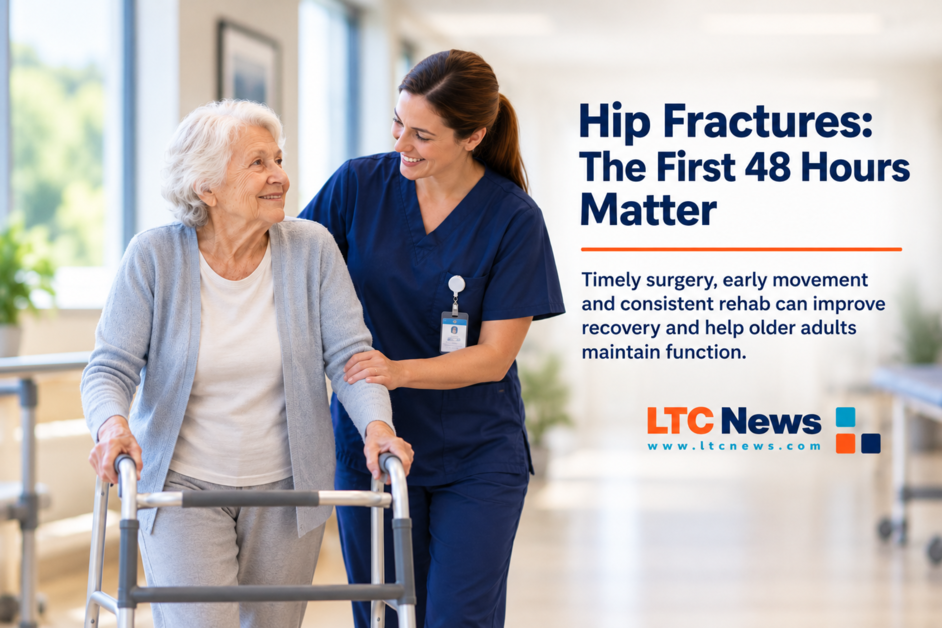
A hip fracture can quickly alter an older adult’s health and independence. Timely surgery, early mobility and consistent rehabilitation can make a critical difference, reducing the need for extended long-term care or improving quality of life for those already living in care settings.

Dr. Adrian Lau
Dr. Adrian Lau is a Specialist Orthopedic Surgeon in Singapore with an interest in primary and complex hip and knee arthroplasty.
For the clinical staff of a long-term care facility, a resident's hip fracture is rarely a single event. It is the start of a chain: an emergency transfer, a hospital stay, a return to the facility with new mobility limits, a surge in nursing hours, a heightened risk of pressure injuries and delirium, and, in a significant share of cases, a decline that ends in death within the year.
The clinical literature has been consistent about that trajectory for decades. What has changed is how much of it is now considered preventable and how much of the outcome is decided in the first two days.
This article outlines what the evidence says about timing, mobilization, and rehabilitation after hip fracture and what it implies for how providers organize care.
Scale of the Problem
More than 300,000 adults aged 65 and older are hospitalized for hip fracture in the United States each year, and more than 95 percent of those fractures are caused by falls, according to the Centers for Disease Control and Prevention. Residents of nursing homes fracture their hips at several times the rate of older adults living in the community because the same factors that bring people into care, including frailty, dementia, osteoporosis, and polypharmacy, are the strongest predictors of falling.
The consequences are severe. A meta-analysis published in the Annals of Internal Medicine found that older adults who fracture a hip face roughly a five- to eightfold increase in all-cause mortality in the first three months, with excess risk persisting for years. Between 20 and 30 percent of patients die within a year of the fracture, and among those who survive, a large proportion never regain their previous level of function.
For a long-term care facility, that translates into higher acuity, longer-term staffing needs, and, in many jurisdictions, quality metrics that move in the wrong direction.
Why the 48-Hour Window Matters
Nearly every hip fracture in an older adult requires hip fracture surgery, either fixation of the bone or replacement of the joint. The question that determines much of the outcome is not which operation but when.
A meta-analysis of more than 190,000 patients, published in PLOS One, found that surgery within 48 hours of admission was associated with a roughly 20 percent reduction in mortality and fewer complications, including pneumonia and pressure injuries, compared with later surgery. Guidance from the National Institute for Health and Care Excellence in the United Kingdom goes further, recommending surgery on the day of admission or the following day.
The reasons are practical. Every hour a frail patient spends immobile with an unstable fracture is an hour of pain, opioid exposure, immobility and confusion.
Delay is not neutral. The fracture itself is fixable. What we are racing against is the deconditioning, the delirium and the chest infection that build while the patient waits. In most cases, the right approach is to optimize the patient quickly and proceed with hip fracture surgery within 48 hours, rather than wait for every parameter to be perfect." — Dr. Adrian Lau, a consultant orthopedic surgeon at Hip & Knee Orthopedics in Singapore, whose practice includes primary and complex hip surgery.
For care providers, the implication is that the facility's own processes matter. Rapid recognition of a fracture, immediate transfer rather than a watch-and-wait approach, and a transfer packet with an accurate medication list, anticoagulant status, advance directives, and baseline function all shorten the time to surgery. Facilities that have a standing relationship with the receiving hospital's orthogeriatric team tend to see faster surgery and fewer avoidable delays.
Mobilization on Day One
The second determinant of outcome is how quickly the patient moves after surgery. Standard practice in well-organized hip fracture programs is for the patient to sit out of bed and begin weight-bearing, with physical therapy support, on the day after surgery or the same day when feasible.
The evidence for this comes from the orthogeriatric care models developed in the United Kingdom, Scandinavia, and Australia, in which surgeons and geriatricians manage the patient jointly, and early mobilization is a protocol requirement rather than a preference.
Early mobilization reduces pressure injuries, venous thromboembolism and pneumonia, shortens hospital stays and improves the chances of the patient returning to their previous residence. It also sets the tone for what follows: a patient who has walked on day one is far more likely to keep walking after transfer back to the facility.
This is where long-term care providers carry more of the outcome than they often realize. A patient discharged on day four or five is still at the very beginning of recovery. Whether the momentum continues depends on what happens on the receiving unit in the first week.
Rehab Staffing Question
Hospital rehabilitation after hip fracture is short by design. The bulk of functional recovery happens in the weeks after discharge, and most of it happens wherever the patient is living. For nursing home residents, that means the facility's physical therapy capacity, its nursing culture around mobility, and its ability to manage pain well enough that residents are willing to move.
The evidence supports a clear position. Structured, progressive rehabilitation after hip fracture, including supervised walking, strength and balance training, improves mobility and functional independence, and the effect is dose-dependent. Programs that offer therapy several times a week for eight to 12 weeks outperform brief or intermittent programs. Residents with cognitive impairment benefit as well, which counters a common assumption that dementia makes rehabilitation futile.
The operational challenge is that therapy minutes are often the first thing squeezed when census rises or staff are short. A practical benchmark is to treat the first six weeks after a hip fracture as a protected rehabilitation period, with a written plan, daily nursing-led mobility targets in addition to therapist sessions, and a weekly review of progress.
Long-term care facilities that build this into their care pathway see fewer readmissions and better retention of function, both of which have direct financial consequences under value-based payment models.
NOTE: Family members can search for quality long-term care faciltiies and caregivers by using the LTC News Caregiver Directory. Search from over 80,000 providers in the United States.
Preventing the Second Fracture
A resident who has broken one hip is at high risk of breaking the other, and the risk is highest in the first year. Secondary prevention is therefore part of the care plan, not an afterthought. It includes an osteoporosis assessment and, where appropriate, treatment; a medication review with particular attention to sedatives, antihypertensives and other drugs that increase fall risk; a vision check; a review of footwear and the physical environment; and a formal falls-prevention program with strength and balance components.
Bone-protective medication after hip fracture is under-prescribed in almost every health system studied, and long-term care residents are among the least likely to receive it. Closing that gap is one of the simplest quality improvements available to a provider.
What Long-Term Care Providers Can Do Now
Four measures stand out. Audit the time from fall to hospital transfer for every fracture in the past 12 months and look for avoidable delays. Establish a transfer packet that gives the receiving surgical team what they need to operate within 48 hours.
Define a protected rehabilitation pathway for the six weeks after discharge, with named responsibility for daily mobility. And make secondary fracture prevention a standard item in every post-fracture care plan.
None of these requires new capital. They require the same thing that surgical teams have learned over 20 years of hip fracture care: treating time as a clinical resource and treating movement as medicine. For providers, the return is measured in residents who walk again and in a fracture that becomes an episode of care rather than the beginning of the end.
About the author: Dr. Adrian Lau is a specialist orthopedic surgeon in Singapore with an interest in primary and complex hip and knee arthroplasty and a writer for LTC News.
Sources
Centers for Disease Control and Prevention, Hip Fractures Among Older Adults; Haentjens P. et al. (2010), "Meta-analysis: excess mortality after hip fracture among older women and men," Annals of Internal Medicine, 152(6), pp. 380–390; Moja L. et al. (2012), "Timing matters in hip fracture surgery: patients operated within 48 hours have better outcomes. A meta-analysis and meta-regression of over 190,000 patients," PLOS One, 7(10), e46175; National Institute for Health and Care Excellence (2011, updated 2023), Hip fracture: management, Clinical guideline CG124.
NOTE: Long-Term Care facilities can claim their free listing on the LTC News Caregiver Directory and/or upgrade the listing to enhance visibility and highlight your staff and services through the LTC News Directory Business Portal.
Frequently Asked Questions
How important is rehabilitation after a hip fracture?
Rehabilitation is a major part of recovery. Structured physical therapy that includes supervised walking, strength training, and balance exercises can help improve mobility and functional independence. Recovery often continues for weeks after the patient leaves the hospital, making rehabilitation especially important for residents returning to a long-term care facility.
Can someone with dementia benefit from rehabilitation after a hip fracture?
Yes. Cognitive impairment does not automatically mean rehabilitation will be ineffective. Residents with dementia can benefit from rehabilitation, although their program may need to be adapted to their cognitive abilities, physical condition, and individual care needs.
Why are hip fractures so serious for older adults?
Hip fractures can have consequences that extend well beyond the broken bone. Older adults may experience pain, loss of mobility, delirium, pressure injuries, pneumonia, and other complications. Many never fully regain their previous level of independence, and the risk of death is substantially higher following a hip fracture.
Can another hip fracture be prevented?
Not every fracture can be prevented, but steps can be taken to reduce the risk. After a hip fracture, the care plan should consider osteoporosis assessment and treatment when appropriate, medication review, vision, footwear, environmental hazards, and strength and balance activities designed to reduce falls.
Why are the first 48 hours after a hip fracture important?
Research has associated hip fracture surgery within 48 hours of hospital admission with lower mortality and fewer complications compared with delayed surgery. For long-term care residents, quickly recognizing a possible fracture and arranging hospital transfer can help avoid unnecessary delays.
What should long-term care providers do when a resident may have fractured a hip?
Prompt recognition and transfer are important. Providers should also send accurate information about the resident's medications, anticoagulant use, advance directives, and baseline function so the hospital team has the information needed to evaluate and treat the resident without avoidable delays.
What can long-term care facilities do after a resident returns from the hospital?
Facilities can establish a structured rehabilitation plan, set daily mobility goals, manage pain appropriately, and regularly review the resident's progress. The article recommends treating the first six weeks after discharge as a protected rehabilitation period with clearly assigned responsibility for mobility and recovery.
How soon should an older adult begin moving after hip fracture surgery?
In well-organized hip fracture programs, patients generally begin getting out of bed and weight-bearing with physical therapy support on the day after surgery, or sometimes the same day when medically appropriate. Early mobilization can help reduce complications associated with prolonged immobility and support functional recovery.

Sponsored