Have Health Issues or Been Declined for Long-Term Care Insurance? You Still Have Options
About This Article
Health problems or a previous LTC Insurance decline doesn't necessarily mean you can't obtain long-term care coverage. Short-term care insurance, hybrid life policies, and annuities with qualified long-term care riders offer alternatives, including options with much easier or guaranteed approval.

James Kelly
LTC News staff writer specializing in long-term care and aging.
Table of Contents
- Why Can You Be Declined for Long-Term Care Insurance if You Feel Healthy?
- How Many Long-Term Care Insurance Applicants Are Declined?
- Why Doesn't Medicare Pay for Most Long-Term Care?
- Hybrid Annuities With Qualified Long-Term Care Riders
- How Do You Choose the Right Long-Term Care Insurance Option?
- Can You Get Long-Term Care Insurance Through Your Employer?
You may feel healthy, stay active, and take your medications as prescribed. Yet when you apply for Long-Term Care Insurance, you may find that a medical condition or even a medication you consider minor makes it more difficult to qualify for coverage than expected. You may have already been told you do not qualify for an LTC Insurance policy or had an insurance company decline your application. If so, other options may still be available.
Learn More: How Does Long-Term Care Insurance Work?
You want long-term care coverage because you understand that, as you age, you will eventually need assistance with everyday activities or face the risk of cognitive decline, including dementia. You also recognize that the rising cost of long-term care services can significantly impact your income and assets, potentially placing a financial, physical, and emotional burden on the people you love. Having coverage in place helps protect your financial security while providing greater choice and independence when care is needed in the future.
However, as we get older, most of us develop a few health concerns along the way. After age 40, conversations with friends and family often shift from hobbies and vacations to medications, doctor visits, and health conditions. You may have type 2 diabetes, a history of heart disease, or have undergone surgery several years ago. You may have assumed you have missed your chance to plan for the future. However, that may not be the case. Don't assume you are out of options.
Experts tell LTC News that traditional LTC Insurance remains an excellent choice for many Americans, particularly those who apply in their 40s or 50s, even into their early to mid-60s. However, traditional policies are not the only way to prepare for the physical, emotional, and financial consequences of needing extended care at some point in your lifetime.
Short-term care insurance, hybrid life policies, and annuities with qualified long-term care riders may provide meaningful protection for people who have difficulty qualifying for traditional coverage. Most insurance agents and financial advisors don't have access to all these solutions, but most Long-Term Care Insurance specialists do, and they play an important role.
Learn More: What is a Long-Term Care Insurance Specialist?
Some LTC Insurance products have more flexible underwriting requirements. One annuity-based solution even offers guaranteed approval for its long-term care rider, provided the applicant meets the company's financial suitability requirements.
Knowing the differences can help you make informed decisions before a health crisis limits your choices.
Why Can You Be Declined for Long-Term Care Insurance if You Feel Healthy?
Insurance companies evaluate more than how you feel today. They review your medical history and assess the likelihood that you will need extended care in the future above the averages. Every insurer has its own underwriting guidelines. A condition that results in a decline from one company might be acceptable to another.
Depending on the company and product, underwriting may consider your age, medical conditions, prescription medications, height and weight, tobacco use, family medical history, mobility, and cognitive health. Recent surgeries, hospitalizations, and ongoing treatments can also affect eligibility. Some insurers request medical records, conduct telephone interviews, or require cognitive assessments. Others use simplified applications with fewer health questions.
Consider someone with well-controlled type 2 diabetes. One company might approve coverage, while another could decline the application because of additional risk factors. The same differences can occur with heart disease, previous cancer treatment, or orthopedic conditions.
The good news here is that a decline from one insurance company does not automatically mean every insurer will turn you down. An experienced independent LTC Insurance specialist can review your medical history before you submit an application and identify companies with more favorable underwriting guidelines.
Learn More: How to Apply for Long-Term Care Insurance
How Many Long-Term Care Insurance Applicants Are Declined?
Your likelihood of being declined for traditional LTC Insurance coverage generally increases with age. The 2025 Milliman Long Term Care Insurance Survey, published by Broker World reported the following decline rates based on 2024 industry experience:
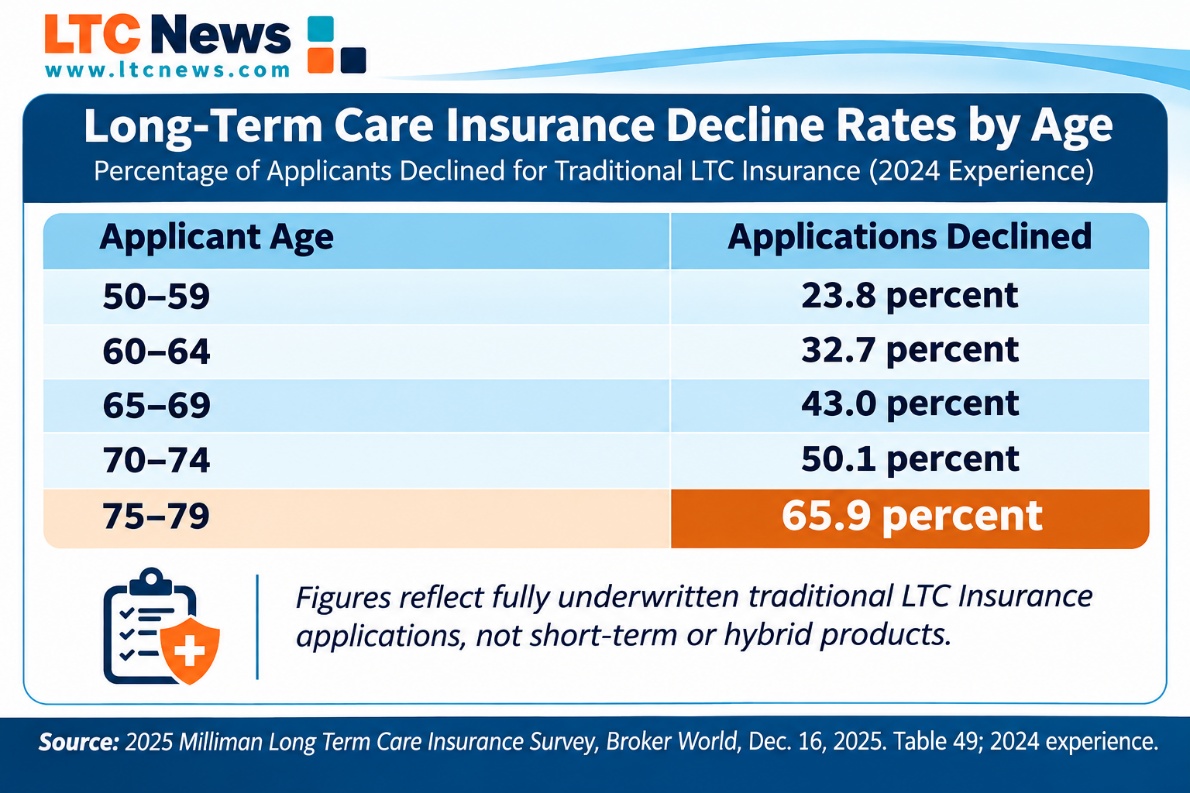
These figures reflect applications for fully underwritten, stand-alone traditional LTC Insurance policies, not simplified-underwriting short-term care plans or hybrid life and annuity products. The survey also includes a separate adjusted 2024 column reflecting a product with more generous underwriting, so the results should not be interpreted as universal approval probabilities. The statistics also do not account for people screened out before submitting a formal application.
Waiting until your 70s means higher premiums, fewer insurance choices, and a greater likelihood of being declined.
Why Doesn't Medicare Pay for Most Long-Term Care?
The simple answer is that Medicare was never designed to be a long-term care program. When Medicare was created in 1965, its primary purpose was to help older Americans pay for medical care, such as hospital stays, physician services, rehabilitation, and treatment for illness. It was not designed to pay for ongoing assistance with everyday activities like bathing, dressing, eating, or supervision due to cognitive impairment.
So even if you have excellent health insurance, Medicare, and a Medicare Supplement policy, Medicare is not the solution. The key difference is skilled medical services and custodial care. Medicare does not pay for ongoing custodial long-term care.
If you have questionable health or have been declined for an LTC policy, you might think you can rely on Medicare. Medicare is not an option because it only pays for short-term skilled care.
Learn More: Does Health Insurance, Medicare, or Medicaid Pay for Long-Term Care?
Here is the difference. Custodial care includes help with everyday activities such as bathing, dressing, toileting, eating, transferring, and maintaining continence. Custodial long-term care can also involve supervision for someone with Alzheimer's disease or another form of dementia who cannot safely remain alone. However, this is mostly, if not all, custodial care and is not covered by health insurance, including Medicare and supplements.
Under qualifying circumstances, Medicare Part A may cover up to 100 days of skilled nursing facility care during a benefit period. Coverage requires medically necessary skilled services and other eligibility conditions. The 100 days are a maximum, not a guarantee.
Medicare Supplement Insurance helps pay certain Medicare-covered expenses. It does not provide coverage for ongoing custodial care.
Learn More: Review Medicare's Long-Term Care Coverage
Medicaid usually isn't an answer either. It should never be your 'goal' unless you have limited income and assets. Medicaid will cover long-term care for individuals who meet financial and functional eligibility requirements. However, eligibility rules and available services vary by state.
Learn More: Medicaid's Long-Term Care Coverage
Without private LTC Insurance, you must rely on retirement income, savings, and unpaid help from relatives.
What Long-Term Care Insurance Options Are Available if You Have Health Problems?
There are several ways to obtain insurance benefits for future extended care. Each has different underwriting requirements, benefit structures, and costs.
- Traditional Long-Term Care Insurance
Traditional LTC Insurance is designed specifically to pay for qualifying extended care. Depending on the policy, benefits may cover professional home care, adult day care, assisted living, memory care, and nursing home services. Policies offer inflation protection; many offer shared benefits for couples, and others let you customize coverage.
Traditional LTC Insurance often provides substantial long-term care benefits relative to the premium, especially when purchased at younger ages. However, medical underwriting can be extensive. Premiums on many traditional policies may also increase in the future, subject to regulatory approval. However, rate stability rules make that much less likely for policies sold today.
For applicants who qualify medically, traditional coverage is often the first option worth considering.
- Short-Term Care Insurance
The biggest benefit with short-term care insurance is the relaxed underwriting. Often, this is an option if you have been told your pre-existing health conditions prevent you from getting coverage or if you have already been declined.
The “short-term” in short-term care insurance refers to the length of time benefits are paid, not necessarily how long those benefits may help cover extended care needs. These policies typically provide cash benefits based on a person's need for care and generally pay the full approved benefit regardless of the actual cost of services. This flexibility allows policyholders to use the funds in the way that best meets their needs.
Depending on the insurance company and the options selected, benefits may be paid for several months, one year, or up to two years. Coverage may include nursing home care, rehabilitation facilities, assisted living, or home care, although not every policy covers every setting.
Short-term policies often use simplified underwriting, making them worth considering for applicants who cannot qualify for traditional coverage. For example, a policy paying $400 per day for 360 covered days could provide up to $144,000 in benefits, assuming the full daily benefit is payable and all policy conditions are met. Adding in-home care will add additional dollars. Most of these policies include a restoration of benefits provision that restores the benefit if you recover and go 180 days without requiring care. Always check the policy for details.
That amount could cover years of care, depending on your costs and how the money is used. While it may not cover every cost you or a loved one may incur, it will reduce the amount withdrawn from savings or retirement accounts. Some short-term policies can also pay benefits during periods when Medicare covers qualifying skilled care, depending on the contract's coordination provisions.
Consumers should review benefit triggers, exclusions, elimination periods, and tax treatment carefully. Short-term care policies do not necessarily receive the same federal tax deduction treatment as tax-qualified LTC Insurance.
- Hybrid Life Insurance With Long-Term Care Benefits
Hybrid long-term care policies combine life insurance with benefits that can help pay for qualifying extended care. Some policies accelerate the death benefit to pay for care. Others provide additional long-term care benefits beyond the original death benefit, extending the period of protection.
These policies offer guaranteed premiums, some offer cash indemnity benefits, and a death benefit for beneficiaries if long-term care is not needed. However, not every life insurance rider that provides money when someone becomes chronically ill is Long-Term Care Insurance.
👉A federally tax-qualified long-term care rider under Section 7702B of the Internal Revenue Code is different from a chronic illness accelerated death benefit rider under Section 101(g).
A Section 101(g) rider on a life insurance policy may provide access to a portion of the life insurance death benefit following a qualifying chronic illness, but it is not itself tax-qualified Long-Term Care Insurance and should not be represented as equivalent LTC Insurance coverage. The distinction matters because the tax treatment, benefit triggers, payment methods, available benefits, and consumer protections differ. Some of these chronic illness riders are paid for when you need long-term care, thus reducing the available benefit even more.
Confirm that the policy includes a genuine Section 7702B qualified long-term care rider, rather than assuming any chronic illness benefit provides equivalent protection.
Hybrid life insurance can appeal to people who want protection against future care expenses while retaining a life insurance benefit. Medical underwriting still applies to most hybrid policies, although some companies offer simplified underwriting or more flexible eligibility standards.
Hybrid Annuities With Qualified Long-Term Care Riders
Annuities with qualified long-term care riders offer another approach, particularly for people who have accumulated retirement assets but struggle to qualify for traditional LTC Insurance.
These single-premium products immediately turn into an extended pool of tax-free long-term care benefits. Products such as EquiTrust Bridge and OneAmerica Annuity Care are two well-known examples that offer federally tax-qualified long-term care insurance benefits under Section 7702B of the Internal Revenue Code.
These are not simply annuities that waive surrender charges when someone enters a nursing home. Nor would you want to annuitize the policy, since you buy it to obtain the guaranteed tax-free long-term care benefit.
Their qualified LTC riders provide insurance benefits intended to help pay for covered long-term care services. Depending on the product, those benefits may extend beyond the annuity's accumulated value. Qualified LTC rider benefits are received income-tax-free, subject to federal requirements and applicable limits.
Some products offer simplified underwriting, while others require more health screening. For people with existing nonqualified annuities, a properly structured Section 1035 exchange may allow funds to be transferred into an annuity with qualified LTC benefits without recognizing taxable gain at the time of the exchange.
Consumers should compare the available benefit pool, inflation options, surrender charges, rider costs, underwriting requirements, and whether benefits continue after the annuity value is exhausted.
Can You Get Guaranteed Approval for Long-Term Care Benefits With an LTC Annuity?
Yes. One company has a fixed indexed annuity with a federally tax-qualified long-term care rider under Section 7702B, but unlike traditional LTC Insurance, which requires medical underwriting, the product offers guaranteed approval for its long-term care rider when the annuity purchase meets the company's suitability requirements. The initial long-term care benefit amount is based on underwriting.
Some hybrid solutions allow you to reposition existing assets into federally tax-qualified long-term care protection. You could use qualified funds (like those in a 401(k) or IRA) to fund a hybrid policy, including annuity policies that offer more lenient underwriting. Ask a qualified Long-Term Care Insurance specialist about companies that offer that option and whether it's appropriate for you.
What Should You Do if You've Already Been Declined for Long-Term Care Insurance?
If an insurance company declines your Long-Term Care Insurance application, don't assume the decision is final. Your first step should be to understand exactly why they declined you. Another insurer may evaluate a previous cancer diagnosis, medication history, or recent surgery differently. A specialist familiar with multiple companies' underwriting requirements can determine whether another traditional policy, short-term care plan, hybrid life policy, or annuity-based solution is worth considering.
👉 Be cautious about submitting applications without first reviewing your complete medical history with a qualified specialist who represents the top insurance companies offering long-term care solutions. Some insurance agents and financial advisors ask few health questions. Plus, if you have been declined for Long-Term Care Insurance, most insurance companies will require you to disclose that information.
If you get declined for LTC insurance, you should receive a written notice explaining the decision or how to obtain more detailed information about the underwriting findings. Review that information carefully with your insurance agent to determine whether the company relied on accurate and complete medical records.
Medical records sometimes contain outdated diagnoses, incorrect information, or notes that don't accurately reflect your current health. In other cases, an underwriter may need additional information from your physician to better understand a medical condition.
An appeal may be appropriate if the decision was based on inaccurate, incomplete, or outdated information. Your agent can help determine whether additional medical documentation could make a difference.
Working with an experienced Long-Term Care Insurance specialist is especially valuable at this stage. A specialist familiar with the underwriting guidelines of multiple companies understands when an appeal has a reasonable chance of success and when pursuing one would simply waste your time.
Not every decline can or should be appealed. If the medical information is accurate and the insurance company's decision is consistent with its underwriting guidelines, the next step is to explore alternatives.
Different insurers evaluate health conditions differently. Depending on your medical history, age, and state of residence, you may still qualify for another traditional LTC policy, a hybrid product, or short-term care coverage.
If you already need substantial assistance with daily activities or have significant cognitive impairment, your options may be more limited. For some individuals, setting aside dedicated assets and creating a family care plan may be more realistic than purchasing insurance. Always discuss this in detail with a specialist, not a general insurance agent or financial advisor.
How Do You Choose the Right Long-Term Care Insurance Option?
The right Long-Term Care Insurance policy depends on several factors, including your age, health, financial resources, family circumstances, and preferences for future care. Because no single insurance company fits everyone, working with an independent Long-Term Care Insurance specialist who represents multiple carriers can help you compare options and identify the coverage best suited to your situation.
Be cautious if an insurance agent or financial advisor asks few, if any, questions about your health history, medications, family medical history, lifestyle, or financial goals. These factors play a significant role in determining eligibility and identifying the most appropriate coverage. A knowledgeable specialist should take the time to understand your unique circumstances before making recommendations.
Remember that while insurance companies must file their products and rates with state insurance departments, each carrier has its own underwriting guidelines. As a result, two companies may evaluate the same health condition very differently. An applicant declined by one insurer may still qualify with another, making access to multiple carriers and underwriting expertise especially valuable when shopping for coverage.
Can You Get Long-Term Care Insurance Through Your Employer?
Yes, but your options are limited. A few employers offer group or worksite Long-Term Care Insurance, sometimes with reduced underwriting or even guaranteed issue during an initial enrollment window. That means you may qualify with fewer health questions, or none at all.
The trade-off is real. Easier approval usually comes at a price. Employer plans tend to be expensive for the coverage you get, limited in benefits, or both. Some offer small monthly benefit amounts or short benefit periods that may cover only a fraction of what care costs where you live. Others pair long-term care benefits with life insurance in ways that make the true long-term care value hard to judge.
Read the fine print, too. Ask whether premiums can rise, whether you can keep the coverage if you leave your job or retire and whether benefits grow with inflation.
If you’re healthy, you may find stronger coverage at a better price through an individual LTC policy. If health issues make individual coverage hard to get, an employer plan may still be worth a look. Either way, talk with a qualified Long-Term Care Insurance specialist before you enroll. A specialist can compare the employer offer side by side with individual options from multiple insurers and help you decide which one truly fits your needs and budget.
A Long-Term Care Insurance Decline Doesn't Have to Be the End of Your Planning
Being declined for Long-Term Care Insurance doesn't necessarily mean the end of the road. Even if one insurance company has turned you down because of your health, other options may still be available. Remember, every insurance company has its own underwriting guidelines. Some are more flexible with certain medical conditions than others. Depending on your age, health history, and state of residence, you may qualify for a different type of coverage, including a traditional LTC policy, a hybrid policy, or a short-term care insurance plan.
Availability varies by state and insurance company, which is why working with an experienced Long-Term Care Insurance specialist matters. A specialist who understands the underwriting requirements of multiple insurers can often identify realistic options quickly, potentially saving you time and avoiding unnecessary applications.
You may not qualify for the coverage you originally wanted, but that doesn't mean you should give up. Even a policy with more limited benefits could help pay for quality care, protect some of your savings, and reduce the burden on your family.
Some coverage is usually better than no coverage at all, provided the benefits are meaningful, and the premiums fit your budget. Before accepting a decline as your final answer, explore your options with a qualified specialist. You may have more choices than you realize.
👉 If you are already helping a loved one who needs care, the LTC News Caregiver Directory offers access to more than 80,000 care providers, including home care agencies, assisted living communities, memory care facilities, and nursing homes.
Your health may limit your insurance choices, but it doesn't always eliminate them. The sooner you explore what's available, the more opportunities you may have to protect your savings and spare your family some of the responsibilities of caregiving. If you are declined, review other available options without delay.
Frequently Asked Questions
Can I use money from an IRA or 401(k) to purchase long-term care protection?
Certain linked-benefit products allow eligible qualified retirement assets to help fund coverage. However, distributions from an IRA or 401(k) may create taxable income. Annuities funded with nonqualified money may also qualify for a tax-free Section 1035 exchange into an eligible contract with long-term care benefits. The funding method and tax consequences should be reviewed before making a decision.
What is the difference between short-term care insurance and traditional LTC Insurance?
Traditional LTC Insurance generally offers longer benefit periods and more extensive coverage options. Short-term care insurance typically provides benefits for several months to two years and often has less restrictive underwriting. Some short-term policies pay cash benefits that can help with care expenses, but coverage and tax treatment vary by contract.
Is there Long-Term Care Insurance available without medical underwriting?
Yes. Certain annuities with federally tax-qualified long-term care riders offer guaranteed approval when financial suitability and other contract requirements are satisfied. Other products use simplified underwriting. Guaranteed approval for coverage does not guarantee payment of a future claim, which must meet the policy's benefit requirements.
Should I work with a specialist if I have health problems or have been declined?
Yes. An independent Long-Term Care Insurance specialist familiar with multiple insurers can review your medical history, identify realistic coverage options and determine whether appealing a previous decline makes sense. The goal is to find meaningful protection that fits your health, financial circumstances and state of residence.
Can I get Long-Term Care Insurance if I have health problems?
Yes, depending on your medical history. Insurance companies have different underwriting guidelines, so a condition that prevents approval with one insurer may be acceptable to another. Short-term care insurance and certain hybrid life and annuity products may also offer more flexible eligibility requirements.
If I've already been declined for Long-Term Care Insurance, can I apply again?
Yes. A decline from one company does not automatically disqualify you from coverage elsewhere. First, review the reason for the decline with an experienced LTC Insurance specialist. If the insurer relied on inaccurate or outdated medical information, an appeal may be appropriate. Otherwise, another insurer or type of policy may be available.
Will Medicare pay for long-term care if I cannot qualify for insurance?
No. Medicare does not cover ongoing custodial long-term care. Under qualifying circumstances, it may cover up to 100 days of skilled nursing facility care per benefit period. Medicaid may help eligible individuals with limited financial resources, but it has separate financial and functional eligibility requirements.
What percentage of Long-Term Care Insurance applicants are declined?
According to the 2025 Milliman Long Term Care Insurance Survey, 23.8 percent of applicants ages 50–59 and 43 percent of those ages 65–69 were declined. Among applicants ages 75–79, the decline rate reached 65.9 percent. These figures reflect fully underwritten traditional LTC policies, not short-term or hybrid products.
Are hybrid life insurance and annuities with long-term care riders tax-qualified?
Many are, but not all riders are equivalent. Federally tax-qualified long-term care riders under Section 7702B generally provide income-tax-free benefits, subject to applicable rules and limits. A Section 101(g) chronic illness rider on a life insurance policy is different and should not be confused with tax-qualified LTC Insurance.


Sponsored