Dizziness After 50: Warning Signs, Fall Risk, and Loss of Independence
About This Article
Dizziness after 50 isn’t normal. Discover the causes—from vision problems to medications—spot the warning signs and understand how balance issues increase fall risk and can lead to long-term care and loss of independence.

Linda Maxwell
Linda Maxwell is a journalist who writes about aging, health, chronic illness, caregiving, and long-term care issues impacting older adults and their families.
Table of Contents
- Why Dizziness Becomes More Common as You Age
- The Real Risk: Falls, Injury, and Loss of Independence
- Common Causes of Dizziness in Older Adults
- Why Your Vision Plays a Critical Role in Balance
- When to Consider a Vision Evaluation
- Is the Cause BVD?
- When Dizziness Is a Medical Emergency
- How to Reduce Your Fall Risk Starting Today
- Why This Matters for Long-Term Care Planning
- Next Steps: Take Action Before It Becomes a Crisis
- Common Medications that Can Cause Dizziness and Increase Fall Risk After 50
- Key Takeaways for Staying Independent
You stand up, and suddenly the room feels off. Not spinning—but not steady either. You pause, wait a moment, and tell yourself it’s just part of getting older.
It’s not.
Dizziness and imbalance are among the most overlooked warning signs in adults over 50. What seems minor can quietly increase your risk of falls, injury, and even the need for long-term care.
Have you started changing your daily routine because you don’t feel as steady as you once did? Understanding why this happens—and what you can do about it—can help protect your health, independence, and financial future.
Why Dizziness Becomes More Common as You Age
Your ability to stay balanced depends on a complex system working together. Your brain continuously processes signals from your inner ear, your eyes, and your muscles and joints to keep you upright and steady.
As you age, these systems don’t respond as efficiently. When more than one begins to decline at the same time, your brain has a harder time compensating, which can leave you feeling unsteady or unsure of your footing.
You may notice:
- Feeling off-balance walking down stairs
- Needing to pause before moving
- Feeling fatigued after standing or walking
- Experiencing a general sense of unsteadiness
You might even begin avoiding activities you once enjoyed—not because you want to, but because you no longer feel safe.
The Real Risk: Falls, Injury, and Loss of Independence
Dizziness is not just uncomfortable—it can be dangerous. Even occasional imbalance can increase your risk of falling, especially when combined with other age-related changes, such as slower reaction time or reduced strength. And the risk increases quickly when more than one factor is involved.
The Centers for Disease Control and Prevention reports that falls are the leading cause of injury-related death and need for long-term care among adults age 65 and older.
Even one fall can trigger serious consequences:
- Hip fractures or head injuries
- Hospitalization and long recovery periods
- Loss of mobility
- Reduced ability to perform daily activities
- Increased reliance on family or professional caregivers
For many people, a fall becomes the turning point that leads to the need for in-home care, assisted living, or nursing home care. What would happen if a single fall changed your ability to live independently?
Common Causes of Dizziness in Older Adults
Dizziness is often caused by multiple factors—not just one. In many cases, several underlying issues interact, making symptoms more difficult to pinpoint without a thorough medical evaluation.
Dizziness in older adults is a serious symptom that should always be evaluated due to its strong association with fall risk.
Older adults with even non-bothersome dizzy spells should make an appointment with their GP to enable early diagnosis and treatment to prevent falling. — Dr. Toby Ellmers, research fellow in the Department of Brain Sciences at Imperial College London.
Understanding these common causes can help you and your doctor identify what may be contributing to your symptoms:
Inner Ear and Balance Disorders
Conditions like benign paroxysmal positional vertigo (BPPV) can cause sudden spinning or imbalance.
Medication Side Effects and Polypharmacy
Sedatives, antidepressants, and blood pressure medications can affect balance—especially when multiple drugs are used together.
Blood Pressure Changes
Orthostatic hypotension—a drop in blood pressure when standing—can reduce blood flow to the brain and cause dizziness.
Dehydration
A reduced sense of thirst can lead to dehydration, lowering blood volume, and increasing the risk of lightheadedness.
Chronic Health Conditions
Conditions such as diabetes, anemia, and heart disease can impair circulation and energy levels.
Peripheral Neuropathy
Often linked to diabetes, nerve damage in the feet reduces your ability to sense the ground beneath you.
Muscle Weakness and Deconditioning
Loss of strength and coordination can make balance more difficult and increase fall risk over time.
Neurological Conditions
Diseases like Parkinson’s or early cognitive decline can interfere with coordination and spatial awareness.
Why Your Vision Plays a Critical Role in Balance
Your eyes do more than help you see—they help you stay upright and oriented. Vision provides constant feedback that helps your brain understand where you are in relation to your surroundings.
When visual input becomes less reliable, your balance system has to work harder to compensate. This is why many people feel more unsteady in low light or unfamiliar environments.
You may notice:
- Increased instability in dim lighting
- Difficulty navigating crowded or visually complex spaces
- Trouble adjusting focus between near and far distances
In some cases, visual coordination issues—such as binocular vision dysfunction—may contribute to dizziness. While less common than vestibular or cardiovascular causes, vision problems can worsen symptoms when combined with other age-related changes.
When to Consider a Vision Evaluation
Vision is often overlooked during initial evaluations, especially when symptoms are vague or intermittent. However, when dizziness continues despite addressing more common causes, your visual system may be contributing to the problem.
You should consider discussing vision as part of your evaluation if you experience:
- Eye strain or headaches after reading
- Difficulty shifting focus between distances
- Sensitivity in busy environments like grocery stores or shopping centers
- Persistent dizziness despite treatment
Is the Cause BVD?
In older patients who report symptoms of reading difficulty, eyestrain, motion sensitivity, or discomfort in busy complex, visually stimulating environments, it can be helpful to ask whether a more specialized test for BVD might help rule out overlooked visual mismatch and BVD. Appropriate screening can identify whether subtle visual misalignment issues are impacting stability.
Binocular Vision Dysfunction (BVD) is a condition in which your eyes do not align and work together as they should. Even if your vision seems clear during a standard eye exam, subtle misalignment between the eyes can force your brain to constantly adjust to keep images single and in focus. Over time, this extra effort can strain the visual system and affect how your brain processes spatial awareness and balance.
Because your vision plays a key role in helping you stay oriented, even small disruptions in eye coordination can lead to symptoms beyond simple eye strain. People with BVD may experience dizziness, headaches, difficulty focusing, or a sense of imbalance—especially in visually busy environments like grocery stores or crowded spaces. These symptoms can feel similar to inner ear or neurological issues, which is one reason BVD is often overlooked or misdiagnosed.
For older adults, BVD can be particularly important to consider as part of a broader evaluation of dizziness and fall risk. As the body’s balance systems naturally become less efficient with age, the brain relies more heavily on visual input. If that input is inconsistent, it can contribute to unsteadiness and increase the likelihood of falls. While BVD is not among the most common causes of dizziness, it can be a contributing factor, especially when symptoms persist despite treatment of more typical conditions.
Diagnosis typically requires a more specialized eye examination that evaluates how well the eyes work together, not just how clearly you can see. When identified, treatment often involves prism lenses—specialized glasses designed to correct alignment and reduce strain on the visual system. For some people, addressing BVD can lead to meaningful improvements in comfort, balance, and confidence in daily activities.
A comprehensive eye exam can help determine whether visual factors are playing a role in your symptoms.
When Dizziness Is a Medical Emergency
Not all dizziness is harmless. In some cases, it can signal a serious medical event that requires immediate attention. Seek emergency care right away if dizziness appears suddenly and is accompanied by:
- Slurred speech
- Sudden weakness or numbness
- Chest pain
- Loss of consciousness
- Confusion
- Sudden vision loss or double vision
These symptoms may indicate a stroke or cardiovascular emergency.
Use the FAST test:
- Face drooping
- Arm weakness
- Speech difficulty
- Time to call 911
Do not wait or try to “sleep it off.” Acting quickly can save your life.
How to Reduce Your Fall Risk Starting Today
While you work with your doctor to identify the cause, you can take immediate steps to protect yourself at home. Small adjustments in your daily habits and environment can significantly reduce your risk of falling and help you feel more confident moving around.
These practical changes can make a meaningful difference:
- Review medications with your physician
- Stay hydrated throughout the day
- Improve lighting in hallways and bathrooms
- Remove loose rugs and clutter
- Wear supportive, non-slip footwear
- Install grab bars and handrails
These steps are simple, but they can dramatically reduce your risk of a serious injury.
Why This Matters for Long-Term Care Planning
Dizziness is often an early warning sign of declining physical function. What begins as occasional imbalance can progress into difficulty performing everyday tasks if left unaddressed. It often happens gradually—until one day it no longer feels manageable. That’s often when families are forced to make fast decisions without a plan.
If balance problems worsen, you may eventually need help with the activities of daily living. Many families don’t think about long-term care until a fall or health crisis forces urgent decisions. By then, options may be limited, more stressful, and significantly more expensive.
Medicare only covers up to 100 days of skilled care following a qualifying hospital stay and does not pay for ongoing custodial long-term care. That means extended care costs are typically paid out of pocket unless you now.
Long-Term Care Insurance can help:
- Pay for in-home care services
- Protect your income and assets
- Reduce the burden on your family
- Give you control over where and how you receive care
You can explore current extended care costs using the LTC News Cost of Long-Term Care Services Calculator and learn more about long-term care planning by exploring the LTC News Long-Term Care Insurance Learning Center.
Next Steps: Take Action Before It Becomes a Crisis
If you’re experiencing dizziness—even occasionally—don’t ignore it. Early action can help prevent a small issue from becoming a life-changing event.
Start here:
- Schedule a medical evaluation
- Review medications and underlying conditions
- Discuss balance and fall risk openly
- Consider a vision assessment if symptoms persist
- Improve safety conditions in your home
The best time to plan is before a health event forces decisions on you and your family.
Common Medications that Can Cause Dizziness and Increase Fall Risk After 50
| Medication Category | Examples (Generic & Brand) | How They Cause Dizziness |
| Blood Pressure Medications | Lisinopril (Privinil), Losartan (Cozaar), Metoprolol (Lopressor), Hydroclorothiazide (Microzide). | Lower blood pressure too much, especially when standing (orthostatic hypotension) |
| Sedatives & Sleep Aids | Zolpidem (Ambien), Eszopiclone (Lunesta) | Slow brain activity, reduce alertness, and impair balance |
| Anti-Anxiety Medications | Diazepam (Valium), Alprazolam (Xanax) | Depress the central nervous system, causing sedation and impaired coordination |
| Antidepressants | Sertraline (Zoloft), Venlafaxine (Effexor), Amitriptyline (Elavil) | Affect brain chemistry and may alter blood pressure, alertness, or coordination |
| Diabetes Medications | Insulin, Glimepiride (Amaryl) | Can cause low blood sugar (hypoglycemia), leading to dizziness and weakness |
| Heart Medications | Amiodarone (Cordarone), Nitroglycerin (Nitrostat) | Affect heart rate and blood flow to the brain, which can cause lightheadedness |
| Pain Medications | Oxycodone (OxyContin), Cyclobenzaprine (Flexeril) | Depress the central nervous system or relax muscles, leading to sedation and imbalance |
| Antihistamines | Diphenhydramine (Benadryl) | Cause drowsiness and slower reaction time, increasing fall risk |
| Neurological Medications | Levodopa (Sinemet), Gabapentin (Neurontin) | Affect nerve signaling and coordination, which may lead to dizziness or unsteadiness |
Key Takeaways for Staying Independent
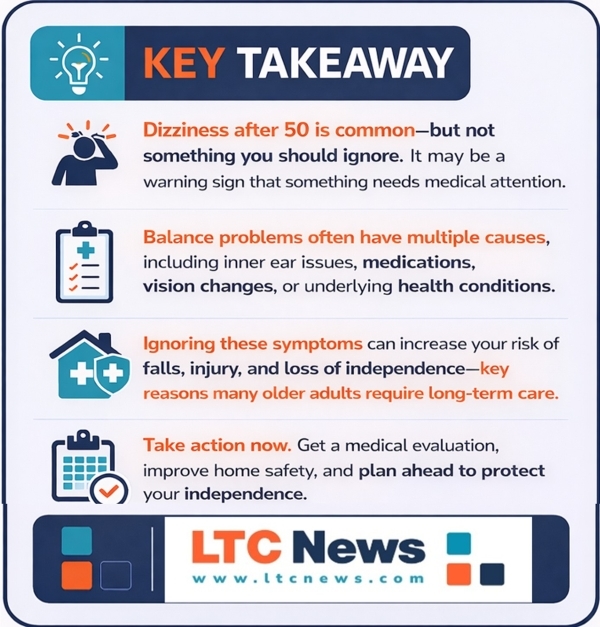
Dizziness may be common as you age—but it is not normal. It’s often your body’s way of signaling that something needs attention. Addressing the cause early can help you stay active, avoid injury, and maintain your independence. Ignoring it could cost you your independence.
Being proactive about your health, including vision and dizziness, will improve your quality of life.
This article is for informational purposes only and should not replace professional medical advice. Always consult your healthcare provider regarding symptoms or treatment decisions.
Frequently Asked Questions
Can vision problems cause dizziness or balance issues?
Yes. Vision plays a key role in maintaining balance. Changes in eyesight or visual coordination can make you feel unsteady, especially in low light or crowded environments. An eye exam may be helpful if other causes have been ruled out.
How can you reduce your risk of falling at home?
You can lower your fall risk by:
- Improving lighting throughout your home
- Removing loose rugs and clutter
- Wearing supportive shoes
- Installing grab bars and handrails
- Keeping frequently used items within reach
These simple steps can significantly improve safety.
How does dizziness increase the risk of falls?
Dizziness affects your ability to stay balanced and react quickly. This increases the likelihood of slips, trips, and falls—especially in older adults. Falls are a leading cause of injury and loss of independence in people over 65.
When should dizziness be considered serious?
Dizziness should be treated as a medical emergency if it comes on suddenly and is accompanied by:
- Slurred speech
- Weakness or numbness
- Chest pain
- Confusion
- Vision loss
- Loss of consciousness
These symptoms may indicate a stroke or heart-related event and require immediate attention.
Does Medicare cover care related to falls or long-term care?
Medicare may cover short-term skilled care—up to 100 days after a qualifying hospital stay—but it does not pay for ongoing long-term care or assistance with daily living. Planning ahead is important to avoid unexpected costs.
What should you do if you feel dizzy frequently?
If you experience ongoing dizziness:
- Schedule a medical evaluation
- Review your medications
- Stay hydrated
- Check your vision
- Improve safety in your home
Early action can prevent more serious problems later.
Can dizziness lead to long-term care needs?
Yes. Ongoing balance problems can lead to falls, injuries, and difficulty performing everyday activities like bathing, dressing, or walking. These challenges are common reasons older adults require long-term care services at home or in a facility.
What causes dizziness in older adults?
Dizziness in older adults is often caused by multiple factors working together, including:
- Inner ear disorders like vertigo
- Medication side effects or interactions
- Low blood pressure when standing
- Dehydration
- Chronic conditions such as diabetes or heart disease
- Vision changes that affect balance
A medical evaluation is important to identify the exact cause.
Is dizziness after 50 a normal part of aging?
No. While dizziness becomes more common as you age, it is not considered normal and should not be ignored. It can be a warning sign of underlying issues such as inner ear problems, medication side effects, blood pressure changes, or other health conditions.
How can you plan ahead to protect your independence?
Planning ahead helps you stay in control of your future. Options like Long-Term Care Insurance can provide access to in-home care, protect your savings, and reduce the burden on your family if you need extended care later in life.

Sponsored