Central Sensitization and Aging: When Chronic Pain Threatens Independence
About This Article
Central sensitization refers to heightened responsiveness in the central nervous system that amplifies how the body processes pain. Chronic pain, injuries, and agerelated health conditions can all contribute to ongoing pain and disability. In some cases, pain continues even after an injury has healed.

Linda Maxwell
Linda Maxwell is a journalist who writes about aging, health, chronic illness, caregiving, and long-term care issues impacting older adults and their families.
Table of Contents
- What Happens When the Nervous System Turns Up the Pain?
- Why Aging Can Make Chronic Pain More Complicated
- Why a Car Accident Can Hurt Long After the Crash
- Absence of Injury on Imaging Doesn't Mean Absence of Pain
- A Fall Can Start a Cycle That Threatens Independence
- Chronic Health Problems Can Keep Pain Going
- Can Doctors Diagnose Central Sensitization?
- Can Chronic Pain and Pain Hypersensitivity Be Treated?
- Start by Treating the Underlying Problem
- Movement and Physical Therapy Can Protect Function
- Medication Can Help, but Age Matters
- Pain Therapy Doesn't Mean the Pain Is Imaginary
- Better Sleep Can Be Part of Pain Treatment
- Does Treatment Work?
- When Chronic Pain Becomes a Long-Term Care Issue
- Chronic Pain Can Affect Your Family, Too
- Where LTC Insurance Fits
- Know What Long-Term Care Costs Before You Need It
- Chronic Pain and LTC Insurance Underwriting?
If you're in your 50s or 60s, you've probably discovered that your body doesn't always bounce back from an injury the way it once did.
Maybe your back still reminds you of a car accident years ago. Arthritis makes your knees hurt when you get out of a chair. A fall that initially seemed minor leaves you hesitant on the stairs. An injury from an accident or surgery heals, but the pain never completely goes away.
Usually, pain has a recognizable purpose. You injure something, nerves send warning signals to your brain, you protect the injured area, and eventually you heal. However, it doesn't always work that way.
Chronic pain can be much more complicated. Researchers have spent years studying how the nervous system processes persistent pain and why some people become unusually sensitive to painful and even normally nonpainful stimulation.
One term you may hear is central sensitization.
Understanding the concept can be useful, particularly as you age. But it also requires some scientific caution. Researchers still debate how to identify central sensitization in humans and whether it can be described as a cause of chronic pain.
What isn't debatable is the effect chronic pain can have on your life.
If pain makes it difficult to walk, exercise, sleep, get out of a chair, or safely use the bathroom, the consequences extend beyond discomfort. Over time, declining mobility and function can threaten your independence and, in some cases, contribute to a need for long-term care.
What Happens When the Nervous System Turns Up the Pain?
Central sensitization is a neurophysiological concept describing increased responsiveness of neurons in the central nervous system. In simpler terms, think of your nervous system as having a volume control for incoming signals.
After an injury, turning up the volume can be useful. Your body is warning you to protect something that has been damaged. Normally, that response diminishes as you recover. Researchers studying sensitization are interested in what happens when pain processing remains unusually responsive.
Two terms commonly encountered in discussions of pain hypersensitivity are:
- Hyperalgesia: An increased response to something that is normally painful.
- Allodynia: Pain resulting from stimulation that normally would not provoke pain.
Researchers also study phenomena such as temporal summation, in which repeated painful stimulation is perceived as increasingly painful. Experiencing these symptoms does not by itself prove that you have central sensitization. That distinction has become increasingly important.
Why Aging Can Make Chronic Pain More Complicated
Getting older doesn't automatically mean living in pain. Still, aging changes several biological systems involved in pain, healing and physical function.
Mario García-Domínguez reviewed these issues in Frontiers in Aging in 2024. The review discusses age-related mechanisms involving the nervous system, inflammatory processes, immune activity and other biological changes that may contribute to chronic pain in older adults.
At the same time, you're more likely to accumulate health conditions capable of producing pain as you get older.
These can include:
- Osteoarthritis
- Degenerative spine disease
- Spinal stenosis
- Peripheral neuropathy
- Diabetes-related nerve damage
- Previous fractures
- Joint replacements and other surgeries
- Chronic neck and back disorders
- Inflammatory diseases
- Cancer and some cancer treatments
You may also have more than one source of pain. Pain rarely exists in isolation in an older adult. Muscle loss, arthritis, balance problems, neuropathy, cardiovascular disease, diabetes, or other chronic conditions can make recovering from an injury more difficult.
Eventually, the question becomes bigger than, "Why does this hurt?"
A more important question may be, "What is this pain preventing me from doing?"
Why a Car Accident Can Hurt Long After the Crash
A car accident provides a good example of how acute pain can become persistent. Imagine being rear-ended and experiencing a whiplash injury. Initially, the pain may come from injured muscles, joints, ligaments, or other structures in your neck and upper back.
Most people improve. Some continue experiencing pain long after the initial injury. A systematic review published in the European Journal of Pain examined research involving adults with chronic complaints following whiplash trauma. Researchers reported findings including persistent pain, local and widespread hyperalgesia, referred pain, allodynia, and enhanced temporal summation.
The authors interpreted the literature available at the time as supporting a role for central sensitization in chronic whiplash. However, they also said the underlying mechanisms remained unclear and called for better research and standardized definitions.
The newer 2024 Velasco review raises important questions about interpreting pain hypersensitivity as proof that central sensitization itself has been demonstrated in humans.
The safest conclusion is simpler: some people experience persistent and widespread pain hypersensitivity following whiplash, but scientists are still working to determine precisely which neurological mechanisms explain it.
Pain lasting longer than three months, or longer than the expected healing time, is classified as chronic. That threshold is not arbitrary. It marks the point at which pain stops tracking tissue repair and starts behaving as a condition in its own right.
Persistent, ongoing pain changes the nervous system. It becomes over-sensitised and responds to lower pain thresholds." — Bart Morlion, M.D., Ph. D, former President of the European Pain Federation (EFIC) and Director, Leuven Centre for Algology & Pain Management, University Hospitals Leuven.
Absence of Injury on Imaging Doesn't Mean Absence of Pain
Modern pain science shows that people can experience significant, disabling pain even when Xrays, MRIs or CT scans fail to reveal structural damage, or that damage has healed, imaging is clear, and the pain continues. Pain is a complex biological, neurological and immunedriven process, and imaging captures only a fraction of what contributes to how the body generates and maintains pain.
Recent studies highlight several mechanisms that help explain why pain can persist without visible injury. Research published in The Journal of Pain in August 2026 notes that patients can have normal imaging findings while still showing abnormal nociceptive biology, meaning the nervous system may amplify pain signals even when tissues appear healthy. The authors emphasize that diagnostic approaches must account for biological changes beyond what imaging can detect.
Other 2026 research shows that spontaneous pain can arise from abnormal activity in sensory neurons, even when those neurons are not visibly injured. A July 2026 study using invivo calcium imaging found that nearly half of the dorsal root ganglion neurons generating spontaneous pain activity came from spared, uninjured nerves. These neurons produced painrelated signals despite showing no response to mechanical or thermal stimuli, underscoring how pain can originate from functional changes rather than structural damage.
When an injury heals, but pain continues, doctors increasingly recognize that the problem often lies in the nervous system rather than the tissue itself. Conditions such as central sensitization, nerve dysfunction, and lingering inflammation can keep pain signals active long after imaging shows everything has “returned to normal.” But in personal injury claims, that distinction rarely works in a patient’s favor.
Matthew A. Rabin, Partner and Managing Attorney at RTRLAW, Massachusetts personal injury lawyers, says that insurance companies are trained to equate a clean scan with the absence of injury. Adjusters rely heavily on objective findings like fractures, tears, swelling, or structural damage. When those markers disappear, they often argue the injury has resolved. Persistent pain without visible damage is frequently labeled “subjective,” even when it is medically welldocumented and consistent with known pain mechanisms.
As a result, someone having ongoing pain following the healing of an accident can face an uphill battle. Insurers may question symptom severity, reduce benefits, or deny coverage outright, citing normal Xrays or MRIs as proof that nothing is wrong. This approach overlooks decades of research showing that chronic pain can stem from nerve changes, altered pain processing, or functional loss that imaging cannot detect.
Because a contemporaneous account of what a person could do before and cannot do now carries more weight than any single test result, personal injury lawyers build these claims from treatment notes, medication history, and specific losses in daily activity rather than waiting for an image that was never going to show the mechanism." — Matthew A. Rabin.
For attorneys and clinicians, the most effective response is documentation. A detailed record of how the injury affects daily life, comparing what the person could do before and what they cannot do now, carries more weight than repeated scans. Treatment notes, medication history, physical therapy records and specific examples of lost function create a timeline that imaging alone cannot provide.
In practice, the absence of findings on imaging does not mean the absence of pain. It simply means the source of the pain is not visible on a scan. And in the insurance world, that makes thorough, consistent documentation essential for proving what the images cannot show.
A Fall Can Start a Cycle That Threatens Independence
Falls become increasingly consequential as you age. Suppose you are 72 and fall, fracturing your hip. Surgeons repair the fracture successfully. But surgery may only be the beginning of your recovery.
Pain makes you reluctant to walk. Less activity contributes to muscle weakness. Weakness makes walking harder. You become afraid of falling again, so you stop using the stairs and avoid going outside.
Your muscles weaken further. Balance declines. Eventually, the fracture may heal medically while your function remains substantially worse than before the fall.
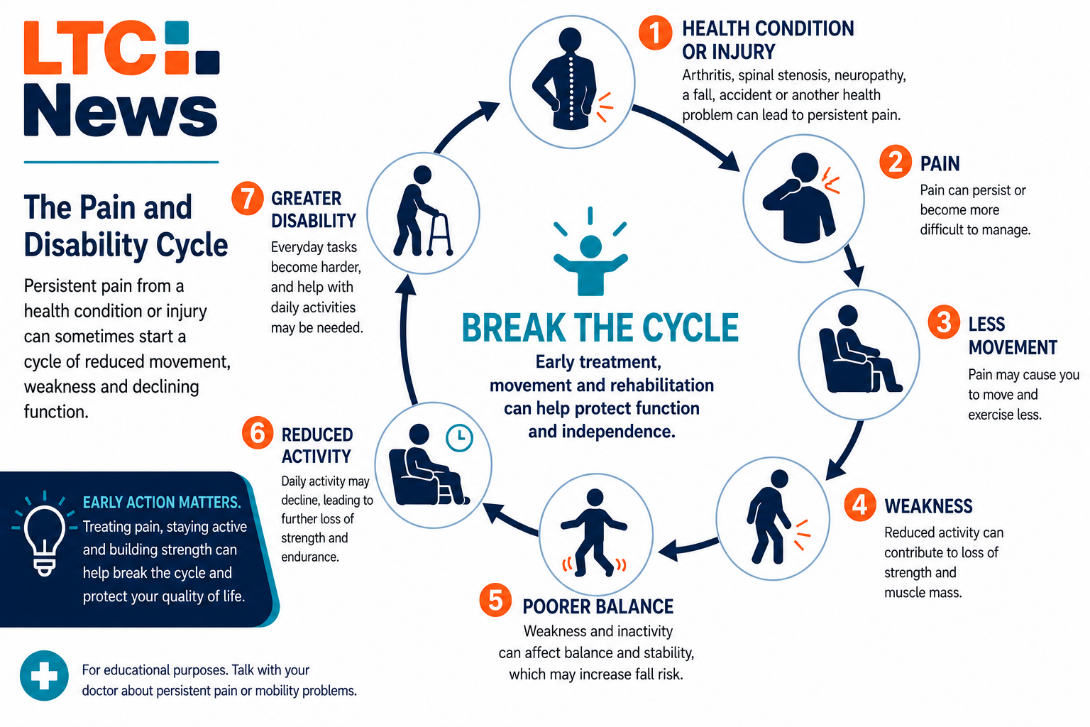
Central sensitization doesn't have to be present for that cycle to occur. Persistent pain, however, can make the cycle harder to break. That's one reason rehabilitation after an accident, surgery, or fall becomes particularly important as you get older.
Chronic Health Problems Can Keep Pain Going
You don't need an accident to develop chronic pain. Someone with severe osteoarthritis may receive painful signals from a knee for years. Spinal stenosis can produce persistent back or leg symptoms. Diabetic neuropathy can cause burning, tingling, and nerve pain. Inflammatory diseases can produce recurring painful episodes.
Multiple conditions can exist simultaneously. In some cases, treating an obvious structural problem doesn't eliminate all of the pain.
A knee may have been replaced.
A fracture may have healed.
A damaged muscle may have recovered.
Yet pain persists.
When you are older, general health and aging can complicate everything. Persistent pain is real, even when imaging doesn't completely explain its severity. At the same time, unexplained pain shouldn't automatically be attributed to sensitization. New or worsening symptoms deserve medical evaluation.
Can Doctors Diagnose Central Sensitization?
No routine blood test, X-ray, or MRI definitively diagnoses central sensitization in a person with chronic pain. Evaluation typically starts with a medical history and physical examination.
Depending on your symptoms, your physician may also investigate neurological, orthopedic, rheumatological or other possible causes. Doctors sometimes use questionnaires such as the Central Sensitization Inventory as part of an assessment. However, questionnaires shouldn't be confused with direct measurement of the neurological phenomenon itself.
The 2024 Velasco review specifically warns against making that leap. Getting the right diagnosis matters more than getting a particular label.
Can Chronic Pain and Pain Hypersensitivity Be Treated?
No single treatment switches central sensitization off, and treatment depends heavily on what is causing or contributing to your pain. The larger objective is often to reduce pain while restoring function.
Daniel J. Clauw, M.D., Professor of Anesthesiology, Medicine, and Psychiatry and Director of the Chronic Pain and Fatigue Research Center at the University of Michigan, focuses on improving function, but not on pain intensity or level. Clauw says the goal is to improve someone's pain so they can play nine holes of golf or pick up their grandchild.
Start by Treating the Underlying Problem
Doctors first identify treatable causes whenever possible. Depending on the diagnosis, treatment may involve:
- Medication
- Physical therapy
- Occupational therapy
- Treatment of inflammation
- Injections or other interventions
- Management of neuropathy
- Joint or spine treatment
- Surgery in appropriate cases
Pain hypersensitivity shouldn't become a reason to stop looking for an underlying medical problem.
Movement and Physical Therapy Can Protect Function
Physical therapy can be particularly important for older adults. The goal isn't simply to "push through" pain. A carefully designed program may gradually improve:
- Strength
- Balance
- Flexibility
- Endurance
- Walking
- Range of motion
- Confidence in movement
For someone in their 60s, 70s or 80s, those improvements can be critical to remaining independent.
Medication Can Help, but Age Matters
Depending on the condition, physicians may use medications that affect pain processing. Examples can include duloxetine, pregabalin, gabapentin, and certain other antidepressant or anticonvulsant medications.
No medication is appropriate for everyone.
Older adults require particular caution because medications can interact with existing prescriptions or contribute to dizziness, sedation, confusion and falls. Kidney and liver function may also affect how medications are prescribed and dosed.
Your doctor should therefore individualize medication.
Pain Therapy Doesn't Mean the Pain Is Imaginary
Cognitive behavioral therapy, or CBT, can be another component of chronic pain treatment. Using CBT doesn't mean a physician thinks your pain is imaginary. The approach can help you manage fear of movement, avoidance behaviors, stress, and other factors that can contribute to disability.
Pain education may similarly help you understand that experiencing some discomfort during carefully supervised rehabilitation doesn't necessarily mean you are damaging your body.
Better Sleep Can Be Part of Pain Treatment
Chronic pain can disrupt sleep. Poor sleep can, in turn, make pain more difficult to manage. Identifying insomnia, sleep apnea, or other sleep disorders may therefore be an important part of a broader treatment plan.
Does Treatment Work?
Treatment can help many people, but success shouldn't always mean becoming completely pain-free. For someone with longstanding chronic pain, meaningful improvement might mean:
- Walking farther
- Sleeping better
- Getting out of a chair without assistance
- Returning to hobbies
- Exercising again
- Experiencing fewer severe pain episodes
- Taking less pain medication
- Becoming less afraid of movement
- Remaining independent
Age doesn't eliminate your ability to improve. It can make rehabilitation more complicated. If you're 75 and simultaneously dealing with arthritis, neuropathy, heart disease, diabetes and balance problems, your rehabilitation plan will probably look different from that of an otherwise healthy 35-year-old recovering from the same injury.
Treatment addresses the whole person, not just pain.
When Chronic Pain Becomes a Long-Term Care Issue
Chronic pain becomes particularly important from an aging and long-term care perspective when it starts interfering with everyday activities. You may first notice difficulty with instrumental activities of daily living, such as:
- Shopping
- Cooking
- Housekeeping
- Driving
- Managing medications
More serious functional impairment can eventually affect the basic activities of daily living:
- Bathing
- Dressing
- Toileting
- Transferring in and out of a bed or chair
- Eating
- Maintaining continence
Imagine chronic back and leg pain becoming so severe that you can't stand safely in the shower. Putting on socks becomes difficult. Getting off the toilet requires assistance. You need help getting out of bed. Walking across the house requires a walker and someone nearby to prevent a fall.
At that point, pain has become much more than a medical symptom.
You have a long-term care need.
Chronic Pain Can Affect Your Family, Too
Family members frequently provide the first layer of help when someone starts losing independence. Millions of loved ones become unpaid caregivers in the absence of an advance plan like Long-Term Care Insurance.
Pain-related disability can gradually pull a family member into that role.
Your daughter may initially drive you to physical therapy. Later, she gets your groceries. Then she starts doing the laundry. Eventually, she's helping you get dressed or take a shower. Then it becomes too overwhelming, professional caregivers come in, and the money flies out the door because Medicare doesn't cover this type of care.
Long-term care needs don't always arrive suddenly. They often develop one task at a time.
Where LTC Insurance Fits
Long-Term Care Insurance doesn't pay for treatment of central sensitization, arthritis, or chronic back pain. LTC Insurance helps pay for qualifying long-term care when you or a loved one meets the policy's benefit requirements.
Depending on the policy, benefits can help pay for care at:
- Home
- Adult day care
- Assisted living
- Memory care
- Nursing homes
Health insurance helps pay to treat your medical problem. LTC Insurance helps pay for qualifying care when a health problem has impaired your ability to function independently.
LTC Insurance is medically underwritten, so planning generally needs to occur before serious health or functional problems develop. LTC news research shows that most people acquire an LTC policy between the ages of 47 and 67.
Know What Long-Term Care Costs Before You Need It
If chronic pain or another health problem eventually affects your independence, the cost of care will depend heavily on where you live and how much assistance you require.
A few hours of home care each week costs very differently than daily home care, assisted living, or 24-hour nursing care. If you need care because of an injury or accident, an attorney may help you recover the cost. However, if your pain came from a health or aging issue, you will pay for these ongoing costs unless you had LTC Insurance already in place.
Use the LTC News Cost of Care Calculator to see current and projected long-term care costs where you live. If you're already helping a parent or spouse find care, the LTC News Caregiver Directory can help you locate care providers and senior communities. Families with an existing LTC Insurance policy can also get free LTC Insurance claims assistance from LTC News to help navigate the claims process.
Chronic Pain and LTC Insurance Underwriting?
LTC Insurance is medically underwritten. Insurers typically consider your diagnoses, medications, treatment history, mobility, use of assistive devices, and ability to perform everyday activities.
If you are considering Long-Term Care Insurance, be sure to seek help from a qualified Long-Term Care Insurance specialist. In most cases, this will not be someone at a financial advisor or a general insurance agency. Be sure this "specialist" works with all the major insurance companies and has helped hundreds or more people obtain an LTC policy.
Your health can change at any time; an accident or fall can happen without notice. Planning before significant age, health, or functional problems develop can preserve more coverage options, ensuring you have access to quality extended care in the future, safeguarding income and assets, and easing the burden on those you love.
Frequently Asked Questions
Can central sensitization be seen on an MRI?
A routine MRI, X-ray, or blood test doesn't diagnose central sensitization.
Imaging can help identify other causes of pain, including joint damage, fractures, spinal problems, and other structural abnormalities.
Does central sensitization cause chronic pain?
It hasn't been proven. A 2024 review in Neuroscience & Biobehavioral Reviews found that none of the studies examined met the authors' criteria for demonstrating that central sensitization causes chronic pain.
That doesn't prove central sensitization has no role in chronic pain. It means the available evidence hasn't demonstrated the causal relationship.
Can a fall lead to chronic pain?
Yes. A fall can cause fractures, joint injuries, back problems, nerve injuries, and other conditions that result in persistent pain. For older adults, the consequences can extend beyond the original injury. Pain can reduce physical activity, contributing to weakness and balance problems that make mobility harder and may increase the risk of another fall.
What is central sensitization in simple terms?
Central sensitization describes increased responsiveness of neurons within the central nervous system. Some describe it as the nervous system's pain "volume" becoming unusually high. However, scientists continue to debate how central sensitization can be demonstrated in humans and exactly what role it plays in chronic pain.
Does central sensitization get worse as you age?
Not necessarily. Aging itself doesn't mean someone will develop central sensitization. However, older adults are more likely to have multiple chronic conditions, previous injuries, arthritis, neuropathy, and other sources of persistent pain. Age-related changes in the nervous and immune systems may also influence pain processing.
Can a car accident trigger chronic pain?
Yes. Injuries sustained in car accidents can result in persistent pain in some people. Research involving chronic whiplash has identified pain hypersensitivity and other altered pain responses. However, those findings shouldn't automatically be interpreted as proof that central sensitization is causing an individual's chronic pain.
Is central sensitization a real medical phenomenon?
Central sensitization is an established neurophysiological concept involving increased responsiveness of neurons in the central nervous system. The scientific controversy involves how it is identified in humans with chronic pain and whether researchers can establish that it causes particular chronic pain conditions.


Sponsored