Cataracts and Aging: What Older Adults and Their Families Should Know

About This Article
A cataract develops when the eye’s clear lens becomes cloudy as its proteins change with age. The National Eye Institute says more than half of Americans 80 and older either have cataracts or have had them removed.

Linda Maxwell
Linda Maxwell is a journalist who writes about aging, health, chronic illness, caregiving, and long-term care issues impacting older adults and their families.
Table of Contents
- What Causes Cataracts
- How Vision Loss Affects Independence
- Vision Loss and Fall Risk
- Traditional Surgery vs. Laser-Assisted Surgery
- How Laser-Assisted Cataract Surgery Works
- Choosing an Intraocular Lens
- What Cataract Surgery Costs
- Signs You May Have Cataracts
- When Is It Time to Consider Surgery
- Recovery: What to Expect
- Understanding the Risks
- Can Cataracts Be Prevented
- Talking With Your Doctor
- How Caregivers and Long-Term Care Providers Help Protect Vision
- Protecting Your Vision Protects Your Independence
You reach for your glasses, clean them, and put them back on, but the room still looks hazy. Colors seem duller than you remember. Night driving has started to feel like a hazard course of glare and starbursts. If this sounds familiar, you are likely not imagining it, and you are not alone.
Maybe it is not you noticing these changes at all. Maybe it is your mother squinting at the TV from across the room, or your father, who has quietly stopped driving after dark. You might be wondering if this is aging or something more.
Whether you are the one reaching for the glasses or the one watching a parent struggle to read the mail, what you are noticing is often the same thing: the slow, physical change of a cataract forming in the lens of the eye.
What Causes Cataracts
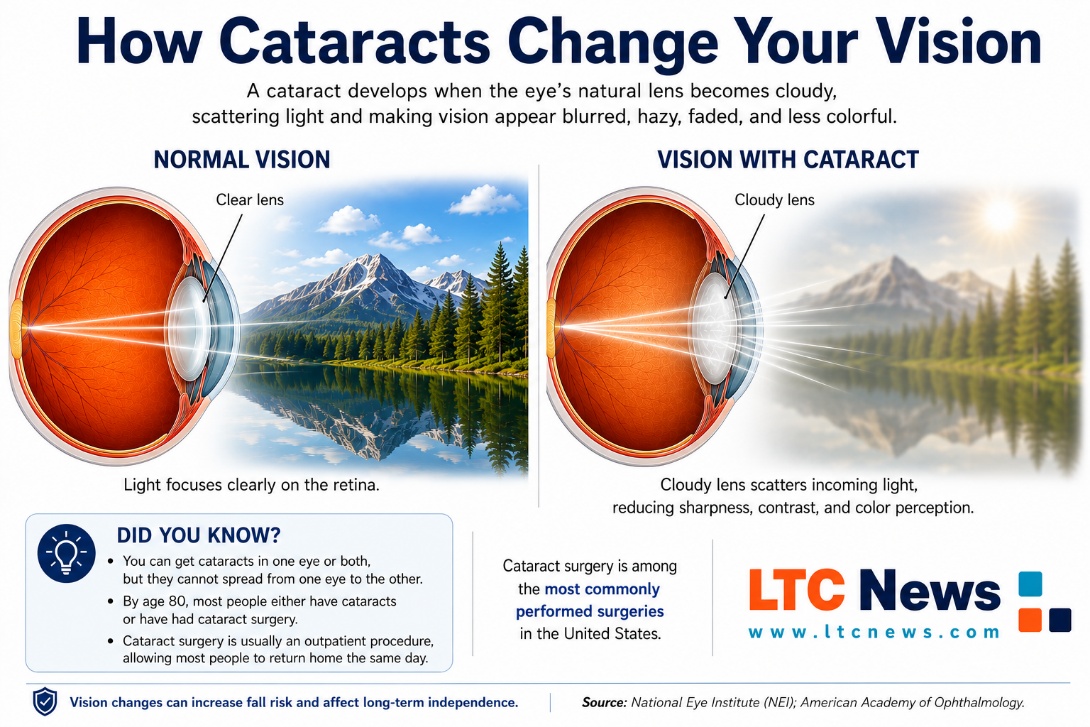
Your eye's lens is made mostly of water and protein, arranged in a precise structure that keeps it clear. As you age, some of those proteins begin to break down and clump together, clouding small areas of the lens. Over the years, the clouding spreads and thickens, scattering light instead of focusing it.
Age is by far the biggest risk factor. According to the National Eye Institute's (NEI) patient page on cataracts, more than half of all Americans age 80 or older either have cataracts or have already had surgery to remove them, with a variety of different types of cataracts that impact people.
In a 2017 NEI research feature (updated in 2025), Manuel B. Datiles III, M.D., a medical officer and senior clinical investigator at NEI, explained that vision changes associated with cataracts can begin in a person's 40s, with cloudy lenses becoming common in the 50s and 60s.
By age 80, almost everyone will have some form of cataract," Datiles said. The same NEI report notes that an estimated 24.4 million Americans age 40 and older had cataracts as of 2010, a figure expected to double to about 50 million by 2050 as the population ages." — Dr. Manuel B. Datiles III.
Other factors can speed up the process, including smoking, diabetes, prolonged UV exposure, certain medications, and eye injuries. But even without any of those risk factors, age-related changes to the lens eventually catch up with most people.
How Vision Loss Affects Independence
Cataracts are not just an inconvenience. Cloudy vision gradually changes how safely and independently you can manage daily life, and that matters a great deal as you plan for the years ahead.
Reduced or blurry vision can interfere with routine tasks that fall under what geriatric care providers call Activities of Daily Living (ADLs) and Instrumental Activities of Daily Living (IADLs), the everyday skills used to measure how well someone can live independently. Vision changes commonly affect:
- Medication management. Reading small print on prescription labels and identifying pills by shape or color becomes harder.
- Meal preparation. Reading recipes, checking expiration dates, and safely operating a stove all require clear vision.
- Driving. Glare, halos, and reduced contrast sensitivity make night driving especially risky.
- Financial management. Reading bills, statements, and checks becomes more difficult, which can lead to missed payments or vulnerability to scams.
- Stair safety. Poor depth perception and reduced contrast sensitivity make it harder to judge step edges.
- Recognizing faces. Difficulty recognizing people at a distance or in dim lighting can affect social connection.
- Managing chronic disease. Reading a glucose monitor or blood pressure cuff display, or drawing up an insulin dose accurately, depends on clear near vision.
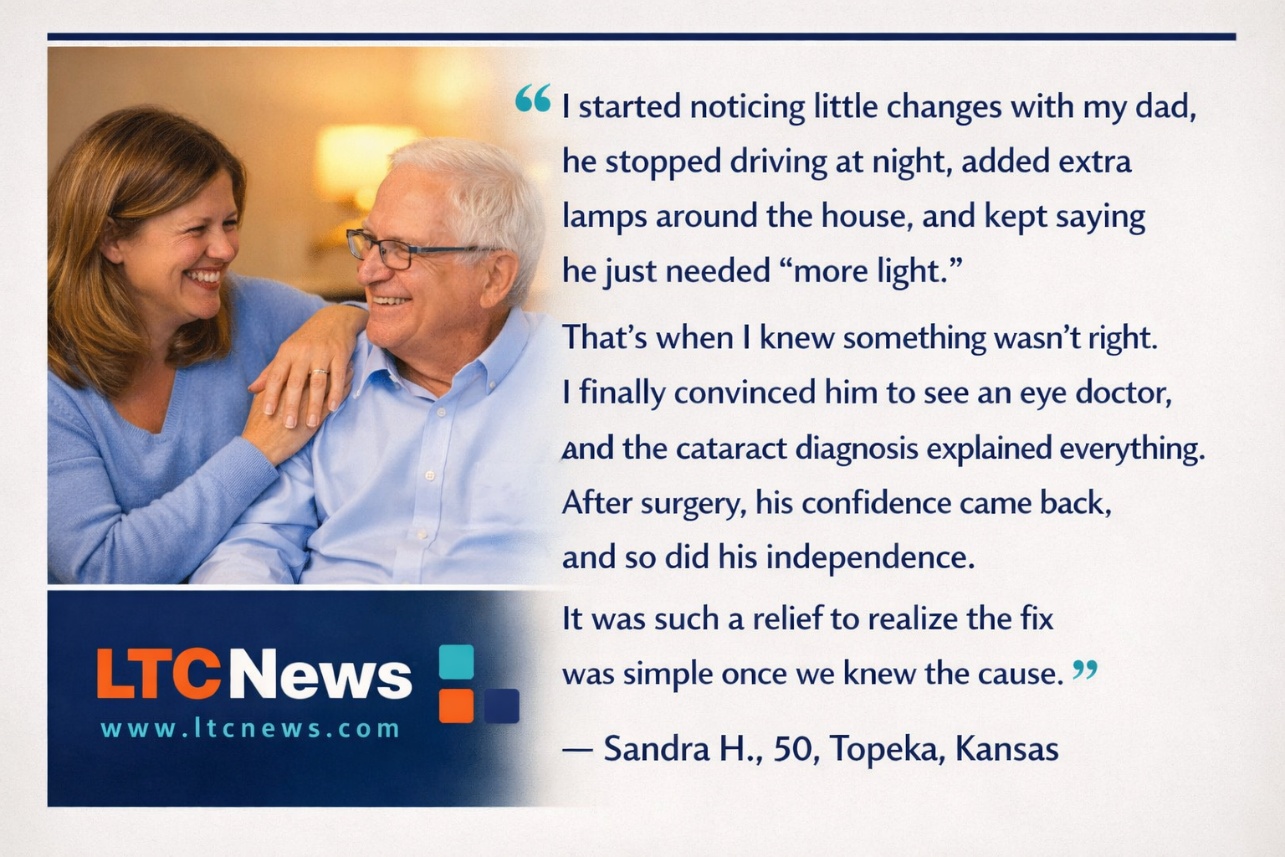
Adult children are often the first to notice these changes in a parent. A parent who stops driving at night, adds extra lamps throughout the house, or seems to struggle to recognize faces across the room may be showing signs of vision loss rather than memory decline. An eye examination is often a useful first step before assuming cognitive decline is the cause.
Share your thoughts and experiences about aging, caregiving, health, retirement, and long-term care with LTC News —Contact LTC News.
Vision Loss and Fall Risk
Poor vision is one of the more overlooked contributors to falls in older adults. It affects safety in several specific ways: missed steps, reduced contrast perception, slower reaction times to obstacles, an inability to detect hazards such as curbs or uneven flooring, and poorer overall balance.
According to a 2016 CDC report published in the Morbidity and Mortality Weekly Report (MMWR), 46.7 percent of adults age 65 and older with self-reported severe vision impairment reported falling in the previous year, compared with 27.7 percent of those without severe vision impairment.
More broadly, a 2023 CDC MMWR report found that about 14 million older adults, or 27.6 percent of adults 65 and older, reported falling in 2020, and nearly 39,000 died from fall-related injuries in 2021. A large 2023 study published in JAMA Ophthalmology, which followed more than 3.4 million adults in England, found an increased risk of both falls and fractures among people with cataract, age-related macular degeneration, or glaucoma.
A fall that results in a hip fracture or head injury can be the event that moves someone from independent living into a higher level of care. According to projections from the U.S. Department of Health and Human Services' Office of the Assistant Secretary for Planning and Evaluation (ASPE), 56 percent of Americans turning 65 will need some level of long-term services and supports during their lifetime. Protecting your vision is one of the more overlooked ways to protect your independence.
Traditional Surgery vs. Laser-Assisted Surgery
Cataract surgery is one of the most common and safest procedures performed in the United States. There are two main approaches, and it is worth understanding both before assuming newer automatically means better.
Traditional phacoemulsification relies on a surgeon making incisions by hand and using an ultrasonic probe to break up and remove the clouded lens. It has been refined over decades and remains highly successful.
Femtosecond laser-assisted cataract surgery (FLACS) adds a computer-guided laser to several of the most precise steps, including the initial incisions, softening of the lens, and, when needed, correction of astigmatism.
Laser-assisted surgery is not always required for a good outcome. A 2022 report from the American Academy of Ophthalmology (AAO), which reviewed the highest-quality published evidence on the topic, concluded that FLACS and traditional phacoemulsification have similar excellent safety and refractive outcomes, and that at this time, one technique is not consistently superior to the other for most patients. The same report noted that FLACS is generally less cost-effective.
That said, some surgeons find laser assistance advantageous in selected, more complex cases, such as dense cataracts or eyes needing precise astigmatism correction. The right choice depends on your individual eye anatomy, your surgeon's experience, and your budget, since the laser add-on carries additional out-of-pocket costs, discussed below.
How Laser-Assisted Cataract Surgery Works
When laser assistance is used, the process generally follows these steps:
- Mapping. A digital scan creates a detailed, three-dimensional image of your cornea and lens, unique to your eye's anatomy.
- Incision. The laser creates incisions following the pattern mapped out beforehand.
- Softening. The laser softens the clouded lens before removal, which can reduce the amount of ultrasound energy needed during the rest of the procedure.
- Removal and replacement. The surgeon removes the cataract and places an artificial intraocular lens (IOL) in its place.
The full procedure, laser-assisted or traditional, typically takes about fifteen to twenty minutes per eye, and most patients go home the same day.
Dr. Sao J. Liu, M.D., a board-certified ophthalmologist and cataract surgeon at the Omaha Eye & Laser Institute, tells LTC News that the added precision of laser assistance changes how some surgeons approach individual cases.
Laser-assisted cataract surgery provides a level of precision that allows us to tailor the procedure to the unique anatomy of each patient's eye, ensuring a more customized and predictable visual outcome." — Dr. Sao J. Liu, M.D., who performs cataract surgery in Omaha.
Choosing an Intraocular Lens
Every cataract surgery, laser-assisted or traditional, involves implanting an artificial lens to replace the natural one that is removed. The main options include:
- Monofocal lenses, which are set for one focal distance, usually far vision, and are the standard lens covered by Medicare.
- Multifocal lenses, which allow focus at multiple distances and can reduce dependence on reading glasses.
- Toric lenses, designed for patients with astigmatism.
- Extended depth-of-focus (EDOF) lenses, which provide a continuous range of vision rather than distinct focal points.
Your surgeon can help determine which lens best fits your vision goals, eye health, and budget.
What Cataract Surgery Costs
Traditional cataract surgery is generally covered by Medicare Part B when deemed medically necessary, meaning cataracts significantly impair vision and interfere with daily activities. Medicare covers the surgeon's fee, facility costs, and a standard monofocal IOL, whether the surgery is performed using traditional or laser-assisted technique. After meeting the Part B deductible, patients are typically responsible for 20 percent coinsurance, although most Medicare supplements will cover that portion.
Laser-assisted technology and premium lenses such as multifocal, toric, or EDOF lenses often involve additional out-of-pocket costs beyond what Medicare covers, since Medicare only pays the amount it would for a standard monofocal lens with traditional surgery. Ask your surgeon for an itemized cost breakdown before agreeing to any upgrade.
Signs You May Have Cataracts
Cataracts usually develop slowly, so the changes can be easy to overlook. Many people assume they simply need stronger glasses or that blurred vision is a normal part of getting older. In reality, these symptoms may be your eyes telling you it's time for a comprehensive eye examination.
Common signs include:
- Blurred or cloudy vision. Objects may appear hazy, as though you're looking through a foggy or dirty window.
- Glare or halos around lights. Headlights, streetlights, and bright sunlight may become increasingly uncomfortable, especially when driving at night.
- Difficulty driving after dark. Reduced contrast and increased glare can make it harder to judge distance, pedestrians, and road hazards.
- Colors appear faded or yellowed. Whites may look off-white, and familiar colors may lose their brightness.
- Needing brighter light to read. Reading books, menus, medication labels, or your phone may require more light than before.
- Frequent changes in your eyeglass prescription. If new glasses seem to help only briefly, cataracts may be affecting your vision.
- Double vision in one eye. Some people notice ghost images or overlapping images in one eye.
- Difficulty recognizing faces or seeing steps clearly. Reduced contrast sensitivity and depth perception can make it harder to recognize people across a room or safely navigate stairs and uneven sidewalks.
These symptoms do not necessarily mean you have cataracts. Other eye conditions—including glaucoma, age-related macular degeneration, diabetic eye disease, and even changes in your eyeglass prescription—can cause similar vision problems. Any persistent change in your eyesight deserves a prompt evaluation by an optometrist or ophthalmologist. Early diagnosis can help preserve your vision, reduce your risk of falls, and support your ability to live independently.
When Is It Time to Consider Surgery
Cataracts develop slowly, and many people put off talking with a doctor because they assume surgery means a long, difficult recovery. In reality, most people know it is time to act when everyday tasks start to feel harder than they should:
- Headlights and streetlights create glare or halos at night
- Reading, sewing, or cooking requires increasingly bright light
- Colors look faded or yellowed
- You find yourself avoiding night driving altogether
Not every cataract needs to be removed right away. A doctor can monitor mild cataracts and recommend surgery only once vision loss begins to interfere with daily life or safety.
Recovery: What to Expect
Recovery varies from person to person, but the first week generally calls for some care.
- Vision may fluctuate in the first few days as your eye heals
- Many people resume reading, watching television, and walking within 24 to 48 hours
- Wear the protective shield you are given, especially while sleeping, so you do not rub or bump your eye
- Use prescribed eye drops on schedule
- Avoid heavy lifting, swimming, and dusty or windy environments for about a week
- Driving depends on your doctor's clearance, which is typically given once vision has stabilized enough to meet legal driving standards
- Call your doctor right away if you notice sudden pain, flashing lights, or a sudden increase in floaters
Most people notice sharper, brighter vision within a day or two, with full stabilization over the following weeks.
Understanding the Risks
Although cataract surgery is among the safest and most commonly performed operations in the United States, it is still surgery, and complications can occur. These can include infection, swelling, retinal detachment, or shifting of the artificial lens.
Some patients later develop a secondary cataract, a clouding of the lens capsule that can occur months or years after surgery. This happens because a small number of lens cells remain even after a well-performed procedure. Melinda K. Duncan, Ph.D., an NEI-funded researcher at the University of Delaware, said the leftover cells try to heal the surgical wound, producing a mix of scar tissue and new lens cells. In most cases, this response helps hold the artificial lens securely in place. But when the cells spread beyond the lens edges instead, cloudy vision can return.
Remaining epithelial cells try to heal the wound or remake the lens by producing a combination of scar tissue and new lens cells." — Melinda K. Duncan, Ph.D.
A secondary cataract is treated with a quick, painless laser procedure called YAG capsulotomy, which creates a small opening in the clouded capsule to restore clear vision. Your ophthalmologist will review these risks with you and help you decide whether laser-assisted surgery is appropriate for your situation.
Can Cataracts Be Prevented
Cataracts cannot be entirely prevented, since they are largely tied to normal aging. However, you may be able to reduce your risk or slow their progression by:
- Not smoking
- Managing diabetes and blood sugar levels
- Wearing UV-blocking sunglasses
- Eating a healthy, nutrient-rich diet
- Getting regular dilated eye exams
Talking With Your Doctor
Before your appointment, take a few minutes to write down exactly how your vision is affecting your daily life. Is it harder to drive at night because of glare or halos? Does reading fine print take longer than it used to? Do you misjudge distances on stairs or struggle to recognize faces in dim lighting? Have you stopped doing certain activities because you no longer feel confident seeing clearly?
Bring a list of your medications, any previous eye conditions or surgeries, and your current eyeglass or contact lens prescription if available. It also helps to prepare a list of questions before your visit.
Ask whether your cataracts are affecting your safety, whether surgery is recommended now or can safely be delayed, and which type of intraocular lens (IOL) best fits your vision goals and lifestyle. If surgery is recommended, ask about the expected recovery, when you can resume driving and other normal activities, and what costs Medicare or your private insurance will cover, including any additional costs for premium lenses or laser-assisted surgery.
The more specific you are about your symptoms, daily activities, and expectations, the better your ophthalmologist can recommend the right treatment plan and the most appropriate timing for surgery.
How Caregivers and Long-Term Care Providers Help Protect Vision
Vision changes can have a significant impact on an older adult's safety, mobility, and quality of life. That's why professional caregivers and long-term care providers pay close attention when someone begins having difficulty seeing clearly, even if cataracts have not yet been diagnosed.
Family caregivers and home care professionals are often the first to notice subtle changes. An older adult may begin avoiding nighttime driving, need brighter lighting to read, misjudge steps, struggle to recognize familiar faces, or have trouble managing medications. These observations can prompt an eye examination that identifies cataracts or another treatable vision condition before it leads to a serious fall or loss of independence.
In assisted living communities, memory care residences, nursing homes, and rehabilitation centers, vision concerns are commonly incorporated into care planning. Physicians, nurses, therapists, and other members of the care team routinely monitor how changes in eyesight affect mobility, medication management, participation in therapy, and other daily activities. When vision problems interfere with function or safety, residents are often referred to an optometrist or ophthalmologist for further evaluation and treatment.
👉 Search from over 80,000 caregivers and long-term care facilities for your loved one by using the LTC News Caregiver Directory. If they have a Long-Term Care Insurance policy be sure to tell the admission’s directory. LTC News partners with Amada Senior Care to provide free claim support with no cost or obligation— File a Long-Term Care Insurance Claim. If there is no LTC policy, and your loved one has a life insurance policy, you could sell it for cash now to cover the costs of care.
Addressing treatable eye conditions, including cataracts, can improve more than vision. Better eyesight may reduce fall risk, support rehabilitation after illness or injury, encourage greater participation in social activities, and help older adults maintain as much independence as possible. For families caring for an aging loved one, recognizing changes in vision and seeking prompt evaluation can be an important step in helping that person remain safe and active for years to come.
Protecting Your Vision Protects Your Independence
Vision problems often appear years before people begin thinking about long-term care. Maintaining healthy vision supports safer mobility, helps reduce fall risk, and allows older adults to continue managing medications, finances, driving, and household responsibilities on their own. Protecting your eyesight is an important, often overlooked component of maintaining independence as you age.
This article is for general informational purposes and is not a substitute for professional medical advice. Talk with an eye care provider about your individual symptoms and treatment options.
Frequently Asked Questions
What are the first signs of a cataract?
Early symptoms often include:
- Blurry or hazy vision
- Glare or halos around headlights at night
- Colors appearing faded or yellowed
- Needing brighter light for reading
- Frequent changes in eyeglass prescriptions
- Difficulty driving after dark
These changes usually develop gradually over several years.
Can cataracts cause falls?
Yes. Vision plays an important role in balance, depth perception, and recognizing hazards. Cataracts can make it harder to judge stairs, curbs, uneven sidewalks, and obstacles, increasing the risk of falls. For older adults, a serious fall can lead to hospitalization, rehabilitation, or the need for long-term care.
Is laser-assisted cataract surgery better than traditional surgery?
Not necessarily. Both traditional cataract surgery and femtosecond laser-assisted cataract surgery have excellent safety records and produce outstanding visual outcomes for most patients. Laser-assisted surgery may offer advantages in certain complex cases, but research reviewed by the American Academy of Ophthalmology has not found it to be consistently superior for everyone. The best choice depends on your eyes, your surgeon's recommendation, and your personal preferences.
When should I talk with an eye doctor?
Schedule a comprehensive eye examination if you notice persistent blurry vision, increased glare, difficulty driving at night, or if your vision begins interfering with reading, hobbies, work, or daily activities. Cataracts often develop gradually, and regular eye exams can help determine when treatment is appropriate.
Can cataracts come back after surgery?
The cataract itself cannot return because the natural lens has been removed. However, some people develop a clouding of the lens capsule behind the artificial lens, often called a "secondary cataract." This is not a new cataract and is typically treated quickly with a painless laser procedure called a YAG capsulotomy.
Is cataract surgery painful?
Most patients experience little or no pain. The eye is numbed with anesthetic drops, and many people describe feeling only slight pressure or mild discomfort during the procedure. Mild irritation afterward is common and usually resolves within a few days.
What types of replacement lenses are available?
During cataract surgery, the clouded natural lens is replaced with an artificial intraocular lens (IOL). Common options include:
- Monofocal lenses for one focal distance
- Multifocal lenses for near and distance vision
- Toric lenses to correct astigmatism
- Extended depth-of-focus (EDOF) lenses for a broader range of vision
Your ophthalmologist can help determine which lens best fits your lifestyle and vision goals.
Can cataracts be prevented?
There is no guaranteed way to prevent age-related cataracts, but healthy habits may help slow their progression. These include:
- Not smoking
- Managing diabetes
- Wearing UV-blocking sunglasses outdoors
- Eating a healthy diet rich in fruits and vegetables
- Scheduling regular comprehensive eye examinations
These steps also support overall eye health as you age.
How soon will I notice better vision?
Many patients notice brighter, clearer vision within 24 to 48 hours, although vision may fluctuate during the first few days. Complete healing and stabilization typically occur over the following weeks.
Does everyone develop cataracts as they age?
Almost everyone develops some degree of cataract if they live long enough. According to the National Eye Institute, more than half of Americans age 80 and older either have cataracts or have already had cataract surgery.
What is a cataract?
A cataract is the gradual clouding of the eye's natural lens. As proteins in the lens change with age, they clump together, making vision appear blurry, hazy, faded, or less colorful. Cataracts usually develop slowly and become more common as you get older.
How long does cataract surgery take?
The procedure typically takes about 15 to 20 minutes per eye, although you should expect to spend several hours at the surgical center for preparation and recovery. Most people return home the same day.
Can cataracts affect independence?
Absolutely. Cataracts can interfere with many everyday activities that support independent living, including:
- Reading medication labels
- Preparing meals safely
- Driving
- Managing finances
- Recognizing faces
- Monitoring chronic health conditions
Addressing vision problems early can help older adults remain independent longer.
Why is vision health important when planning for long-term care?
Good vision supports safe mobility, medication management, driving, financial independence, and many other daily activities. Protecting your eyesight can reduce fall risk and help you remain independent longer. As part of a comprehensive aging plan, maintaining healthy vision is just as important as planning financially for future long-term care needs.
Does Medicare cover cataract surgery?
Yes. Medicare Part B generally covers medically necessary cataract surgery, including a standard monofocal intraocular lens. However, laser-assisted surgery and premium lenses may involve additional out-of-pocket costs because Medicare pays only the amount it would for standard cataract surgery. Always ask your surgeon for a detailed estimate before scheduling surgery.

Sponsored