Can Fall Detection Technology Help an Older Parent Stay Independent?
About This Article
Fall detection technology uses sensors and software to recognize movements that may indicate a fall and automatically call for help. For older adults, it can add a safety net when living independently, especially if a fall leaves someone unable to reach a phone or press an emergency button.

Beth Rush
Beth Rush writes about health and wellness to help readers learn how to make healthier lifestyle choices.
Table of Contents
- In This Article
- Why Falls Can Threaten an Older Adult's Independence
- How Fall Detection Technology Actually Works
- The Sensors and Algorithms Behind Automatic Alerts
- Why Fall Detection Isn't Always Perfect
- Fall Detection Is a Backup — Not a Guarantee
- Medical Alert Systems With Fall Detection in 2026
- Medical Care Alert: Automatic Fall Detection and EMT/EMD-Certified Monitoring
- Key Features
- Medical Guardian: Longer Battery Life and Multiple Wearing Options
- Key Features
- Lifeline: Long-Established Medical Alert Provider
- Key Features
- ADT: Home and Mobile Medical Alert Options
- Key Features
- How LTC News Selected Systems for Comparison
- What Families Should Look for in Fall Detection
- Comparative Summary
- Choosing the Right Medical Alert System
Maybe you've noticed it on your last visit. Your mom holds the railing a little tighter on the stairs. Your dad lives alone now and insists he's fine, but you wonder what would happen if he fell and no one knew. For many older adults, the fear isn't just getting hurt. It's losing the freedom to live on their own terms, in the home they love. And for adult children, the worry often follows them home, long after the visit ends.
A fall can change an older adult's life in a matter of seconds. Beyond the immediate risk of injury, a serious fall can lead to an emergency room visit, hospitalization, rehabilitation, and a loss of independence with the need for long-term care. Medical alert systems with automatic fall detection offer another way to summon help when someone falls and cannot reach a phone or press an emergency button.
For an older parent who wants to remain at home, that extra safeguard can be useful. Fall detection cannot prevent falls or guarantee that every fall will be detected. But it may reduce the amount of time someone remains without assistance after a fall.
In This Article
This article covers:
- Why falls can threaten an older adult's independence
- How fall detection technology works
- Why automatic fall detection isn't perfect
- Medical alert systems with fall detection in 2026
- How LTC News selected systems for comparison
- What families should look for in fall detection
- A comparative summary
- Frequently asked questions
- How to choose the right medical alert system
Why Falls Can Threaten an Older Adult's Independence
Falls are one of the biggest health and safety concerns as people get older. The Centers for Disease Control and Prevention reports that falls among adults age 65 and older result in about 4.5 million emergency department visits each year. About 3.1 million of those patients are treated and released, while another 1.4 million are hospitalized.
Falls are also the leading cause of injury death among adults age 65 and older. In 2024, more than 43,000 older adults died from falls. For some older adults, a fall becomes the event that changes everything. An emergency room visit can lead to hospitalization and rehabilitation, followed by reduced mobility or a greater need for help at home. In some cases, that loss of independence eventually leads to assisted living or nursing home care.
Luis Rodriguez, M.D., a primary care sports medicine physician with Baptist Health Orthopedic Care, says home may feel safe, but it’s full of hidden hazards. Uneven floors, slick surfaces, loose electrical cords, pets underfoot, cluttered walkways, poorly placed furniture and dim lighting are common risks in many households.
People know their homes so well that they may stop noticing the hazards. A rug that has been in the same place for 20 years may suddenly become dangerous when a person’s vision, strength, balance or reaction time changes.”—Luis Rodriguez, M.D.
Research published in 2026 underscores that connection. Researchers analyzed 31,517 community-dwelling older adults using Medicare Current Beneficiary Survey data. Older adults who reported a fall had a 51 percent higher adjusted risk of nursing home placement during the following year.
That doesn't mean a fall will lead to a nursing home. The study found an association, not that a fall inevitably leads to long-term care. Health, mobility, chronic conditions, cognitive ability, family support, and other factors can also affect whether someone can continue living independently.
Still, falls are a warning sign families shouldn't ignore. For an adult child worried about a parent living alone, a medical alert system can provide another way to get help when family members or caregivers aren't there.
AARP has found that most older adults want to remain in their homes as they age. Medical alert systems, home modifications, fall-prevention efforts, and appropriate support can all play a role in making that goal safer and more realistic.
How Fall Detection Technology Actually Works
Most automatic fall detection systems use motion sensors to recognize movements associated with a fall. Accelerometers are common. Some devices combine them with gyroscopes, barometric sensors, or other technology.
Software analyzes sensor data and looks for movement patterns that may indicate a fall, such as rapid downward movement followed by a sudden stop and a change in body position. If the system determines that a fall may have occurred, it can automatically send an alert. Depending on the system, the alert may connect the person with a professional monitoring center or notify a family member or caregiver.
That can be especially important if someone is unconscious, confused, injured, or physically unable to press a help button. Interest in this technology is significant. A 2024 AARP survey found that 64 percent of adults age 50 and older said they would need a medical alert system to continue living safely and independently as they age.
The Sensors and Algorithms Behind Automatic Alerts
Wearable fall detection devices typically monitor changes in acceleration, orientation, and movement. An algorithm compares those movements with patterns associated with falls. Some systems use several types of sensors together in an effort to improve detection and reduce false alarms.
Research reviews have found high sensitivity and specificity for wearable fall-detection technologies under studied conditions. An umbrella review of systematic reviews found that three reviews reported average sensitivity of at least 93.1 percent and average specificity of at least 86.4 percent.
Those numbers require context. They do not mean that a medical alert pendant bought today will detect more than 90 percent of actual falls. Results vary by device, sensor placement, type of fall, and testing conditions. Researchers also cautioned that more high-quality research is needed to determine how accurately these devices work among frail older adults in everyday, real-world settings.
Why Fall Detection Isn't Always Perfect
No automatic fall detection system catches every fall. How someone falls can affect whether a device recognizes what happened. For example, someone who slowly slides to the floor or catches themselves on furniture may not create the movement pattern the system expects.
False alarms can happen, too. Dropping a device or making certain sudden movements can sometimes resemble a fall. Other practical issues matter. The device needs to be worn, charged, and connected to its network. Cellular coverage can also vary by location.
Fall Detection Is a Backup — Not a Guarantee
Automatic fall detection should supplement the emergency help button, not replace it. If you fall and can press the button, do so. Fall detection also doesn't prevent falls. Reducing fall risk may involve:
- Medication reviews
- Vision and hearing care
- Strength and balance exercises
- Appropriate footwear
- Grab bars and other home modifications
- Better lighting
- Removing tripping hazards
- Evaluating dizziness, weakness, or balance problems
The goal isn't simply to detect a fall. It's to reduce the chances of falling in the first place and make it easier to get help when a fall does occur.
Medical Alert Systems With Fall Detection in 2026
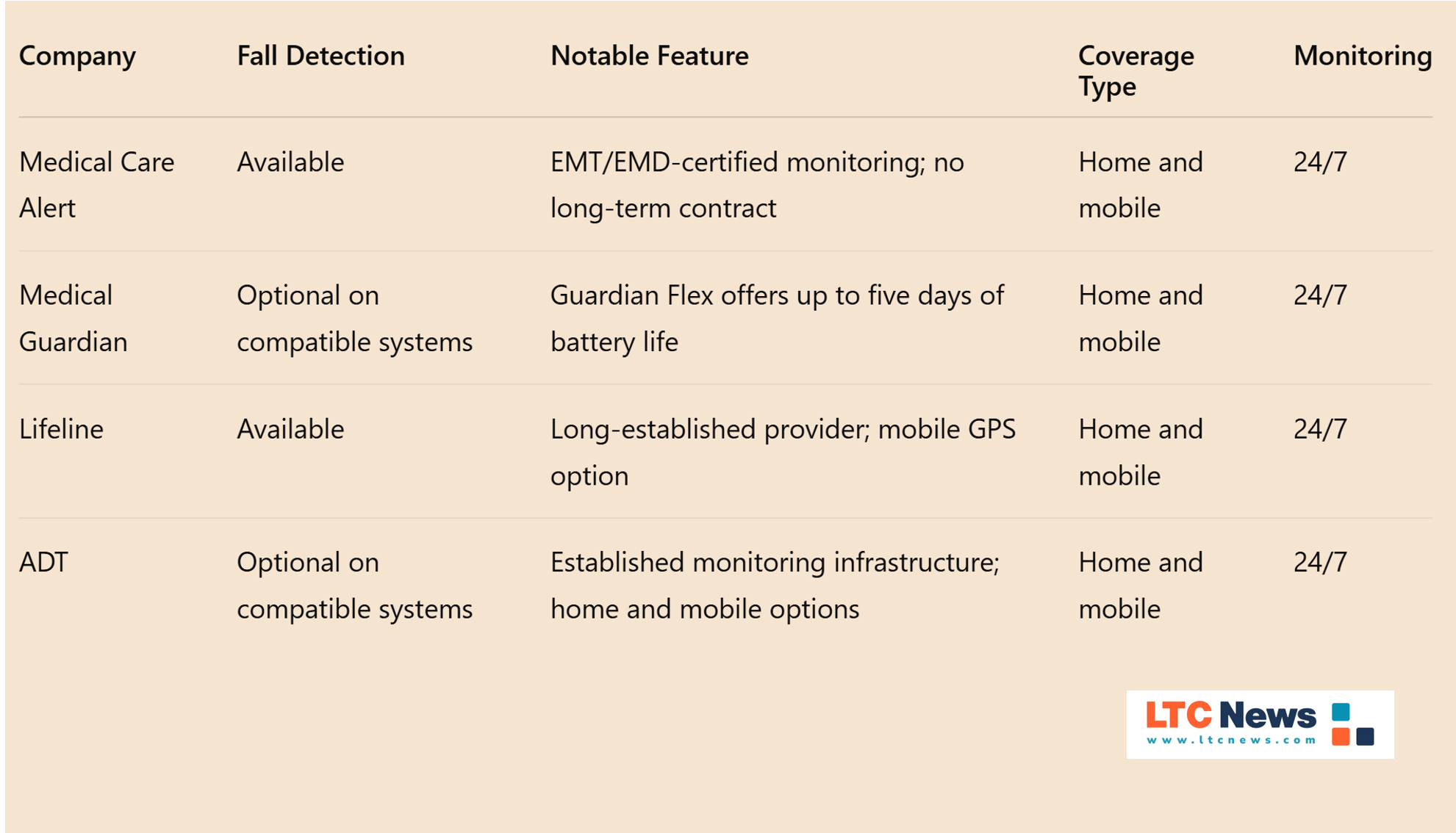
Medical alert systems vary in fall-detection technology, monitoring services, battery life, mobile capabilities, pricing, and contract terms. The following companies offer fall detection along with other features that may help older adults stay independent.
Medical Care Alert: Automatic Fall Detection and EMT/EMD-Certified Monitoring
Medical Care Alert offers AutoFALL technology on several systems. The technology is designed to recognize movement associated with a fall and initiate an alert without requiring the user to press a button. Users can also manually press the emergency button to contact the company's monitoring center.
Medical Care Alert provides 24-hour U.S.-based monitoring with EMT/EMD-certified operators. Mobile options include GPS location technology. The company doesn't require a long-term contract.
Key Features
- Automatic fall detection available
- No long-term contract
- U.S.-based EMT/EMD-certified monitoring
- GPS available with mobile systems
- Nationwide mobile coverage where supported by the cellular network
- Multiple wearing options depending on the device
- Lockbox included with service
Medical Guardian: Longer Battery Life and Multiple Wearing Options
Medical Guardian offers home and mobile medical alert systems, including Guardian Flex. Guardian Flex can be worn on the wrist, belt, or lanyard. It includes GPS location technology, two-way communication, and its own cellular connection.
Medical Guardian advertises up to five days of battery life between charges. The device is also water-resistant and can be worn in the bath or shower. Users can press the SOS button to connect with the company's monitoring center. Automatic fall detection is available as an optional feature.
Medical Guardian says it has served more than 600,000 families. That is a company-reported figure.
Key Features
- Up to five days of battery life with Guardian Flex
- Water-resistant design
- Three wearing options
- One-button access to the monitoring center
- GPS location technology
- Two-way communication
- 24/7 monitoring
- Optional automatic fall detection
Lifeline: Long-Established Medical Alert Provider
Lifeline has provided medical alert services for more than 50 years. Its fall detection technology uses motion sensors and algorithms designed to recognize a fall and contact the response center when someone may be unable to press the help button.
Lifeline's On the Go system includes GPS location technology and two-way voice communication. The device is waterproof and can be worn in the shower. The rechargeable battery can last up to four days on a single charge, although Lifeline recommends charging the device daily.
Lifeline also makes an important point that applies to every system in this article: automatic fall detection cannot detect every fall.
Key Features
- Long history in the medical alert industry
- Automatic fall detection available
- Two-way communication
- Home and mobile options
- GPS available with the On the Go system
- Waterproof On the Go device
- Up to four days of battery life, with daily charging recommended
ADT: Home and Mobile Medical Alert Options
ADT offers home-based and mobile medical alert systems with 24/7 monitoring. ADT says its monitoring professionals receive more than 200 hours of specialized training. The company also emphasizes training designed around the needs of older customers.
Fall detection is available with compatible ADT systems, including Medical Alert Plus and On-the-Go. It is not available with every ADT medical alert system, so consumers should confirm that the equipment they select supports the feature.
The On-the-Go system uses cellular and GPS technology and includes two-way voice communication. Fall detection is available as an optional add-on.
Key Features
- 24/7 monitoring
- Fall detection available on compatible systems
- Home and mobile options
- GPS and cellular technology with the On-the-Go system
- Two-way communication
- Specialized training for monitoring personnel
How LTC News Selected Systems for Comparison
LTC News reviewed publicly available product specifications, manufacturer information, and other available sources. Factors included fall-detection capabilities, monitoring services, battery life, contract terms, mobile capabilities, and features that may matter to older adults and their families.
LTC News did not independently test these devices or verify every manufacturer's performance claim under real-world conditions. Product features, equipment, prices, promotions and service terms can change. Consumers should verify current information directly with a company before purchasing a system.
Inclusion in this article does not mean a particular system is appropriate for every older adult. The right choice depends on the person's health, mobility, living arrangement, location, daily routine, and willingness to use the device.
What Families Should Look for in Fall Detection
The most sophisticated medical alert system won't help much if your parent refuses to wear it. That makes everyday usability one of the most important things to consider.
Before choosing a system, ask these questions:
- Will they wear it? A comfortable device that fits naturally into someone's routine may be more useful than a more sophisticated device that sits on a dresser.
- Can it be worn in the shower? Bathrooms are a common place for falls.
- Does it work away from home? Someone who drives, walks outdoors, shops, or visits friends may benefit from mobile cellular coverage and GPS.
- How long does the battery last? Frequent charging can become a problem, particularly for someone who has trouble remembering to charge a device.
- Is it professionally monitored? Some systems connect users with a 24/7 monitoring center, while others may primarily notify family members or designated contacts. Understand who receives the alert and who is responsible for calling emergency services.
- What happens when a fall is detected? Ask what the monitoring center does and how it responds if the user doesn't answer.
- Can the user talk through the device? Two-way communication can help monitoring personnel understand what happened and what type of assistance may be needed.
- How will emergency responders get inside? A lockbox can provide emergency personnel with a way to enter without forcing a door.
- Does cellular service work where the person lives? Don't assume coverage is equally reliable everywhere, particularly in rural areas.
- What does fall detection cost? Some companies charge an additional monthly fee.
- Is there a contract? Check cancellation policies, activation charges, equipment costs, and refund terms.
- Who can see location information? Understand how GPS information works and who can access it.
If your loved one has Long-Term Care Insurance, check whether the policy will pay for medical alert systems; many do. You can get free, no-obligation expert help processing a Long-Term Care Insurance claim — File a Long-Term Care Insurance Claim.
Families should also periodically ask whether a medical alert system is still enough. Repeated falls, worsening mobility, cognitive decline, or increasing difficulty with activities of daily living may indicate that additional help is needed.
👉You can find quality caregivers and long-term care facilities by using the LTC News Caregiver Directory. You can search over 80,000 providers nationwide.
Comparative Summary
NOTE: LTC News can conduct independent reviews of products and services and publishes detailed articles based on those evaluations. Products or services submitted for review must be provided to LTC News at no cost. Providing a product or service does not guarantee a favorable review or publication. LTC News maintains full editorial control over all reviews. Contact LTC News to learn more: Contact LTC News.
Choosing the Right Medical Alert System
The right medical alert system isn't necessarily the one with the longest list of features. It's the one the older adult will actually use and that fits the person's health, lifestyle and living situation. Someone who rarely leaves home may be comfortable with a home-based system. An active older adult who drives, walks outdoors, shops or visits family may benefit from a mobile system with GPS and cellular connectivity.
Fall detection may be especially worth considering for someone with a history of falls, balance problems, weakness or other conditions that could make it difficult to reach a phone or emergency button after falling.
Families should also look beyond the technology.
A fall can be a warning that an older adult's needs are changing. Repeated falls, difficulty getting up, increasing weakness or problems with activities of daily living should prompt a conversation with physicians, nurses, therapists and other members of the care team.
Medical alert technology can provide a safety net, but it works best as part of a broader plan that includes fall prevention, appropriate medical care, a safer home and realistic planning for future long-term care needs.
For many families, the goal is straightforward: help an older loved one remain safer and more independent for as long as possible.
Fall detection technology can't prevent a fall or guarantee that every fall will be detected. But when an older adult falls and can't reach a phone or press a button, having another way to summon help can be an important part of a broader plan for safety, independence and aging at home.
Frequently Asked Questions
Can fall detection help an older parent remain independent?
It can be one part of a larger plan. A medical alert system gives an older adult another way to call for help while living alone. It may also reassure family members who can't be there around the clock.
Technology, however, shouldn't substitute for personal care when personal care is needed. If someone has significant mobility problems, cognitive impairment or difficulty performing activities of daily living, a medical alert system alone may no longer provide enough support.
Can a medical alert system prevent falls?
No. Medical alert systems are primarily designed to summon assistance. Fall prevention requires a broader approach. Depending on the person, that can include exercise, medication reviews, vision care, appropriate footwear, home modifications and medical evaluation of problems affecting balance or mobility.
Does Medicare pay for medical alert systems?
Original Medicare generally does not cover standard medical alert systems as durable medical equipment. Some Medicare Advantage plans may offer medical alert or personal emergency response benefits as an extra benefit. Coverage varies by plan and location, so consumers should check directly with their plan.
Can a medical alert system automatically detect a fall?
Some can. Automatic fall detection generally uses motion sensors and software to identify movement consistent with a fall. If the system detects a possible fall, it can initiate an alert without requiring the person to press an emergency button.
Can medical alert technology help family caregivers?
It can help, but it doesn't replace family caregivers. An adult child may feel more comfortable knowing a parent has a way to summon help when alone. Family members should still check in regularly and watch for changes in mobility, cognition or the ability to handle everyday activities.
A pattern of falls can be particularly important. Rather than simply buying better technology, repeated falls should prompt families to look for the reason they are happening.
Why is getting help quickly after a fall important?
Falls can cause fractures, head injuries and other medical problems. An older adult may also be unable to stand without assistance. Spending an extended period on the floor can lead to additional problems, including dehydration, pressure injuries and hypothermia.
Automatic fall detection provides another way to summon assistance when someone cannot reach a phone or press an emergency button.
Will fall detection recognize every fall?
No. No consumer fall detection system can guarantee that it will detect every fall. A slow fall, sliding from a chair or catching yourself on furniture may not produce the movement needed to trigger an automatic alert.
If you can press the emergency button after falling, do so even if your device includes automatic fall detection.
Does Long-Term Care Insurance pay for medical alert systems?
It depends on the policy. Depending on the policy, Long-Term Care Insurance benefits may sometimes include a medical alert or personal emergency response system as part of covered home care, care coordination, alternative care or related services once benefit eligibility requirements have been met.
Coverage varies by policy. Never assume the expense is covered. Review the policy or contact the insurance company to confirm available benefits.


Sponsored