Best Cleaning Tips for Aging Adults to Stay Safe and Independent at Home

About This Article
Household cleaning can become dangerous for aging adults, as limited mobility can increase fall risk. Luckily, implementing safer cleaning routines and habits can help older adults age in place.

Anna Marino
Anna Marino is a seasoned writer specializing in topics related to family, aging, and lifestyle in retirement. She shares advice on intergenerational relationships and strategies for enjoying retirement.
Table of Contents
- Older Everyday Tasks Become More Dangerous Over Time
- Quiet Changes Families Often Notice First
- Independence Does Not Mean Doing Everything Alone
- Small Tools Often Make a Big Difference
- Safe Cleaning Supplies Can Reduce Injury Risks
- Cleaning Chores Older Adults Should Avoid
- When to Call in Outside Help for Cleaning
- Some Areas of the Home Become More Dangerous with Age
- Avoid Loose Rugs and Throw Rugs
- Why Families Often Miss Early Warning Signs
- Family Caregiving Is Expanding Rapidly
- Aging at Home Looks Different Around the World
- Household Changes Often Signal Bigger Care Needs Ahead
- Staying Safe at Home Starts with Everyday Habits
- Why Accepting Help Feels So Difficult
If you have started noticing that routine household chores leave you or an older loved one exhausted, sore, or worried about falling, you are not alone. For many older adults, simple tasks like vacuuming, scrubbing a bathtub, carrying laundry, or bending to wipe up a spill become more physically demanding with age.
Adult children often notice subtle changes first. A once spotless kitchen becomes cluttered. Laundry piles up. Dust gathers on furniture that once looked immaculate. A parent casually mentions sore knees after mopping the floor or quietly stops cleaning certain rooms altogether.
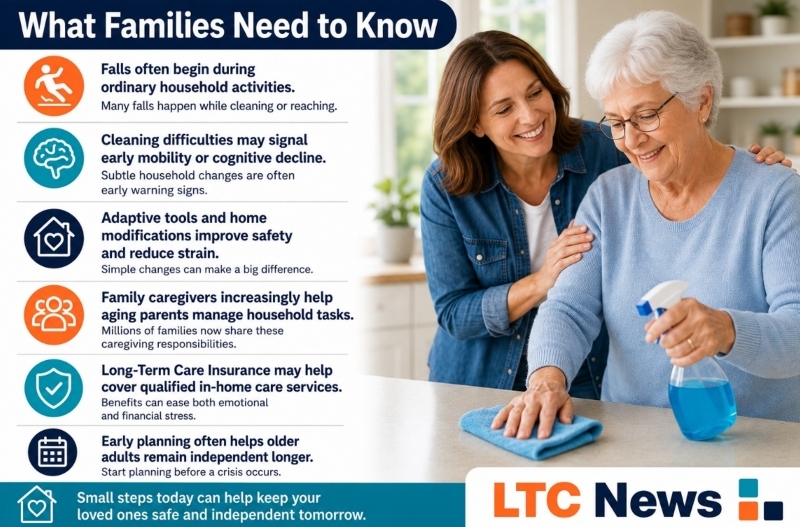
Those small changes are easy to dismiss as “normal aging.” Sometimes they are. But they can also become early warning signs of mobility decline, arthritis progression, balance problems, chronic illness, or increasing frailty.
Often, loved ones are afraid to mention these noticeable changes.
Determine if there's an opening, if there's anything they think they might need help with. Start small, like offering them someone to help with laundry. — Jennifer Reckrey, associate professor of geriatrics and palliative medicine at the Icahn School of Medicine at Mount Sinai.
Families across the United States, Canada, and the United Kingdom are all facing the same growing challenge: helping older loved ones remain safe, independent, and comfortable at home as long as possible.
The encouraging news is that cleaning does not need to stop because mobility changes. With safer routines, adaptive tools, thoughtful home modifications, and the right support, and even help from caregivers, older adults often continue living independently for years.
Older Everyday Tasks Become More Dangerous Over Time
Cleaning requires many of the exact movements that become harder and riskier as the body ages. Tasks like bending to wipe baseboards, stretching to reach shelves, lifting laundry baskets, or standing for long periods can strain joints, muscles, and balance systems that may no longer respond as quickly as they once did.
Aging itself is not the only issue. Older adults frequently manage arthritis, neuropathy, reduced vision, chronic pain, fatigue, dizziness, or medication side effects that affect coordination and balance.
What once felt automatic may suddenly require concentration and physical effort. A wet kitchen floor, a cluttered hallway, or an awkward twist while cleaning a bathtub may lead to a serious fall in seconds.
According to the Centers for Disease Control and Prevention, falls remain the leading cause of injury among older Americans. More than 14 million adults age 65 and older report falling each year, resulting in roughly 3 million emergency department visits. The CDC also estimates that falls lead to more than 1 million hospitalizations annually among older Americans.
Older Adult Falls by the Numbers
- 1 in 4 Americans age 65+ falls each year
- Roughly 3 million emergency room visits annually
- More than 1 million fall-related hospitalizations yearly
- Bathrooms and kitchens remain among the highest-risk rooms in the home
- Falls are a leading reason older adults lose independence
Experts tell us that falls are not a normal part of aging; however, they remain among the top reasons seniors go to the emergency room and need long-term care.
In Canada, the Public Health Agency of Canada reports that falls remain the leading cause of injury-related hospitalizations among older adults.
In the United Kingdom, the National Health Service warns that falls are among the leading causes of emergency hospital admissions for older adults and frequently contribute to loss of independence.
For families, the concern extends far beyond bruises or sore muscles. A serious fall may trigger hospitalization, rehabilitation, reduced mobility, caregiver dependence, or eventual placement into assisted living or nursing care.
Quiet Changes Families Often Notice First
You may have experienced something similar in your own family. An adult daughter visits her mother and notices unopened mail stacked on the kitchen counter. The bathroom no longer looks clean. Towels sit on the floor because bending has become painful. Her mother quietly admits she stopped scrubbing the bathtub because she feels unsteady leaning over the edge.
Nothing dramatic happened. There was no ambulance ride or emergency room visit. Yet something important changed. What appears to be a housekeeping issue is often one of the earliest visible signs that routine daily activities are becoming physically harder and potentially unsafe.
These moments feel emotionally complicated for both generations. Aging parents may fear losing independence. Adult children often struggle with when to step in and how to help without sounding controlling or dismissive.

Independence Does Not Mean Doing Everything Alone
Many older adults grew up believing a clean home reflected responsibility, pride, and self-respect. That mindset does not disappear with age. When cleaning becomes difficult, the emotional impact often feels surprisingly personal.
Some seniors feel embarrassed when adult children notice clutter or unfinished chores. Others push themselves beyond safe physical limits because they do not want to admit certain tasks have become harder.
That is why the goal should never be to simply “take over” unless safety absolutely requires it.
Maintaining safe involvement in household routines supports physical movement, emotional well-being, cognitive engagement, confidence, and daily structure. Even small routines help older adults preserve independence and control over their daily lives.
The focus should shift from cleaning harder to cleaning smarter.
Occupational therapists and aging-in-place specialists often recommend low-strain cleaning routines that reduce unnecessary bending, lifting, and fatigue while helping older adults remain active and independent.
Working while seated significantly reduces fatigue and balance instability. A sturdy chair or rolling stool allows older adults to safely fold laundry, wipe counters, prepare meals, or clean sinks without standing for extended periods.
Reducing the amount of walking and carrying during cleaning also matters. Carrying supplies from room to room may seem minor, but repeated trips increase fatigue and fall risk, especially for people with arthritis or mobility problems.
Melissa Maker, a well-known Canadian cleaning expert, entrepreneur, author, and founder of the Clean My Space cleaning brand and YouTube channel, encourages people to “clean smarter, not harder,” a concept that can be especially important for older adults with mobility limitations.
Shorter cleaning sessions matter as well. Trying to clean an entire home in one day may overwhelm aging joints and muscles. Cleaning in shorter 10- to 15-minute periods with breaks in between is often safer and far more sustainable.
Small Tools Often Make a Big Difference
The right tools dramatically reduce dangerous bending, kneeling, twisting, and reaching. For example, a simple grabber allows an older adult recovering from hip surgery to safely pick items up from the floor without risking another fall. Lightweight cordless vacuums reduce shoulder strain compared to heavier upright models. Trigger-assist spray bottles help older adults with arthritis continue cleaning despite weakened grip strength.
Small adjustments often create meaningful improvements in safety and comfort. Robot vacuums have also become increasingly popular among older adults because they reduce daily floor-cleaning demands without requiring bending or pushing heavy equipment. While they do not replace occasional deep cleaning, they help maintain safer, cleaner floors between larger cleaning sessions.
Long-handled dusters and electric scrubbers reduce the need to kneel or stretch into awkward positions that often lead to falls or muscle strain. Long-handled dusters and electric scrubbers reduce the need to kneel or stretch into awkward positions that often lead to falls or muscle strain.
The National Institute on Aging recommends modifying household routines and using adaptive equipment to help older adults remain safer and more independent at home.
The National Institute on Aging also encourages older adults to modify household routines and environments to reduce fall risks while preserving independence.
Safe Cleaning Supplies Can Reduce Injury Risks
The right cleaning tools can make a major difference for older adults trying to remain safe and independent at home, but cleaning products matter as well. Strong chemical odors from bleach, ammonia, or aerosol sprays may trigger breathing problems, dizziness, headaches, or eye irritation, especially for older adults with asthma, chronic obstructive pulmonary disease (COPD), or other respiratory conditions.
Safer choices often include:
- Fragrance-free products
- Non-aerosol sprays
- Premoistened disinfecting wipes
- Lightweight spray bottles
- Microfiber cloths that trap dust without harsh chemicals
Microfiber products can be especially helpful because they collect dust, allergens, and dirt more effectively while reducing the need for repeated scrubbing. Keeping supplies in multiple rooms also reduces unnecessary carrying and walking throughout the house, which may lower fatigue and fall risks.
Cleaning Chores Older Adults Should Avoid
Some cleaning chores become too physically risky with age, even for older adults who remain active and independent. Tasks involving ladders, climbing, heavy lifting, or slippery surfaces create especially dangerous conditions for falls and injuries.
Geriatricians and fall-prevention experts often recommend avoiding:
- Climbing ladders to clean ceiling fans or high shelves
- Washing exterior windows
- Carrying heavy buckets of water
- Moving furniture alone
- Deep carpet shampooing
- Cleaning gutters
- Scrubbing bathtubs while kneeling
- Using harsh chemical cleaners in poorly ventilated spaces
When to Call in Outside Help for Cleaning
Some tasks remain risky even with the best tools. Carpets trap dust and allergens deep in their fibers, and upholstery often holds years of spills that household cleaners cannot lift safely. For this reason, deeper jobs like carpet and upholstery cleaning are best handled by trained professional cleaners who carry the right equipment and liability insurance. The time and strain saved usually outweigh the cost.
Home care agencies can also arrange light-cleaning visits as part of a care plan. Many Long-Term Care Insurance policies help cover these services when a senior needs support with daily activities.
Don’t avoid using your loved one’s Long-Term Care Insurance policy. Get free professional help. LTC News partners with Amada Senior Care to provide free claim support with no cost or obligation — File a Long-Term Care Insurance Claim.
Some Areas of the Home Become More Dangerous with Age
Certain rooms naturally create greater risks because they combine slippery surfaces, awkward movements, confined spaces, and frequent daily use.
Bedrooms
Bedrooms often become gradually cluttered because carrying laundry, changing bedding, and organizing belongings can become physically tiring over time.
Keeping laundry baskets near the bed reduces the need to carry. Removing loose rugs lowers fall risk. Many older adults also find that simplifying bedding with lighter duvets instead of multiple blankets reduces lifting and strain.
Kitchens
The kitchen presents multiple hazards at once: wet floors, lifting, bending, heat, and constant movement. Many falls happen while rushing to clean spills or reaching for heavy cookware stored in low cabinets. Reorganizing the kitchen so commonly used items remain at waist level greatly reduces strain and improves safety.
Running smaller dishwasher loads more frequently also reduces bending and lifting demands for older adults with back or shoulder pain.
Bathrooms
Bathrooms remain among the highest-risk areas in any aging adult’s home because slippery surfaces and confined spaces create ideal conditions for falls.
Fear often develops after even a minor near-fall. Some older adults quietly stop cleaning showers or tubs because they no longer feel stable leaning or kneeling.
Safety improvements like grab bars, shower chairs, non-slip mats, handheld showerheads, and improved lighting dramatically lower risk while helping older adults maintain independence longer. Using a daily shower spray also reduces the need for physically demanding deep scrubbing later.
Avoid Loose Rugs and Throw Rugs
Throw rugs and loose area rugs remain among the most overlooked hazards in many homes. Besides increasing fall risks, rugs often trap dirt, dust, allergens, and pet hair that can worsen indoor air quality and make cleaning more difficult for older adults with mobility limitations.
Remove your loose rugs in the house. Some people — myself included — enjoy a lot of area rugs, but they can be dangerous. — Dr. Mark Merrill, a geriatrician, quoted in AARP fall-prevention guidance.
Rugs that bunch, curl at the edges, or slide on hard flooring create serious tripping hazards for aging adults, especially those already dealing with balance problems, neuropathy, arthritis, or reduced vision. Research has found that hazardous rugs and carpets are among the most common environmental hazards inside older adults’ homes.
Why Families Often Miss Early Warning Signs
Cleaning difficulties often appear before families recognize greater care needs, as household decline often occurs gradually. Dust builds slowly over time. Laundry accumulates over weeks. Expired food quietly remains in the refrigerator. A parent may stop vacuuming certain rooms or avoid cleaning entirely because of pain or fear of falling.
Adult children frequently explain away these changes:
- “Dad is just slowing down.”
- “Mom has never liked cleaning.”
- “The house is only a little messy.”
But these changes may represent declines in instrumental activities of daily living (IADLs), which are often among the earliest signs that additional support may eventually become necessary. Paying attention early matters because small mobility problems today often become larger health and safety concerns later.
Family Caregiving Is Expanding Rapidly
Family caregiving has quietly become one of the largest responsibilities facing middle-aged adults today. Many adult children now balance careers, parenting, financial stress, and caregiving responsibilities simultaneously. Adult daughters especially often coordinate appointments, handle shopping, clean homes, manage medications, and check on aging parents while still raising children or working full-time jobs.
The emotional pressure becomes overwhelming for many families.
In the United States alone, approximately 63 million Americans now provide unpaid care for an aging or disabled loved one, according to recent LTC News caregiving analysis.
LTC News Family Caregiving Report
The economic value of unpaid caregiving now reaches hundreds of billions of dollars annually, according to AARP.
Many family caregivers help aging loved ones with:
- Housekeeping
- Laundry
- Transportation
- Meal preparation
- Medication reminders
- Mobility support
Canada and the U.K. face similar pressures as aging populations grow faster than available caregiving workforces.
Aging at Home Looks Different Around the World
Families across the U.S., Canada, and the U.K. increasingly want older loved ones to remain safely at home as long as possible. However, the systems supporting aging adults vary significantly.
United States
In the U.S., families often shoulder much of the financial burden for long-term care and household support services. Medicare generally does not pay for ongoing custodial care, housekeeping, or extended home support. The cost of long-term care services can be substantial, and it is increasing every year. As a result, many families rely heavily on unpaid caregiving, private-pay home care, Medicaid programs, or Long-Term Care Insurance.
Long-Term Care Insurance helps pay for qualified care services at home, assisted living, memory care, or nursing homes depending on policy eligibility.
Learn More: LTC News Long-Term Care Insurance Learning Center.
Canada
Canada’s publicly funded healthcare system covers hospital and physician care, but long-term home support services vary widely by province.
Some provinces offer cleaning assistance, mobility assessments, occupational therapy, and home support programs for qualifying seniors. However, wait times and service availability vary significantly depending on local funding and regional staffing shortages.
United Kingdom
In the U.K., older adults may qualify for local council support based on both care needs and financial assessments. Support may include home adaptations, cleaning assistance, mobility equipment, or personal care services. However, funding pressures and staffing shortages mean many families still rely heavily on unpaid caregiving and private support services.
Household Changes Often Signal Bigger Care Needs Ahead
Housekeeping problems are often among the earliest visible signs that someone may eventually need assistance with activities of daily living. The progression is frequently gradual. Cleaning becomes more difficult over time. Cooking may become exhausting. Laundry piles up. Falls become more common. Medications are missed. Mobility worsens and confidence often declines alongside it.
Many families wait until a crisis forces them to make difficult care decisions. Planning earlier gives families more choices, better financial preparation, and less emotional stress. Most planning happens well before someone retires, but no matter the age, a discussion should be had about aging, long-term care, and how to help them live independently.
Families exploring extended care options can search local providers using the LTC News Caregiver Directory.
Additional LTC News resources families may find helpful include:
- Aging-in-place planning guides
- Home modification safety resources
- Dementia home safety checklists
- Family caregiver burnout support
- Fall prevention planning articles
Staying Safe at Home Starts with Everyday Habits
One of the safest approaches is to divide cleaning tasks across the week rather than attempt large cleaning days that leave older adults physically exhausted.
Simple routines often work best. Light kitchen cleaning on Monday. Bathroom touch-ups on Wednesday. Laundry and floors on Friday. Rest periods in between help reduce fatigue and lower fall risk. Visible calendars and written routines may also help older adults experiencing mild memory changes remain organized and engaged in daily activities.
Why Accepting Help Feels So Difficult
Many older adults fear that accepting cleaning assistance means losing independence completely. That fear is understandable because cleaning is often tied to dignity, privacy, and identity. For some people, admitting difficulty with household tasks feels like admitting they are “old.”
We all want to maintain control over our lives and our homes as we age, and you and your older family members are no exception.
Frequently Asked Questions
Why does cleaning become harder as people age?
Cleaning becomes more difficult with age because older adults often experience reduced balance, arthritis, chronic pain, muscle weakness, fatigue, vision problems, or mobility limitations. Tasks like bending, lifting, kneeling, and reaching may increase fall risks and physical strain.
Why are throw rugs dangerous for older adults?
Loose rugs and throw rugs create major tripping hazards because they may slide, bunch up, or curl at the edges. Rugs also trap dust, dirt, pet hair, and allergens that can worsen indoor air quality and make cleaning more physically demanding.
What cleaning chores are most dangerous for older adults?
High-risk chores include climbing ladders, washing exterior windows, deep carpet cleaning, moving heavy furniture, carrying heavy buckets, cleaning gutters, and scrubbing bathtubs while kneeling. These activities significantly increase the risk of falls and injuries.
Can Long-Term Care Insurance help pay for cleaning or home care?
Many Long-Term Care Insurance policies help cover qualified in-home care services once benefit eligibility requirements are met. Some policies may help pay for caregivers who assist with household support and activities of daily living.
Why is aging in place important to older adults?
Most older adults prefer remaining in familiar surroundings as long as possible because home provides comfort, independence, emotional security, and connection to routines and memories. Safer cleaning routines and home modifications can help support aging in place longer.
Can cleaning difficulties signal future long-term care needs?
Yes. Difficulty maintaining a clean and safe home is often one of the earliest signs that someone may eventually need help with activities of daily living or long-term care services. Early planning allows families more care choices and less financial stress later.
How can families help older adults clean more safely?
Families can help by:
- Removing fall hazards
- Installing grab bars
- Using adaptive cleaning tools
- Breaking chores into shorter sessions
- Hiring professional cleaners for risky jobs
- Encouraging safer routines instead of overexertion
Supportive conversations focused on safety and independence often work better than criticism or taking over household responsibilities.
Does Medicare pay for housekeeping or cleaning services?
Generally, Medicare does not pay for routine housekeeping, custodial care, or ongoing cleaning assistance. Some older adults instead rely on private-pay services, Medicaid programs, unpaid family caregiving, or Long-Term Care Insurance benefits.
What are the safest cleaning tools for seniors?
Safer cleaning tools for older adults include:
- Lightweight cordless vacuums
- Long-handled dusters and mops
- Electric scrubbers
- Reacher and grabber tools
- Trigger-assist spray bottles
- Robot vacuums
- Microfiber cloths
These tools reduce bending, lifting, twisting, and repetitive strain.
What are early warning signs an aging parent may need help at home?
Adult children often notice:
- Cluttered rooms
- Laundry piling up
- Dust accumulation
- Unopened mail
- Missed cleaning routines
- Expired food
- Difficulty using stairs
- Complaints about pain or fatigue during chores
These changes may signal declining mobility, cognitive changes, or increasing frailty.


Sponsored