App-Based Medical Rides Put Older Adults at Risk: What You Need to Know

About This Article
App-based transportation services like Uber and Lyft are not designed for patients with medical or mobility needs. Non-emergency medical transportation (NEMT) requires trained drivers, specialized vehicles, and safety protocols that standard rideshare platforms often lack, increasing risks for older adults and those recovering from illness or surgery.

Jacob Thomas
Jacob Thomas writes on health, wellness, and retirement topics, including aging, caregiving, insurance, and long-term care.
Table of Contents
- Hidden Risks Behind “Non-Emergency” Medical Transport
- Where Rideshare Falls Short for Medical Needs
- Accountability Problem Nobody Talks About
- What Responsible Platforms Are Doing Right
- Transportation Is Health Care Access—Not Just Convenience
- Accountability Problem
- State Oversight: Present but Uneven
- What Better Medical Transportation Looks Like
- Practical Guidance for You and Your Family
- Key Questions to Ask Before Booking a Medical Ride
- What to Ask a Long-Term Care Facility About Transportation
- Planning Protects Your Independence
- Safety First
You might think getting an older family member to a medical appointment is as simple as tapping a button on your phone. For many people, that works. But if you or someone you love needs help walking, getting into a vehicle, or arriving on time for critical treatment, that convenience can quickly turn into risk. Perhaps a big risk.
More and more older adults rely on transportation to get to and from medical appointments. Whether you or a loved one lives at home or in a long-term care facility, getting there safely matters. As app-based transportation expands into healthcare, the gap between convenience and care is becoming harder to ignore—and more important for you and your family to understand.
Hidden Risks Behind “Non-Emergency” Medical Transport
The term “non-emergency medical transportation” (NEMT) can be misleading. It doesn’t mean the situation isn’t serious. It simply means an ambulance isn’t required.
In reality, NEMT often involves:
- Dialysis patients who must arrive on strict schedules
- Individuals recovering from surgery who need physical assistance
- Older adults with mobility challenges or cognitive impairment
- Patients undergoing chemotherapy or other time-sensitive treatments
A missed ride or improper assistance isn’t just inconvenient. It can lead to:
- Missed treatments
- Medical complications
- Falls or injuries
- Hospital readmissions
Traditional NEMT providers were built around these realities, with structured safety standards and trained personnel. App-based rideshare services were not.
Where Rideshare Falls Short for Medical Needs
Services like Uber and Lyft were designed for independent riders—people who can get in and out of a vehicle without assistance. That assumption breaks down for many older adults, especially those with chronic illness and mobility problems.
Key concerns include:
- No required medical or mobility assistance training
- Limited ability—or willingness—to help passengers physically
- Lack of accessible vehicles (wheelchair ramps, securement systems)
- No coordination with healthcare providers, long-term care facilities, or discharge teams
- Inconsistent reliability for time-sensitive care
For someone using a walker or recovering from surgery, even getting to the curb can be a challenge—something standard rideshare services are not designed to address.
Accountability Problem Nobody Talks About
That gap between "convenient" and "clinically appropriate" is exactly where problems start. It's also why attorneys who handle cases involving these ride share services are seeing a new pattern: medical trips managed through standard consumer apps, with no adapted safety protocols, no driver training requirements, and no clear accountability when something goes wrong.
Here’s where it becomes more complicated. When a traditional medical transportation company fails a patient—whether it’s a missed pickup, an unsecured wheelchair, or improper assistance—there are clear accountability structures in place. The company is licensed. The driver is trained and certified. Contracts with healthcare systems or insurers establish enforceable standards and responsibility.
With app-based platforms, those lines are far less defined. Drivers are typically classified as independent contractors, and the platform may position itself as a technology intermediary rather than a transportation provider. If something goes wrong during a medical trip booked through a general rideshare app, you and your family may be left navigating a confusing web of responsibility—with no single party clearly accountable.
With app-based platforms, those lines blur considerably. Drivers are typically classified as independent contractors. The platform itself may assert that it's a technology intermediary, not a transportation company. If something goes wrong during a medical trip booked through a general rideshare app, patients and families can end up navigating a complicated web of competing responsibilities — with no obvious single party clearly accountable for what happened.
When you're dealing with a dialysis patient or someone just discharged from surgery, this isn't a convenience ride, it's part of their care." — Alina Landver, Esq., MBA, a personal injury attorney and Uber Lyft & rideshare accidents lawyer in California.
Landver says that standard app-based services don't have the protocols or accountability structures for that level of responsibility.
That's where preventable injuries start to happen." — Alina Landver, Esq.
What Responsible Platforms Are Doing Right
Not every platform is cutting corners, and that distinction matters.
Some companies built specifically for non-emergency medical transportation are taking a very different approach. The gap between these providers and standard rideshare services shows up in small but critical details. Drivers receive training that goes beyond navigation, including wheelchair securement and safe passenger assistance.
Vehicles are equipped with proper accessibility features, such as ramps and securement systems. Trips are monitored in real time, with alerts when delays occur—because for a patient receiving chemotherapy, even a short delay can have serious consequences.
Some providers go further. They integrate directly with hospital discharge teams, so drivers arrive when a patient is truly ready and not based on an estimated app time. They offer tiered service levels, matching patients with the appropriate level of care, whether that means an ambulatory ride, hands-on assistance, or stretcher transport. Support teams are trained to understand the medical importance of each trip, not just the logistics.
The underlying principle is simple: know the patient’s needs before the ride begins and match them with the right driver, vehicle, and level of support. While it sounds obvious, many platforms in the medical transport space still rely on sending the nearest available driver—regardless of whether that driver is equipped to safely meet the passenger’s needs.
Transportation Is Health Care Access—Not Just Convenience
Transportation isn’t just a logistical issue. It directly affects whether you receive care at all. The Centers for Medicare & Medicaid Services says that transportation barriers can significantly affect a patient’s ability to access needed health care services. In 2017, research reported that 5.8 million people in the United States (1.8%) delayed medical care because they lacked transportation.
However, even those who can easily access transportation may find the type of transportation inappropriate. When transportation fails, access to care breaks down.
Accountability Problem
With traditional medical transportation providers:
- Companies are licensed
- Drivers are trained and certified
- Contracts establish clear standards and accountability
With app-based platforms, those lines blur. Drivers are typically independent contractors. Platforms often describe themselves as technology intermediaries. If something goes wrong, families can face a confusing mix of responsibilities with no clear answer.
A Government Accountability Office report found that oversight of non-emergency medical transportation varies widely by state, creating gaps in patient protections.
State Oversight: Present but Uneven
Oversight of medical transportation varies widely—and that inconsistency matters more than most people realize. Some states operate robust Medicaid transportation programs, with vendor audits, defined complaint processes, and real consequences for providers who fail to meet standards. Others have far less oversight, especially for rides paid out of pocket rather than through Medicaid. The result is a patchwork system in which your level of protection can vary significantly depending on where you live.
California offers a useful example, not because it has solved the issue, but because it has been a testing ground for larger questions around rideshare accountability. Legal battles over driver classification, platform liability, and passenger safety have all played out in the courts there, shaping how companies operate nationwide. For medical transportation providers, the legal environment shapes how services are structured and how responsibility is handled when something goes wrong.
Landver says that for you and your family, the takeaway is simple: understand what your state actually requires from medical transportation providers. In some places, standards are clear and enforced. In others, they may be minimal. Knowing the difference gives you a clearer picture of what you can—and cannot—rely on.
What Better Medical Transportation Looks Like
Not all solutions fall short. Some healthcare-focused transportation providers are closing the gap. The most reliable non-emergency medical transportation services include:
- Driver training in mobility assistance and patient handling
- Accessible vehicles with ramps and securement systems
- Tiered service levels based on patient needs
- Real-time monitoring of delays or missed pickups
- Coordination with hospitals and discharge planners
- Support teams trained in medical urgency
The difference is simple: these providers are built around patient needs—not just location and availability.
Practical Guidance for You and Your Family
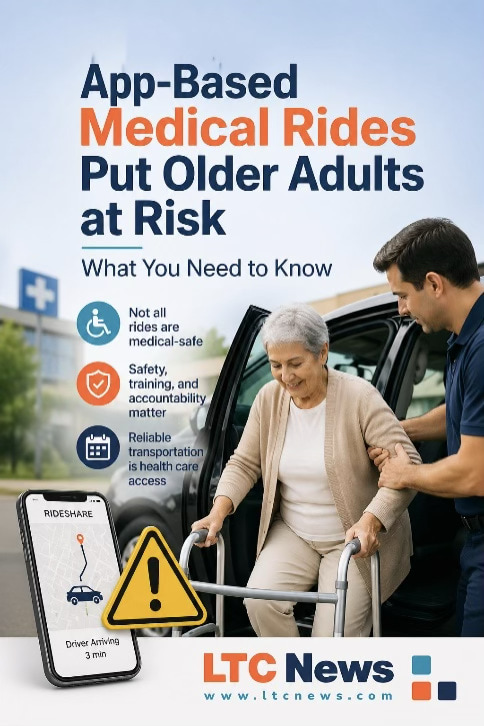
Key Questions to Ask Before Booking a Medical Ride
Before booking any medical ride, ask:
- Does the driver have training to assist with mobility needs?
- Is the vehicle equipped for wheelchairs or walkers?
- What happens if the ride is late or canceled?
- Who is responsible if something goes wrong?
- Is this service designed for medical transport, or just adapted from rideshare?
You can also explore vetted providers using the LTC News Caregiver Directory to find safe transportation for older adults and care services in your area.
What to Ask a Long-Term Care Facility About Transportation
When you or a loved one moves into a long-term care setting, transportation to medical appointments becomes part of daily life, not an occasional need. But not all facilities handle it the same way.
Start by researching long-term care facilities on the LTC News Caregiver Directory. Narrow down options and start asking questions. Asking the right questions upfront when evaluating facilities for a loved one can prevent confusion, delays, and added stress later.
Start with the basics:
- Do you provide transportation to medical appointments?
- Some assisted living communities and nursing homes offer scheduled transportation. Others do not.
- If transportation is provided, what is included?
- Ask whether the service covers routine doctor visits, specialist appointments, therapy sessions, and hospital follow-ups.
- Is there an additional cost?
- Transportation may be included in the monthly fee, or billed separately per trip.
- How are appointments scheduled and coordinated?
- Does the facility help arrange transportation, or are families responsible for booking and managing rides?
- What level of assistance is provided?
- Will staff help residents get in and out of the vehicle? Is escort service included for those who need support during the appointment?
- What types of vehicles are used?
- Are they equipped for wheelchairs, walkers, or other medical needs?
- What happens if the facility does not provide transportation?
- Do they coordinate with licensed non-emergency medical transportation providers? Do they recommend vetted services?
- How are delays or missed pickups handled?
- Is there a process in place to ensure residents don’t miss critical appointments?
- Can family members be notified or involved?
- Communication is key, especially if issues arise during transport.
Transportation is more than a convenience; it’s a critical link to ongoing care. A facility that either provides reliable service or actively coordinates safe, appropriate transportation can make a significant difference in maintaining health and independence.
Planning Protects Your Independence
Transportation is often overlooked in long-term care planning—but it plays a critical role. Most long-term care begins at home. Getting to appointments, therapy, and treatments safely is part of staying independent.
Planning usually starts before you retire. Long-Term Care Insurance not only helps pay for your choice of care—it gives you access to better options. Most policies cover in-home care, reducing the need for risky transportation. Some caregivers will provide transportation to doctor's visits. Benefits from an LTC policy are typically tax-free, helping protect your income and assets while ensuring you receive care on your terms.
You can start by exploring Long-Term Care Insurance before a crisis forces you to make decisions that place a burden on your loved ones and could become a financial disaster. Always seek help from a qualified independent Long-Term Care Insurance specialist.
Research: LTC News Long-Term Care Insurance Learning Center
Safety First
App-based rides can be helpful, but they are not a substitute for proper medical transportation. When your safety, recovery, and access to care are at stake, the difference between a convenience service and a care-focused solution matters.
Frequently Asked Questions
What questions should you ask before booking a medical ride?
Before booking, ask:
- Is this a licensed medical transportation provider?
- Are drivers trained in patient assistance?
- Is the vehicle equipped for your specific needs?
- What happens if the ride is delayed or canceled?
- Is there live support available during the trip?
These questions help you avoid risks associated with standard rideshare services.
If a facility doesn’t provide transportation, will they help coordinate it?
Many long-term care facilities will help coordinate rides with licensed NEMT providers or recommend vetted services. However, the level of support varies, so you should ask how involved the facility will be in scheduling and managing transportation.
Do long-term care facilities provide transportation to doctor appointments?
Some facilities offer transportation services, but not all do. It’s important to ask whether transportation is included, what types of appointments are covered, and whether there are additional costs.
What is non-emergency medical transportation (NEMT)?
Non-emergency medical transportation (NEMT) provides rides for people who do not need an ambulance but still require assistance getting to medical appointments. This includes older adults, people with mobility issues, and those undergoing treatments like dialysis or chemotherapy.
Does Medicaid cover non-emergency medical transportation?
Yes, Medicaid often covers NEMT for eligible individuals. However, coverage and services vary by state, and oversight can differ significantly depending on where you live.
Can Long-Term Care Insurance help with transportation needs?
Many Long-Term Care Insurance policies cover services that support independence, including in-home care. Some caregivers can provide transportation to medical appointments, reducing reliance on outside services and improving safety.
Why is transportation so important in long-term care planning?
Transportation is a critical part of maintaining health and independence. Missed or delayed appointments can lead to worsening health conditions, hospitalizations, and increased caregiving needs. Reliable transportation helps ensure consistent access to care.
Are rideshare services like Uber or Lyft safe for medical appointments?
Rideshare services can work for healthy, independent individuals. However, they are generally not designed for patients who need physical assistance, medical support, or accessible vehicles. For older adults or those with health conditions, specialized medical transportation is usually the safer choice.
What is the safest transportation option for older adults?
The safest option is typically a licensed non-emergency medical transportation provider that offers trained drivers, proper equipment, and services tailored to the patient’s needs.
Does Medicare cover transportation to doctor appointments?
In most cases, Medicare does not cover routine non-emergency transportation. Coverage is typically limited to certain medical situations, such as ambulance transport when medically necessary. This leaves many families responsible for arranging and paying for transportation.
What should you look for in a medical transportation provider?
You should look for:
- Trained drivers who can assist with mobility needs
- Accessible vehicles (wheelchair ramps, securement systems)
- Reliable scheduling and on-time performance
- Coordination with healthcare providers
- Clear accountability if something goes wrong
These features help ensure safe and appropriate transportation for older adults.

Sponsored