Aging Isn't What It Used to Be: How Today's 55- to 70-Year-Olds Are Redefining Growing Older
About This Article
Today's older adults are working longer, embracing technology and approaching retirement differently than previous generations. However, longer lives, changing retirement benefits and chronic health conditions present new challenges including needing long-term care.

James Kelly
LTC News staff writer specializing in long-term care and aging.
Table of Contents
- Today's Older Adults Grew Up in a Different America
- More Americans Are Working Into Their Late 60s
- How Older Workers Have Changed
- Why Are People Working Longer?
- Women Are Experiencing a Different Kind of Retirement
- Retirement Finances Have Become More Complicated
- More Older Americans Are Carrying Mortgage Debt
- Are Today's Older Adults Healthier Than Previous Generations?
- Exercise Is Becoming a Greater Part of Older Adults' Lives
- Technology Has Changed the Experience of Aging
- Americans Are Living Longer After Reaching Retirement Age
- Average Remaining Life Expectancy at Age 65
- How Long Can You Expect to Live?
- Is 60 the New 40?
- Many Adults Ages 55 to 70 Are Caregivers Themselves
- Caregiving Responsibilities by Age
- Longer Lives Increase the Importance of Long-Term Care Planning
- Long-Term Care Costs Can Change Your Retirement
- Medicare Won't Pay for Most Long-Term Care
- Make the Most of Your Years Between 55 and 70
- Aging Has Changed. The Need to Prepare Hasn't.
If you're between 55 and 70, your life may look considerably different from that of your parents or grandparents when they were your age. You may still be working full time, running a business, traveling, going to the gym or considering a career change. You might be helping adult children financially, caring for aging parents and contributing to your retirement savings, all at the same time.
Experts who study aging say your generation is different in ways that go beyond lifestyle. "There have never been older people with this much education, income and expectation," says Joseph Coughlin, founding director of the Massachusetts Institute of Technology (MIT) AgeLab.
Those expectations don't change the biology of growing older. Laura Carstensen is the founding director of the Stanford Center on Longevity and the Fairleigh S. Dickinson Jr. Professor in Public Policy and professor of psychology at Stanford University. She says she hopes it's clearer that "the aging process has not changed much, if any, genetically over the last several thousand years."
Rather, longevity, the length of life, increased, and that has enormous implications for nearly all aspects of our lives."— Dr. Laura Carstensen quoted in the Stanford Report in May 2026.
Retirement may be something you're looking forward to rather than something you've already settled into. Even if you're retired, your daily life may bear little resemblance to retirement a generation or two ago. Changes in medicine, technology, employment, education, family structures and the economy have transformed what it means to grow older in America.
But longer and potentially more productive lives come with a different set of responsibilities. The financial security, health and independence you enjoy today may need to last another 25 or 30 years, perhaps longer.
Today's Older Adults Grew Up in a Different America
Today's 55- to 70-year-olds were born roughly between 1956 and 1971. Think of it this way, they were born during the presidencies of Dwight D. Eisenhower, John F. Kennedy, Lyndon B. Johnson and Richard Nixon. They represent the younger baby boomers and older members of Generation X.
They grew up as television expanded. Many watched the Apollo 11 moon landing on a black-and-white set in 1969. Most homes got only a few channels, and you had to get up to change them. In 1981, MTV went on the air, and cable began to change what Americans watched.
They saw the space program change too. Older members of this group may remember Neil Armstrong walking on the moon. Younger members may remember watching the space shuttle Challenger explode in 1986, often on TVs wheeled into their classrooms.
Social norms shifted around them. They grew up amid the civil rights movement, the Vietnam War, Watergate and Title IX, which opened school sports to girls. Many of their mothers went to work in an era when most of their grandmothers had not.
Then came personal computers. The Apple II arrived in 1977, the IBM PC in 1981 and the Macintosh in 1984. Many also remember Atari video games and the first computer labs in their schools.
Many of them entered the workforce in a world of typewriters, carbon paper, fax machines and desk phones with cords. You looked up businesses in the Yellow Pages and did research with printed encyclopedias. Messages came on pink "While You Were Out" slips. Most offices didn't adopt email until the 1990s. Early cellphones were expensive novelties: Motorola's first handheld model went on sale in 1983 for nearly $4,000.
During their working lives, they witnessed globalization, the decline of traditional manufacturing employment, the expansion of the service economy and a shift from traditional employer pensions to retirement savings accounts, including individual retirement accounts (IRAs).
Now, they're adapting to artificial super intelligence.
Compare their experiences with those of someone who turned 65 in 1980. That person was born in 1915. Many homes still had no electricity, and the horse and buggy hadn't yet given way to the car. As children, they would have heard the first commercial radio broadcasts. They were teenagers when the Great Depression hit and in their late 20s during World War II.
Retirement as most Americans know it didn't exist when they were young. Social Security didn't begin until they were 20, and Medicare didn't arrive until they were 50. Many retired with a traditional pension that paid a set amount every month for life.
In one lifetime, they went from a world without electric lights to watching astronauts walk on the moon on live television. Economic conditions, medical advances and changing cultural expectations help explain why these generations approach their later years differently.
More Americans Are Working Into Their Late 60s
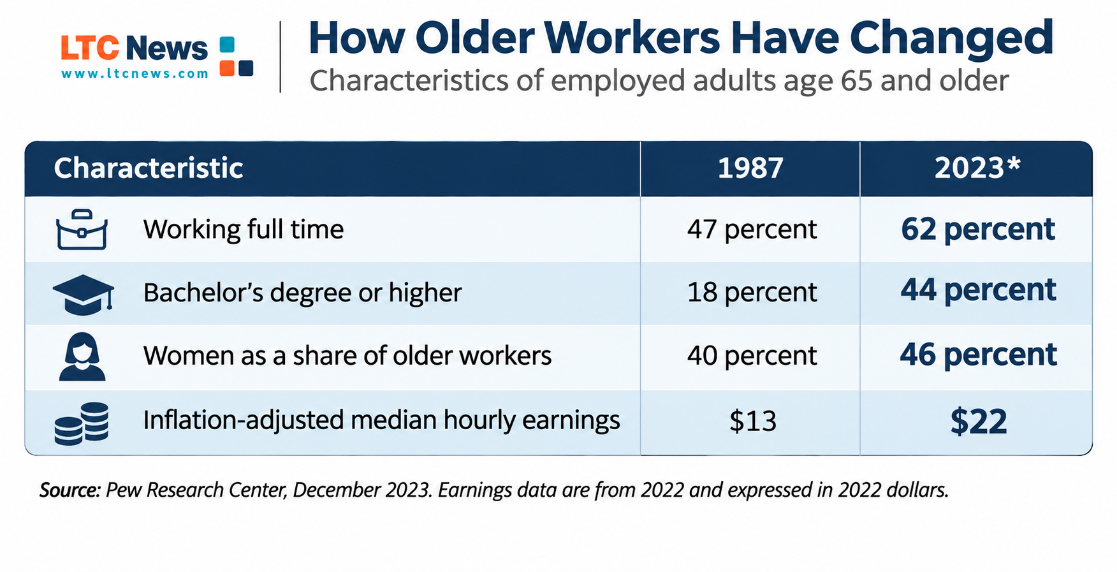
Turning 65 once represented a more predictable transition from employment to retirement. Today, the dividing line is less clear. A 2023 Pew Research Center analysis found that 19 percent of Americans age 65 and older were employed, nearly twice the proportion working in 1987.
Older workers are also better educated, earn more after adjusting for inflation and are more likely to work full time than their counterparts in the late 1980s.
How Older Workers Have Changed
As the Pew Research Center data below illustrates, today's older workers are better educated, more likely to work full time and earning substantially more, even after adjusting for inflation, than their counterparts in the late 1980s.
Working beyond 65, however, is hardly a new phenomenon. According to the U.S. Bureau of Labor Statistics (BLS), 27 percent of Americans age 65 and older participated in the labor force in 1948. That figure fell to a low of 10.8 percent in 1985 before beginning to recover.
The expansion of Social Security and employer-sponsored pensions helped make retirement more accessible during the second half of the 20th century.
More recently, the trend toward working longer has leveled off.

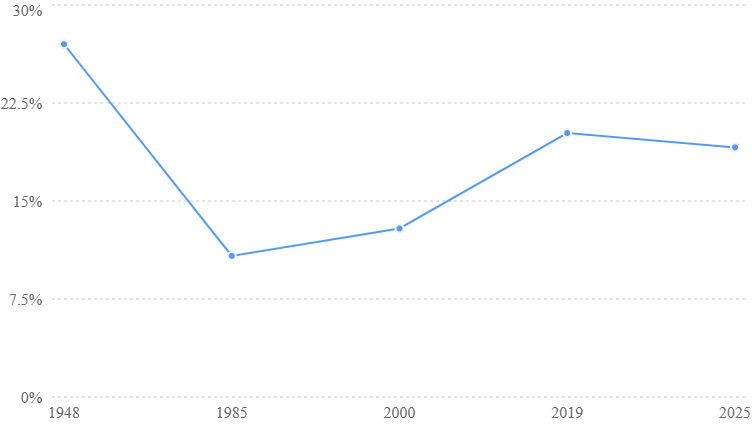
Labor force participation among Americans age 65 and older, selected years. Source: U.S. Bureau of Labor Statistics.
In 2025, 19.1 percent of Americans age 65 and older were working or actively seeking employment. That remains considerably higher than the 12.9 percent recorded in 2000 but below the recent peak of 20.2 percent in 2019.
Changes are also evident among people in their late 50s and early 60s. A separate BLS analysis found that the share of all Americans ages 55 to 64 who were outside the workforce because of retirement fell from 16.8 percent in 1999 to 14.6 percent in 2022.
Why Are People Working Longer?
Several economic and social changes have encouraged Americans to remain employed:
- Greater educational attainment and more opportunities in professional occupations.
- Less physically demanding work in some industries.
- Remote work and flexible employment arrangements.
- Fewer traditional pensions and concerns about retirement savings.
- Social Security's gradual increase in full retirement age from 65 to 67 for younger birth cohorts.
- The need to maintain employer-sponsored health coverage before Medicare eligibility.
- A desire to remain productive, socially connected and intellectually engaged.
Some people work because they enjoy what they do. Others can't afford to stop. For many, the motivation is a combination of both.
Women Are Experiencing a Different Kind of Retirement
One of the most significant generational changes involves women. Many women approaching retirement today have spent decades building careers, accumulating retirement savings and earning Social Security benefits based on their own employment histories.
Women accounted for 46 percent of employed Americans age 65 and older in 2023, compared with 40 percent in 1987 and 33 percent in 1964, according to Pew Research Center. Greater economic independence has expanded women's choices about marriage, housing, retirement and financial planning. However, time away from the workforce to raise children or care for aging relatives can still reduce lifetime earnings and retirement benefits. The damage can be permanent.
Cindy Hounsell, founder and president of the Women's Institute for a Secure Retirement (WISER), says many women claim Social Security at 62 or take early 401(k) withdrawals to help keep a parent at home, without realizing what it costs them.
"They're not aware of any of the penalties," Hounsell told the Stanford Center on Longevity's SCL Magazine. "And then it's a penalty for the rest of your life."
The U.S. Department of Health and Human Services (HHS) estimates that 64 percent of women turning 65 will eventually develop a disability serious enough to require long-term services and supports, compared with 49 percent of men.
For a woman who outlives her spouse, the financial consequences of needing care can be particularly significant. She may have fewer family caregiving resources available while facing expenses that must be financed from her own income and remaining household assets.
Retirement Finances Have Become More Complicated
Your parents or grandparents may have retired with a paid-off mortgage, Social Security and an employer pension providing predictable monthly income. That arrangement was never available to everyone, but traditional pensions have become less common in the private sector.
Today's adults approaching retirement increasingly depend on a combination of Social Security, 401(k) plans, IRAs, investments, annuities and personal savings. More responsibility for managing investment risk, inflation and longevity now rests with individuals rather than employers.
The Federal Reserve's Report on the Economic Well-Being of U.S. Households in 2025, released in May 2026, illustrates that shift.
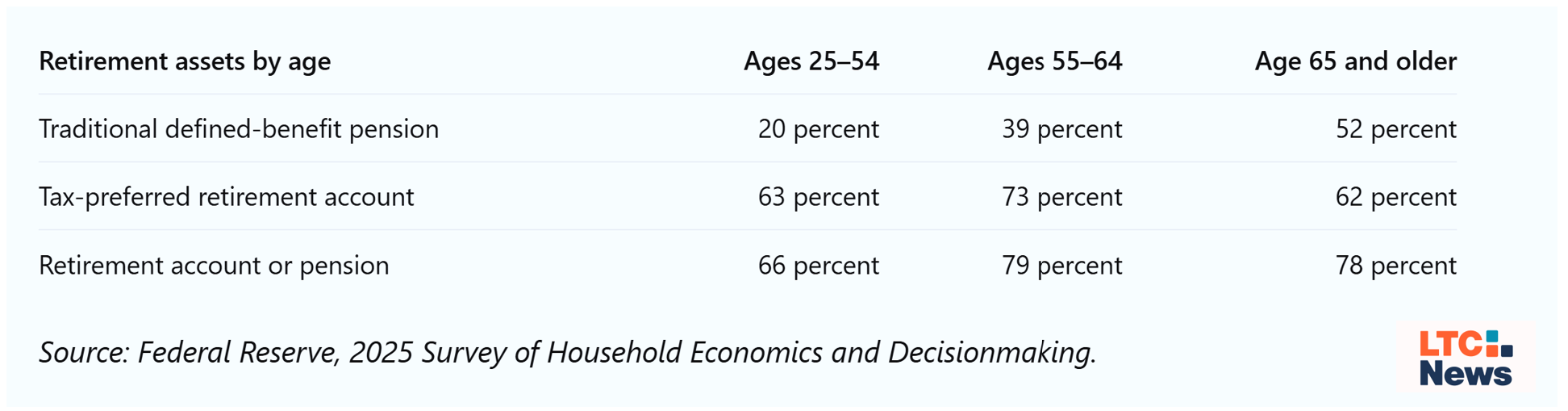
Despite the widespread availability of retirement savings accounts, only 35 percent of nonretired adults believed their retirement savings were on track in 2025, unchanged from 2024. Retirement accounts offer flexibility and opportunities to accumulate substantial wealth. They also require decisions about investment allocations, withdrawals and how much money you can safely spend without outliving your savings.
Having $1 million in a retirement account is different from receiving a guaranteed pension for life. Your savings may need to support decades of living expenses, taxes, health care and unexpected financial setbacks.
A market downturn early in retirement or several years of expensive long-term care can disrupt even a carefully developed financial plan.
More Older Americans Are Carrying Mortgage Debt
Housing is another significant difference between generations. Harvard University's Joint Center for Housing Studies found that older homeowners are increasingly carrying mortgage debt into retirement.
According to its report, Housing America's Older Adults 2023, both the prevalence and amount of mortgage debt increased substantially between 1989 and 2022.
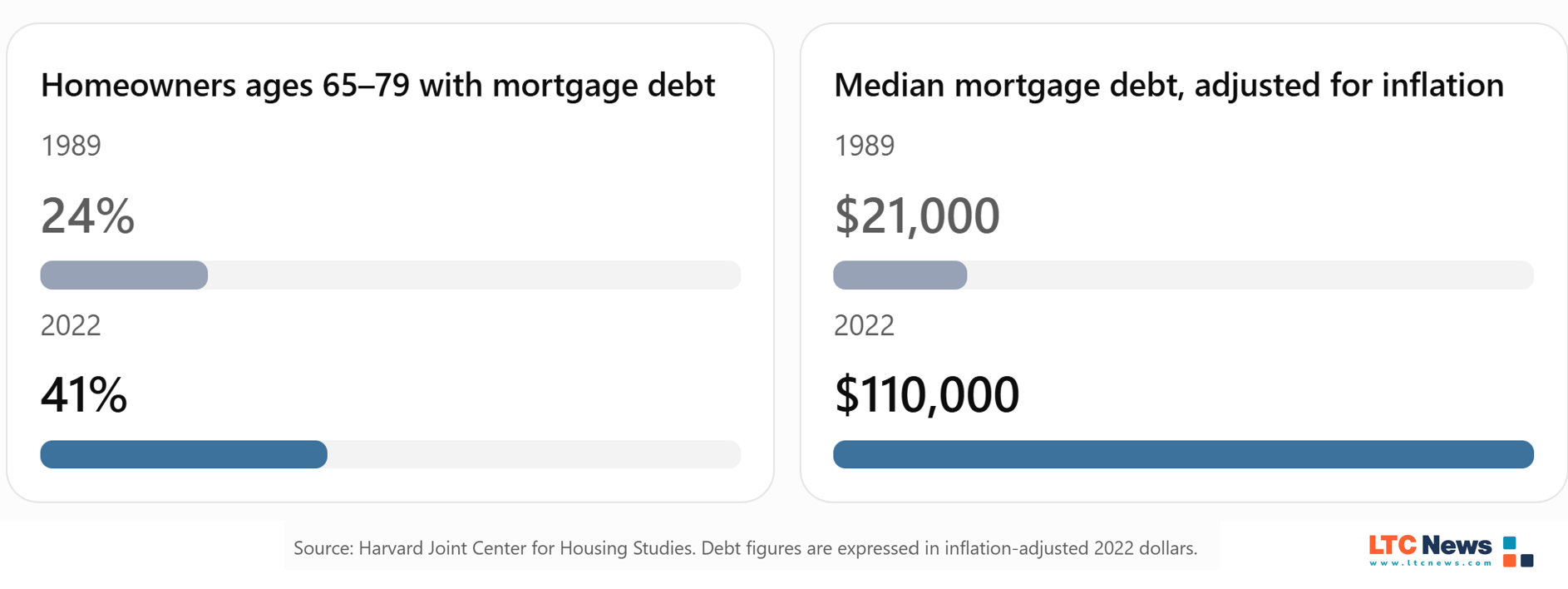
Housing wealth can provide considerable financial security, particularly for those who purchased homes decades ago in communities where property values have appreciated. However, home equity isn't readily available income. Mortgage payments, property taxes, homeowners insurance, repairs and utilities continue to consume household resources.
Those expenses don't disappear when someone develops dementia or needs assistance with daily living. Maintaining a home while paying for care can place considerable pressure on retirement income.
Are Today's Older Adults Healthier Than Previous Generations?
The answer is more complicated than you might expect. Medical advances have improved survival rates for many serious health conditions. Better treatments for heart disease, cancer and diabetes allow many people to remain employed, active and independent.
Joint replacements can restore mobility. Cataract surgery can improve vision. Advances in cardiac care allow people to resume many of their normal activities after a heart attack. Conditions that once ended careers or substantially shortened lives are increasingly manageable. However, living longer with a medical condition isn't the same as avoiding that condition altogether.
Dr. Christina Chen, a Mayo Clinic physician in internal medicine and geriatrics, says that many people are living longer with chronic disease, reduced mobility, cognitive impairment and increasing dependence.
Doctors have been very successful at extending lifespan, but less effective at preserving the quality of those added years." — Dr. Christina Chen.
As people become more dependent on others for everyday tasks, many eventually need long-term care. Lifespans have grown longer, but healthspans, the years lived in good health, haven't kept pace. Greater dependence impacts families and finances and for someone without Long-Term Care Insurance, or who qualifies for Medicaid, the burden can be tremendous.
A 2024 study published in The Journals of Gerontology: Series B, examining generational trends in health and disability in the United States and Europe, challenges the assumption that each successive generation is necessarily healthier than the previous one.
Researchers Gimeno, Goisis, Dowd and Ploubidis examined health and disability trends involving approximately 114,500 adults age 50 and older:
- United States: 26,939 participants.
- England: 14,992 participants.
- Eleven continental European countries: 72,595 participants.
The researchers found that chronic disease became more prevalent across successive generations at comparable ages. Improvements in disability rates also slowed, stalled or reversed among some generations born after 1945.
The study's authors suggest that the growing prevalence of chronic illness could contribute to greater functional limitations as these generations age. The research examined birth cohorts through 1959, capturing some of today's older baby boomers but not establishing the same trends for younger boomers or Generation X.
Earlier diagnosis and better detection may explain some of the increase in reported chronic conditions. Nevertheless, the findings illustrate an important distinction. Modern medicine may allow you to remain active while managing one or more chronic illnesses. It doesn't necessarily prevent those conditions from eventually affecting your ability to live independently.
Exercise Is Becoming a Greater Part of Older Adults' Lives
You may spend your weekends cycling, hiking, golfing or playing pickleball. You might participate in strength training, yoga, swimming or organized fitness classes. Recreational exercise has become more common among older Americans.
Research using National Health Interview Survey data from 1998 through 2018 found increases in the percentage of older adults meeting recommended aerobic exercise guidelines. The federal government's Physical Activity Guidelines for Americans Midcourse Report, published in 2023, also found that the percentage of adults age 65 and older meeting both aerobic and muscle-strengthening recommendations increased from 5.5 percent in 1998 to 13.9 percent in 2018. Despite that improvement, most older Americans still fall short of both recommendations.
It's also worth distinguishing recreational exercise from overall physical activity. Previous generations frequently worked in occupations requiring physical labor. Modern office jobs, automation and technology can reduce daily movement, even among people who exercise regularly.
Regular physical activity helps preserve muscle strength, balance, cardiovascular health and mobility—all important components of maintaining independence as you age.
Technology Has Changed the Experience of Aging
Many of today's older adults remember life before answering machines, personal computers and mobile phones. Yet they've spent much of their adult lives adapting to technological change.
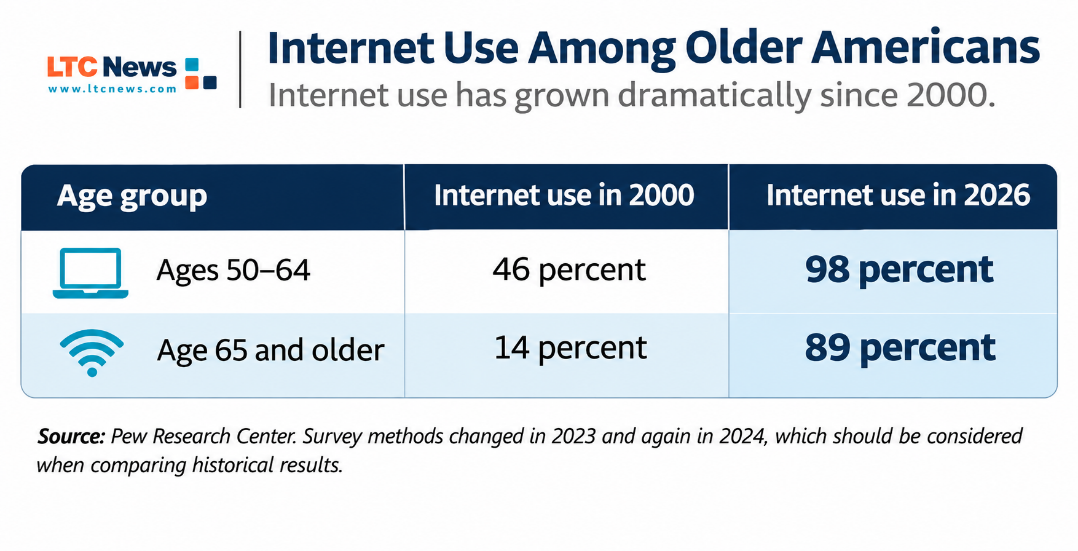
According to Pew Research Center's October 2026 internet-use data, internet adoption among older Americans has increased dramatically since the beginning of the century.
Technology has made it easier to work remotely, manage investments, communicate with grandchildren, maintain friendships and access medical care. As the Pew Research Center data below shows, internet use has become nearly universal among Americans ages 50 to 64, while adults 65 and older have made remarkable gains in digital connectivity since 2000.
Wearable devices can monitor heart rhythms and detect falls. Smart-home technology, medication reminders and emergency response systems can help older adults remain at home. Technology also introduces challenges, including financial scams, identity theft and increasingly complex digital systems. Its benefits depend partly on access, affordability and the ability to use it.
Americans Are Living Longer After Reaching Retirement Age
Perhaps the most consequential difference between today's older adults and those of previous generations is how long they can expect to live after reaching retirement age. Life expectancy at birth isn't necessarily the most useful measure for someone approaching retirement. If you're already 65, you've survived many of the health risks that influence life expectancy earlier in life. Your remaining life expectancy provides a more relevant starting point for retirement planning.
Historical Social Security Administration data and 2024 mortality statistics from the National Center for Health Statistics (NCHS) illustrate how longevity has changed.
Average Remaining Life Expectancy at Age 65
In 2024, a 65-year-old man could expect to live another 18.4 years and a woman another 20.8 years, well beyond what Americans the same age could expect in 1940 or 1950.
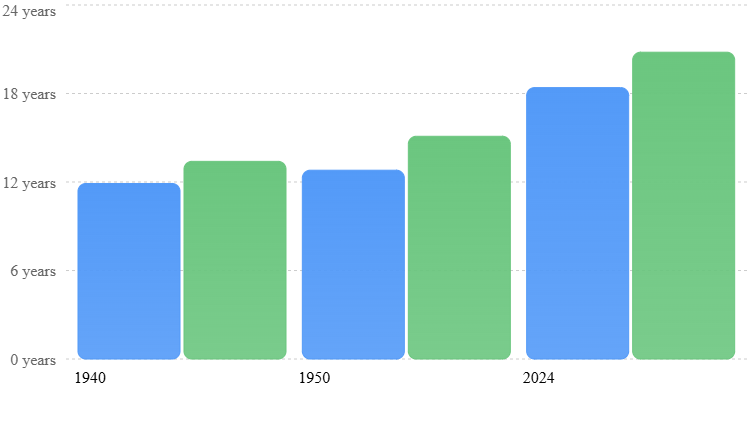
Average remaining years of life at age 65 - spacing not to scale.
Blue = Men
Green = Women
Sources: Social Security Administration and National Center for Health Statistics. Period life expectancy estimates.
Compared with 1950, a 65-year-old man in 2024 could expect approximately 5.6 additional years of life. For women, the increase was approximately 5.7 years. The federal government's United States Life Tables, 2024, published Aug. 25, 2026, provides a more detailed picture of remaining life expectancy.
How Long Can You Expect to Live?
The longer you live, the longer you can expect to live. The latest federal life tables show that the average age at death rises at every stage, because each year you survive puts you past more of the health risks that end lives earlier.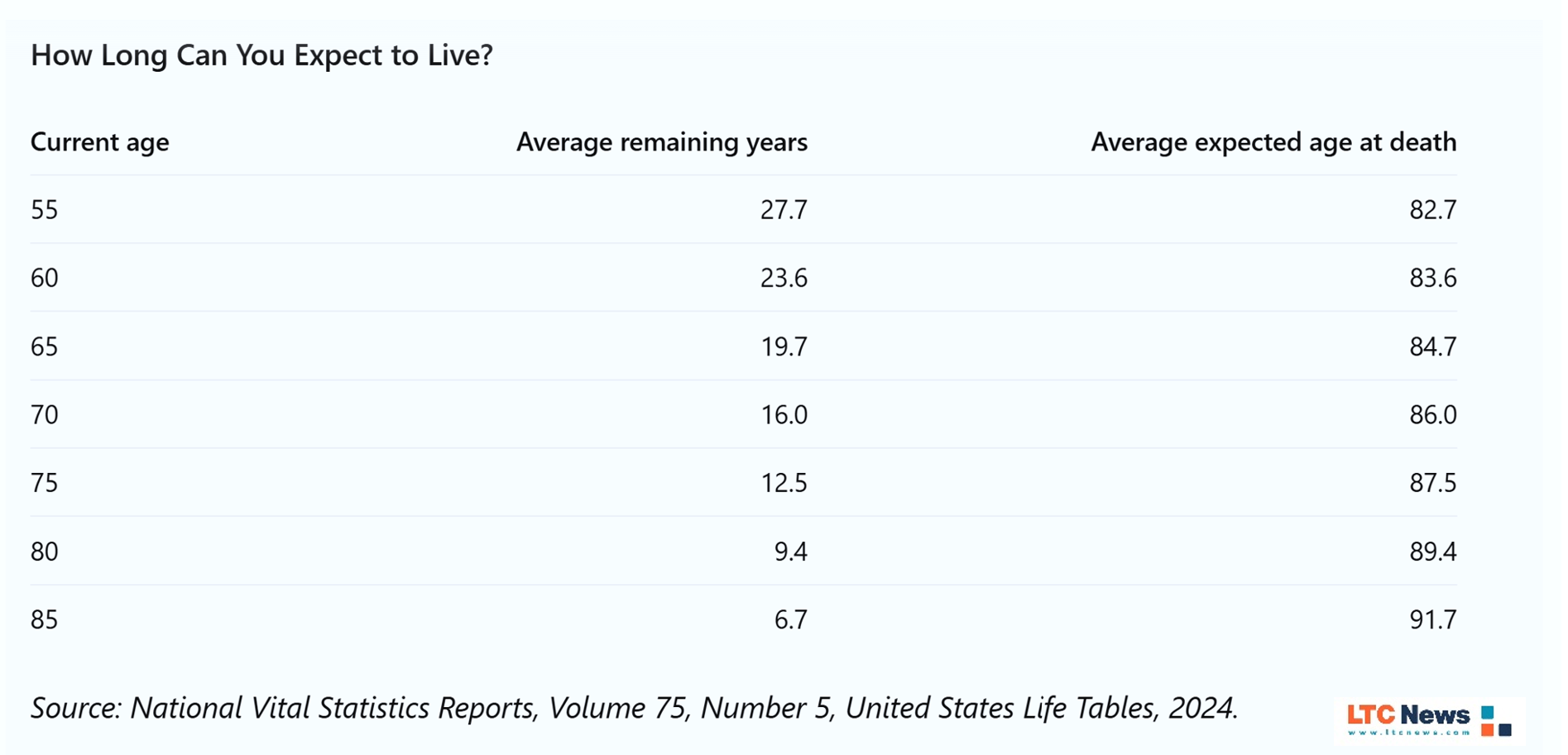
Notice that the average expected age at death increases as you grow older. That's because people who reach an older age have already survived health risks and other causes of death that affected others at younger ages.
These figures are population averages based on 2024 mortality rates, not individual predictions or guarantees of future lifespan. At age 65, women have an average remaining life expectancy of 20.8 years, compared with 18.4 years for men. Many people will live well beyond those averages.
For married couples, retirement planning also needs to account for the possibility that one spouse will significantly outlive the other. A financial plan designed to support you until age 80 could fall considerably short of your actual needs.
Is 60 the New 40?
Chronological age doesn't necessarily reflect your physical capabilities, interests or ambitions. You might be 62 and still managing a successful business, attending concerts, traveling internationally or taking college courses.
Changing attitudes toward aging, advances in medical care and opportunities for professional and social engagement have expanded what many older adults consider possible. However, there are substantial differences within every generation.
A 60-year-old construction worker with decades of physically demanding employment may experience aging differently from a similarly aged attorney or accountant. Income, education, genetics, occupation, access to health care and lifestyle all influence how people age.
Not everyone has the financial resources, health or flexibility to experience an active retirement. The expression that 60 is the new 40 reflects changing expectations about aging. It isn't a biological reality.
Many Adults Ages 55 to 70 Are Caregivers Themselves
One consequence of increased longevity is that you may be approaching retirement while your parents are still alive and need considerable assistance. Someone in their early 60s may have a parent in their 90s, adult children in their 30s and grandchildren.
You could be helping an adult child purchase a home, contributing to a grandchild's education and managing an aging parent's medical appointments, finances and personal care. A November 2026 NCHS report on adult caregivers in the United States estimates that 47 million American adults regularly assisted a friend or relative with an illness or disability during the 30 days preceding their interviews.
Caregiving was particularly prevalent among adults approaching or entering retirement.
Caregiving Responsibilities by Age
Caregiving peaks in midlife and early retirement. Nearly one in four adults ages 50 to 74 provided regular care to a friend or family member in 2025, according to the National Center for Health Statistics (NCHS).
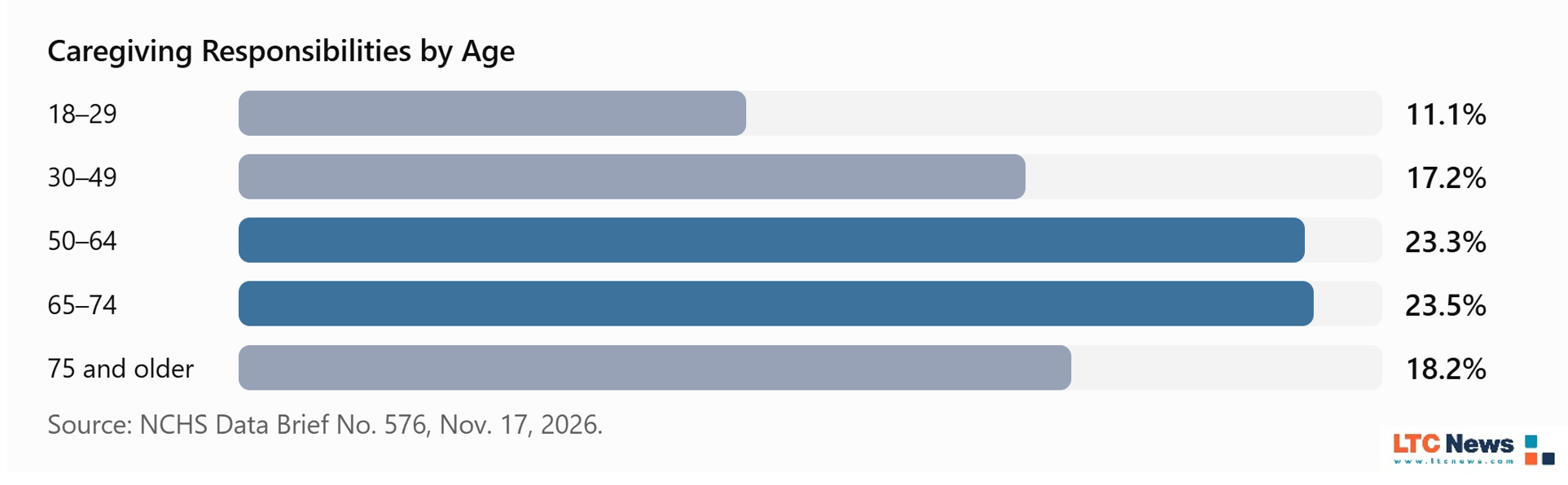
Nearly one in four adults in the two age groups encompassing today's 55- to 70-year-olds reported caregiving responsibilities.
Helping a parent can interfere with employment, retirement savings, travel and social activities. Caregiving can also take a toll on your physical and emotional health. Watching your parents experience the challenges of aging may provide valuable insight into what your own family could face in another 20 or 30 years.
Longer Lives Increase the Importance of Long-Term Care Planning
Living longer gives you more opportunities to enjoy retirement, spend time with family and pursue interests you may have postponed during your working years. It also increases your exposure to age-related physical limitations, frailty, chronic illness and cognitive decline.
A 2022 research brief from the HHS Office of the Assistant Secretary for Planning and Evaluation (ASPE) estimates that 56 percent of Americans turning 65 will eventually develop a disability serious enough to require long-term services and supports. The research also estimates that 22 percent of Americans turning 65 will experience a qualifying disability lasting more than five years.
The study uses a disability threshold consistent with federal tax-qualified Long-Term Care Insurance benefit eligibility standards. Generally, that means needing substantial assistance with at least two of six activities of daily living (ADLs) due to a loss of functional capacity expected to last at least 90 days or requiring substantial supervision because of severe cognitive impairment. The six ADLs are bathing, dressing, eating, toileting, transferring and continence.
So, what is long-term care? Long-term care refers to assistance needed for more than 90 days due to aging, illness, disability, or an accident. It can be provided at home or in a care facility and primarily involves non-medical, custodial care that helps with everyday activities such as dressing, eating, and bathing. Long-term care doesn't necessarily mean moving into a nursing home. Most people receive assistance in their own homes or eventually transition to assisted living or memory care.
For someone who has spent decades managing a career, raising a family and maintaining financial independence, losing control over everyday decisions can be difficult. Experts say that planning gives you more control over where you receive care, who provides it and how you pay for it.
Long-Term Care Costs Can Change Your Retirement
According to the LTC News Cost of Care Calculator, the cost of long-term care services depends on the type of services you require and where you live. The national median monthly long-term care costs as of November 2026 are:
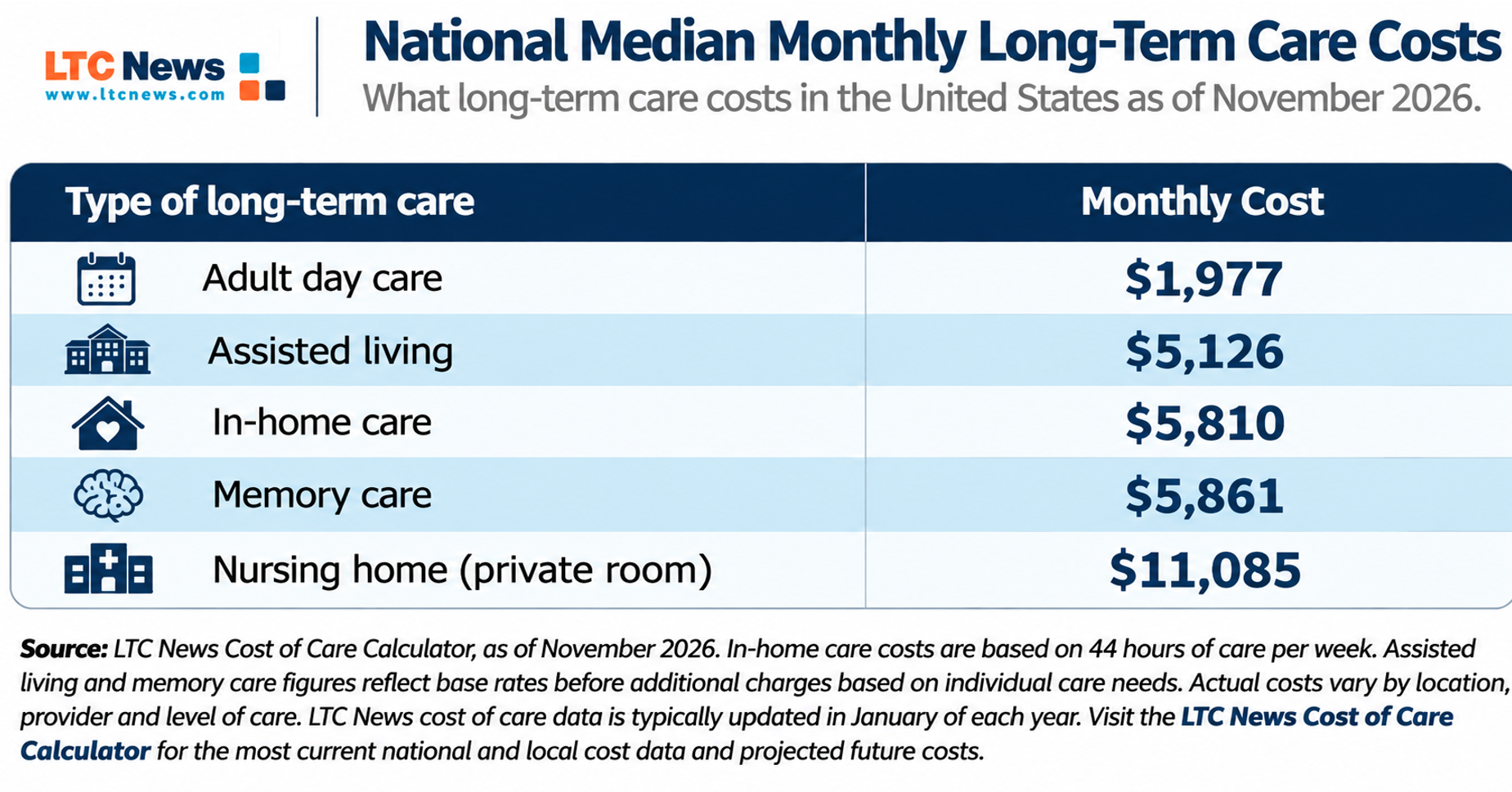
Those figures reflect today's costs. If you're 60 and don't need care until age 85, you have another 25 years of potential cost increases. Assuming an annual increase of 3 percent, in-home care costing $5,810 a month today would cost approximately $12,165 a month in 25 years.
Three years of care at that projected monthly rate would cost nearly $438,000, even without further increases during those three years. Actual future costs will vary depending on labor expenses, economic conditions, local demand and the type and amount of care you need.
Understanding what care could cost in the community where you live or plan to retire allows you to incorporate those expenses into your retirement strategy rather than reacting to a financial crisis later. It can also be helpful if you are researching extended care options for an older loved one. As you search for caregivers or long-term care facilities on the LTC News Caregiver Directory you can compare their costs with the average costs which can be helpful in making a good decision.
Medicare Won't Pay for Most Long-Term Care
If you're approaching retirement, understanding the difference between medical care and long-term care is essential. Traditional health insurance and Medicare primarily cover medical treatment and qualifying skilled care, not the ongoing personal assistance associated with chronic illness, dementia or aging.
Medicare Part A may cover up to 100 days of skilled nursing facility care per benefit period when eligibility requirements are met. It does not generally cover extended custodial care. Medicaid pays for long-term care services for people who meet applicable financial and functional eligibility requirements. Rules governing income, assets and available services vary by state.
Without Long-Term Care Insurance or another funding strategy, the responsibility for financing care generally falls on you and your family. Tax-qualified Long-Term Care Insurance can provide generally tax-free benefits, subject to federal requirements and policy provisions, for care at home, adult day care, assisted living, memory care and nursing homes.
Traditional LTC Insurance and hybrid life insurance or annuity policies with qualified long-term care benefits offer different approaches to financing care. Short-term care insurance may provide an alternative for some people whose age or health limits their other options.
In participating states, qualified Partnership Long-Term Care Insurance policies can provide additional asset protection under Medicaid eligibility rules.
Based on LTC News research, most people who look into and apply for Long-Term Care Insurance do so between ages 47 and 67. Your age and health when you apply influence your eligibility, premium and available coverage options. Waiting until retirement or until your health begins to decline could substantially reduce your choices.
Make the Most of Your Years Between 55 and 70
These years offer an opportunity to enjoy the freedom you've earned while preparing for the decades ahead. Some of the most important decisions you can make now involve your health, finances, family and living arrangements.
- Maintain your physical strength and mobility. Regular exercise, strength training, balance training and preventive medical care can help you remain independent.
- Prepare for a lengthy retirement. Evaluate how your income and investments would support you through several decades, including periods of inflation and market volatility.
- Talk with your family about future care. Don't assume your adult children will have the time, resources or ability to provide extensive personal care.
- Evaluate your home. Consider whether your current home would remain suitable if you developed mobility limitations.
- Review your legal and financial arrangements. Update powers of attorney, advance health care directives, beneficiary designations and estate plans as necessary.
- Explore ways to finance long-term care. Consider insurance and other funding strategies while your health and age still give you choices.
NOTE: If you're already helping an aging parent, the LTC News Caregiver Directory provides access to more than 80,000 long-term care providers nationwide. You can search for care providers by ZIP code to find services close to your loved one.
Families with existing LTC Insurance can access free Long-Term Care Insurance claims assistance. LTC News partners with Amada Senior Care to provide free claim support with no cost or obligation — File a Long-Term Care Insurance Claim.
Aging Has Changed. The Need to Prepare Hasn't.
Today's adults ages 55 to 70 have challenged many traditional assumptions about growing older. They're entrepreneurs, employees, volunteers, travelers, athletes, grandparents and caregivers. Many continue to build businesses, establish new relationships and pursue ambitions that once seemed unlikely at their age.
Your 60s may represent the beginning of a new chapter rather than the closing of an old one. Your parents and grandparents grew older in a different world. They had different opportunities, different expectations and different financial challenges.
You have the benefit of knowing more about aging and having more options to prepare for it. Enjoy your health, pursue your interests, travel, spend time with your family and continue working if that's what you enjoy. The active, independent life you enjoy at 55 is worth protecting at 80 and beyond.
Frequently Asked Questions
Does staying physically active reduce your risk of needing long-term care?
Regular physical activity can help preserve muscle strength, mobility and balance while reducing certain health risks. However, it cannot eliminate the possibility of developing dementia, chronic illness, frailty or other disabilities that require long-term care.
How long can a 65-year-old expect to live?
According to 2024 federal life tables published in August 2026, a 65-year-old American has an average remaining life expectancy of 19.7 years. Women average 20.8 additional years, while men average 18.4 additional years. Many individuals live well beyond those averages.
Can you get Long-Term Care Insurance with diabetes or another chronic condition?
Possibly. Having diabetes or another chronic illness doesn't automatically disqualify you from obtaining coverage. Eligibility depends on the condition, its severity, treatment, complications, overall health and the insurance company's underwriting guidelines.
An experienced Long-Term Care Insurance specialist can compare underwriting requirements across multiple insurance companies.
Are today's 60-year-olds healthier than previous generations?
Not necessarily. Medical advances have improved survival and the management of many health conditions. Recreational exercise has also become more common among older adults. However, research suggests some recent generations have higher rates of chronic illness than previous generations at comparable ages.
Is it too late to purchase Long-Term Care Insurance at 65 or 70?
Not necessarily. Traditional and hybrid Long-Term Care Insurance options may remain available at these ages, depending on health and underwriting requirements. Short-term care insurance may offer another option for some applicants. Planning earlier generally provides more choices and lower premiums for comparable coverage.

Sponsored