7 Health Care License Changes Employers Cannot Afford to Discover Late

About This Article
An active license for a healthcare provider or longterm care facility doesn’t always tell the full story. Restrictions, suspensions, expired credentials, and regulatory actions can affect physicians, nurses, and other care professionals — as well as the agencies and facilities families rely on for safe, dependable care.

Jacob Thomas
Jacob Thomas writes on health, wellness, and retirement topics, including aging, caregiving, insurance, and long-term care.
Table of Contents
- The Check Isn't the Problem. The Answer Is.
- 1. Probation and Practice Restrictions
- 2. Emergency and Summary Suspensions
- 3. Surrender During an Investigation
- 4. The Quiet Nonrenewal
- 5. Discipline in Another State
- 6. DEA and Controlled-Substance Authority Changes
- 7. Compact and Residency Changes
- What a Simple Lookup May Miss
- The Facility or Agency Needs Checking, Too
- Why Periodic Recredentialing Can Leave a Gap
- What Families Should Ask
- Where Health Care Organizations Can Start
A health care organization or family may check the license or credentials of a physician, nurse, or other care professional. They may also check a home care or home health agency, assisted living community, nursing home, or another extended care provider.
The record may say ACTIVE, but that may not tell the whole story. A physician could be practicing under a board order that requires supervision or limits certain types of care. A nurse or other professional could have restrictions on a license or credential. An agency or facility could have regulatory issues that aren't obvious from a simple status check.
In other words, a license or credential may be current, but there can be important conditions attached.
Different types of care also come with different requirements. Physicians, nurses, therapists, pharmacists, and other professionals may need licenses or other credentials. Certified nursing assistants (CNAs) are generally certified and listed on state nurse aide registries. Home care aides and other caregivers may have different training, certification, registry, or background-check requirements depending on the state.
For families, the terminology matters less than the answer: Is this person, and the organization providing the care, properly qualified, current, and authorized to provide the care my loved one needs?
For health care providers and organizations, the goal is just as practical: hire the best-qualified people, protect patients, and make sure employees and contractors remain properly credentialed and in good standing.
That is why simply asking "Is the license active?" may only be the beginning.
The Check Isn't the Problem. The Answer Is.
Credentialing programs document whether required verification occurred. Organizations query primary sources, record the results, and repeat the process as required by applicable credentialing requirements. But a status field may not tell the entire story.
Important information may appear elsewhere on a licensing board's website, in a disciplinary order, on a state registry or in another jurisdiction. And a credential can change after the last verification.
The appropriate check also depends on what is being verified. A physician's medical license, a nurse's multistate privilege, a CNA's certification or registry status, and a home health agency's operating license are not interchangeable. Different regulators maintain different records, and requirements vary by profession, care setting, and state.
That creates a potential gap between what an organization verified then and what is true now.
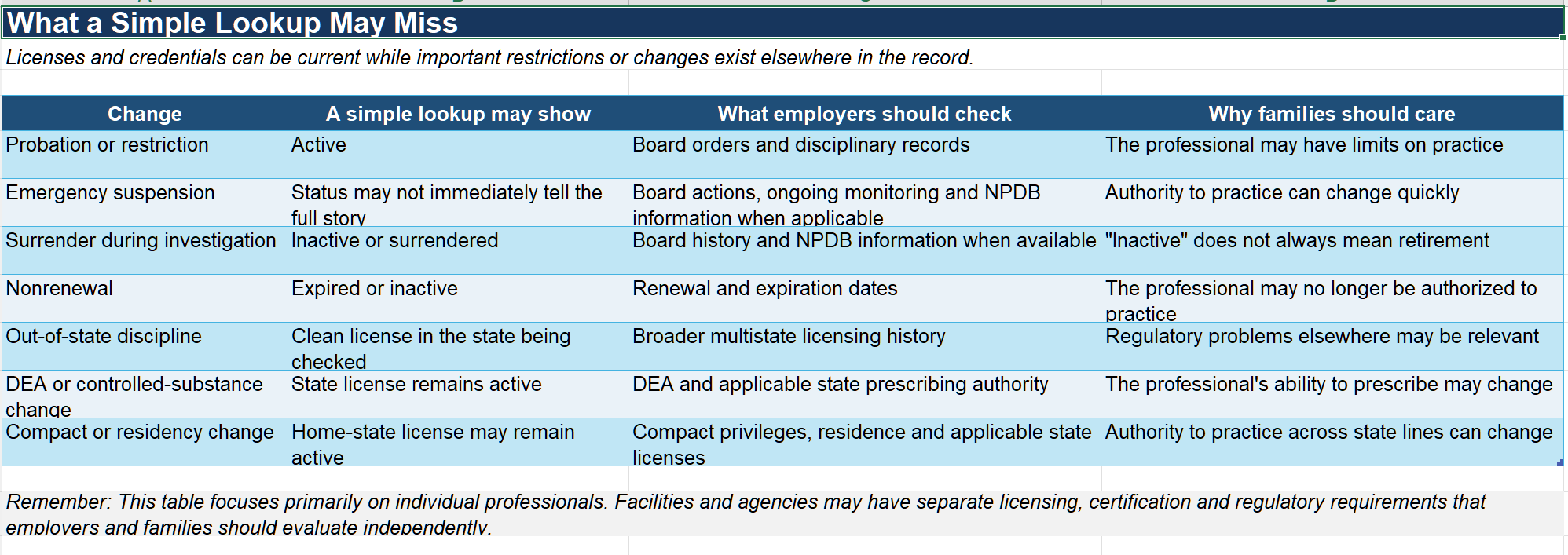
Here are seven changes health care organizations should understand.
1. Probation and Practice Restrictions
A license can remain active while the professional practices under restrictions. Depending on the board action, those conditions might include supervision, chart reviews, limitations on scope of practice, or restrictions involving particular patient populations.
How prominently those conditions appear varies by licensing authority. Details may be contained in a disciplinary record, consent order, or other board document rather than the main status field.
- For employers, failing to identify a restriction can create credentialing, privileging, compliance, and patient-safety concerns.
- For families, the issue is more straightforward: "Active" does not necessarily mean "unrestricted."
2. Emergency and Summary Suspensions
Emergency actions can happen quickly because regulators may act before a case reaches final resolution when they believe patient safety is at risk.
A state board's emergency or summary suspension may be reportable to the National Practitioner Data Bank (NPDB) even when it is an interim action. NPDB guidance specifically recognizes qualifying summary and emergency license suspensions as reportable state licensure actions.
Separately, hospitals and other eligible health care entities generally must report qualifying adverse clinical privileges actions that last longer than 30 days.
The distinction is important because a professional's state license, clinical privileges, and other credentials are related but separate. Employers need processes capable of identifying significant changes between scheduled credentialing reviews.
Families generally will not be monitoring regulatory databases themselves. They rely on hospitals, home health agencies, long-term care providers, and other organizations to know whether the professionals caring for them remain appropriately credentialed and qualified.
3. Surrender During an Investigation
A surrendered license deserves more attention than the status label alone may provide. A provider may surrender a license while under investigation or as part of an agreement that ends or avoids further proceedings.
Someone reviewing only the current status could see "surrendered" or "inactive" without understanding why the professional stopped practicing.
That is different from someone voluntarily allowing a license to become inactive because of retirement, relocation, or another routine reason.
The NPDB has reporting requirements addressing certain license surrenders connected with investigations. Employers should therefore consider the circumstances surrounding a surrender rather than treating every inactive credential the same way.
4. The Quiet Nonrenewal
Not every credentialing problem involves misconduct. A professional may fail to renew because of an unpaid fee, incomplete continuing education, an administrative mistake, or a missed renewal notice.
There may be no dramatic disciplinary order. The license, certification, or registration may expire or become inactive. If a required credential lapses, the professional may no longer be authorized to provide certain services. Depending on the circumstances, that can create patient-safety, employment, reimbursement, and regulatory problems.
Routine expiration tracking is therefore just as important as monitoring disciplinary actions. For families, an expired credential is also a reminder that screening should not end on the day someone is hired.
5. Discipline in Another State
Health professionals increasingly hold licenses in multiple states, particularly those working in telehealth, behavioral health, staffing, and multistate health systems. An organization may naturally focus on the license covering the state where the professional currently works. But disciplinary action elsewhere can still matter.
A physician, nurse, therapist, or other professional may have trained or practiced in another state or continue to hold licenses in several jurisdictions. An action in one jurisdiction may also eventually affect licensure elsewhere.
That makes a broader licensing history valuable when evaluating professionals with multistate practice histories. For families, the important point is that a clean license in one state does not necessarily describe a professional's entire regulatory history.
6. DEA and Controlled-Substance Authority Changes
A state professional license and authority to prescribe controlled substances are not the same credential. A physician or other authorized prescriber's ability to prescribe controlled substances can change even while the underlying professional license remains active.
Employers may therefore need to monitor Drug Enforcement Administration registration and applicable state controlled-substance authority separately from the professional license. This matters to patients and families when a clinician's responsibilities include prescribing controlled medications, including certain pain medicines, anxiety medications, and other controlled substances.
An active medical license does not by itself establish that every prescribing credential remains valid.
7. Compact and Residency Changes
Interstate licensing compacts have made it easier for some health professionals to practice across state lines. They have also added another detail for credentialing teams to track. Under the Nurse Licensure Compact, for example, a nurse who changes primary residence from one compact state to another must apply for a multistate license in the new home state within 60 days.
Moving to a noncompact state changes how the nurse's former multistate license operates, and the nurse must have the appropriate authority to practice where care is being provided.
Individual states also retain authority over professional practice within their borders. Compact status has become particularly important for health systems, staffing organizations, home health providers, and telehealth companies whose professionals may serve patients in several states.
What a Simple Lookup May Miss
The Facility or Agency Needs Checking, Too
Individual credentials are only one side of the equation. The organization providing care may have its own credentials and regulatory requirements.
Depending on the type of care and the state, nursing homes, assisted living communities, home health agencies, hospice providers, home care agencies, and other care organizations may operate under licenses, certifications, or regulatory approvals.
Those credentials and approvals can change. Depending on the regulatory framework, a facility or agency can face deficiencies, sanctions, restrictions, enforcement actions, or changes in its licensing or certification status.
For families evaluating long-term care, there are therefore two levels to consider:the organization providing the service and the people providing the hands-on or clinical care.
A family considering a home health agency, for example, may want to know whether the agency meets applicable licensing and certification requirements. But that does not replace appropriate checks on the nurses, therapists and other professionals who will actually enter the home.
The same principle applies to nursing homes, assisted living communities and other care settings.
For health care organizations, the issue extends to outside agencies, staffing companies and other contracted care partners. Verifying the individual worker does not necessarily answer questions about the organization supplying that worker.
Why Periodic Recredentialing Can Leave a Gap
Credentialing requirements vary by organization, profession, payer, state, and accreditation standard. Some widely used accreditation standards allow formal recredentialing cycles of up to 36 months.
Licenses, certifications, and disciplinary records don't operate on that schedule. A licensing board can impose a restriction. A license or certification can expire. A professional can move between states. Prescribing authority can change. An exclusion can appear. An agency or facility can face a regulatory action.
The U.S. Department of Health and Human Services Office of Inspector General updates its List of Excluded Individuals/Entities monthly. The National Practitioner Data Bank also receives reportable licensing and other adverse actions under federal reporting requirements.
The practical question for health care organizations is therefore not simply whether a professional was appropriately credentialed when hired or last recredentialed. It is: Has anything important changed since then?
Technology has made more frequent monitoring practical. License verification services can help organizations track expirations, status changes, and disciplinary information across jurisdictions rather than relying exclusively on periodic manual checks.
The right approach depends on the organization's size, workforce, regulatory obligations, and the types of professionals and care settings involved.
What Families Should Ask
Families don't need to become credentialing experts or learn the regulatory terminology. They do need confidence that the organization and the people providing care meet the requirements that apply to them.
When evaluating a home health agency, home care company, assisted living community, nursing home, hospice, or other care provider, families can start with two separate questions:Is the organization appropriately licensed or certified, and are the people providing the care appropriately credentialed for their roles?
Those are different questions, and both can matter. Families can ask:
- Are physicians, nurses, therapists, and other licensed professionals' credentials verified before they provide care?
- Does the organization continue checking credentials after someone is hired?
- How does it identify licensing restrictions, disciplinary actions, or expired credentials?
- Are CNAs and nurse aides checked against applicable certification or state registry requirements?
- What screening, training, and background-check requirements apply to home care aides and other caregivers who are not licensed clinicians?
- Does the organization check whether employees or contracted professionals have been excluded from participating in federal health care programs?
- For professionals working across state lines, does the organization verify that they have appropriate authority to practice where the patient is located?
Families can also review public information from state licensing boards and other appropriate state agencies.
For nursing homes, Medicare's Care Compare provides information that can help families evaluate facilities, including health inspections, staffing, and quality measures. Care Compare also provides publicly reported quality information for Medicare-certified home health agencies, including patient outcomes, processes of care, patient experience, and star ratings.
An active license is reassuring. But disciplinary orders, restrictions, certification or registry information, and other regulatory records may provide important context.
For families searching for home care, assisted living, memory care, nursing homes and other long-term care services, the LTC News Caregiver Directory can also help identify care options based on a loved one's needs and location. You can compare LTC News Caregiver Directory results with the information provided by Care Compare.
Where Health Care Organizations Can Start
The first step doesn't have to be complicated. Take a sample of professionals from your current workforce and review more than the current license status. Look at expiration dates, disciplinary records, and, when relevant, certifications or registries, licenses held in other jurisdictions, prescribing credentials, and compact privileges.
Organizations that contract with facilities, agencies, or staffing providers should consider whether their monitoring also addresses the applicable credentials and regulatory standing of those organizations.
Then compare two dates: when the credential was last verified and when it will be checked again.That interval represents the period during which something could change.
Organizations with multistate clinicians, telehealth providers, behavioral health professionals, home health workers, direct-care staff, or large clinical teams may have greater exposure because they track more people and more credentials across more jurisdictions.
Periodic credentialing remains important. But today's health care environment increasingly requires organizations to think about what happens between the checks.For providers, that is a compliance and patient-safety issue. For families, it comes down to something even more fundamental: Is the organization — and the person caring for someone I love — qualified and in good standing to provide that care today?
If your loved one needs long-term care services and they have a Long-Term Care Insurance policy, LTC News can help. LTC News partners with Amada Senior Care to provide free claim support with no cost or obligation — File a Long-Term Care Insurance Claim.
Frequently Asked Questions
Should families check both the caregiver and the organization providing care?
Yes. There are two separate issues to consider: the credentials of the people providing care and the regulatory standing of the organization providing it. Nursing homes, assisted living communities, home health agencies, hospice providers and some home care agencies may have licensing, certification or regulatory requirements separate from those of their employees.
Can disciplinary action in another state matter?
Yes. Physicians, nurses, therapists and other professionals may hold licenses in several states. A clean license in the state where someone currently practices does not necessarily show the professional's entire regulatory history, and an action in one jurisdiction may eventually affect licensure elsewhere.
Does an active health care license mean there are no restrictions?
No. A license can be active while a physician, nurse or other professional is practicing under restrictions or conditions. These could include supervision requirements, limits on scope of practice or restrictions involving certain patients. Important details may appear in disciplinary orders or other regulatory records rather than the basic license status.
Where can families check information about a nursing home or home health agency?
State licensing agencies are an important starting point. Medicare's Care Compare also provides information about nursing homes, including inspections, staffing and quality measures, as well as quality information for Medicare-certified home health agencies. Families searching for long-term care can also use the LTC News Caregiver Directory to identify care options and compare those results with available regulatory and quality information.
Are CNAs licensed health care professionals?
Certified nursing assistants (CNAs) are generally certified rather than licensed as health care professionals. States typically use nurse aide registries or similar systems to track their certification or eligibility status. Other home care aides and caregivers may have different training, certification, registry and background-check requirements depending on the state.
Can a health care professional's credentials change after being hired?
Yes. A license or certification can expire, a licensing board can impose restrictions, prescribing authority can change, or disciplinary action can occur after the initial credential check. That is why health care organizations should consider what happens between scheduled credentialing reviews.
What should families ask a home care agency, assisted living community or nursing home?
Ask whether the organization is appropriately licensed or certified and whether the people providing care have current credentials appropriate for their roles. Families can also ask how the organization checks for expired credentials, disciplinary actions, CNA or nurse aide registry status, background requirements and federal health care program exclusions.


Sponsored